
ASTM D999 vs ASTM D4728: Fixed-Displacement or Random Vibration
Date: August 24, 2026 Categories: Technical Guides & Blog、TESTING SYSTEMS Views: 1555
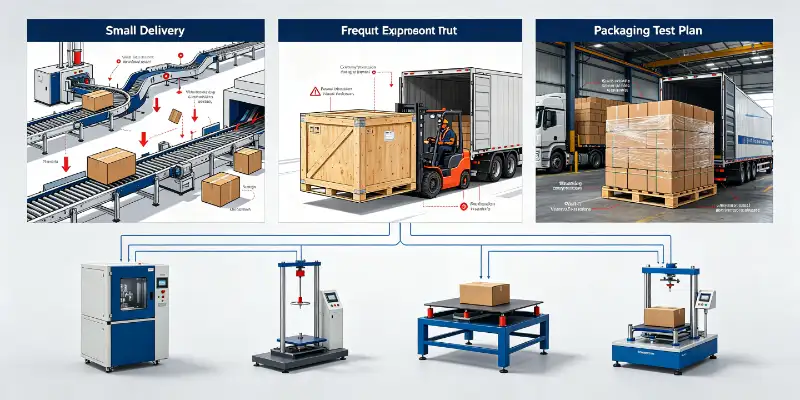
Choose the method named by the governing test plan—not the least expensive machine. ASTM D999 includes repetitive-shock and resonance methods for filled shipping containers. ASTM D4728 applies random vibration to filled shipping units using a power spectral density (PSD) input. A mechanical repetitive-shock table cannot generate an arbitrary random PSD, while a random shaker should not be assumed to reproduce every D999 setup without method-specific verification.
1. The Real Difference
2. Side-by-Side Comparison
3. What ASTM D999 Covers
4. How D4728 Random Vibration Works
5. Where ISTA Fits
6. Laboratory Workflow
7. Equipment Selection Checklist
8. Four Wrong-Selection Consequences
9. What to Send a Supplier
Frequently Asked Questions
The Real Difference: Test Motion, Control and Purpose
The phrase “ASTM D999 vs D4728” is often treated as shorthand for fixed-displacement versus random vibration. That shorthand is useful for an initial equipment discussion, but it is incomplete. ASTM D999-08(2023) contains several methods: A1 and A2 address repetitive shock with different table motions, while B and C address resonance of a single container or a palletized, unitized or vertically stacked load. It is therefore inaccurate to describe every D999 test as one fixed-amplitude procedure.
ASTM D4728-17(2022) addresses random vibration of filled shipping units. Its input is normally expressed as a PSD profile across a frequency range, with overall vibration intensity commonly summarized as root-mean-square acceleration. A controller uses accelerometer feedback to maintain the commanded spectrum within the test plan's tolerances.
The methods can reveal different weaknesses. Repetitive shock can make a package bounce, repeatedly lose contact with the table and experience impacts. Resonance work investigates frequencies at which a container, product or stack responds strongly. Random vibration energizes many frequencies at the same time and can better represent a measured transport environment when a suitable field-derived profile exists.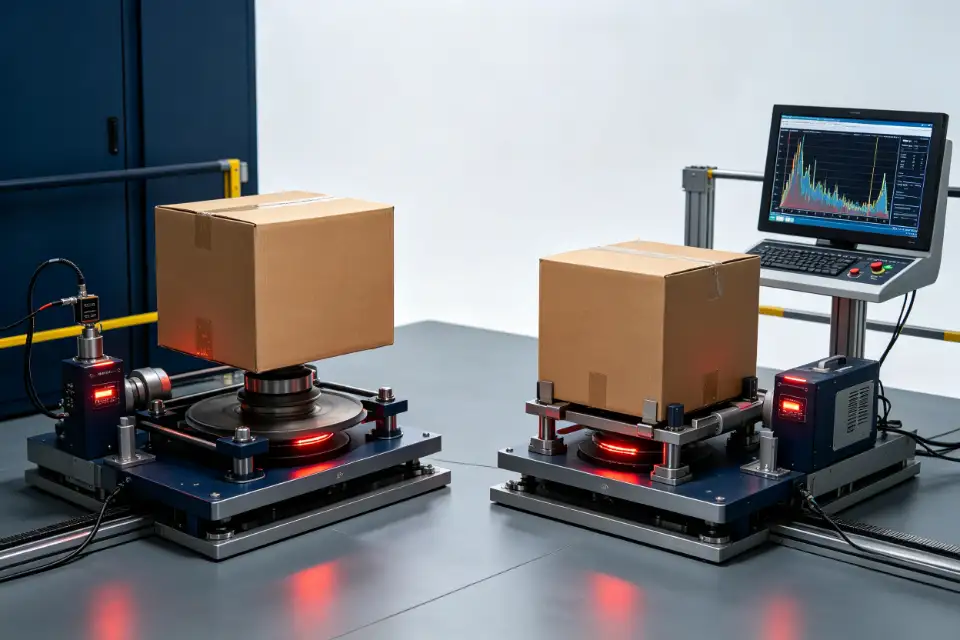
ASTM D999 vs ASTM D4728: Side-by-Side Comparison
| Decision factor | ASTM D999 | ASTM D4728 | Equipment implication |
|---|---|---|---|
| Primary scope | Vibration testing of filled shipping containers through repetitive-shock or resonance methods | Random vibration testing of filled shipping units | Confirm the exact method; a standard number alone is not a machine specification. |
| Input description | Depends on A1, A2, B or C and the governing test plan | PSD versus frequency, normally with overall RMS acceleration and duration | Random testing requires spectrum definition and closed-loop control. |
| Motion | A1 and A2 create different repetitive-shock motions; B/C investigate resonance response | Broadband random motion containing many frequency components simultaneously | Do not treat rotary and vertical repetitive-shock tables as producing equivalent damage. |
| Control variable | Method-specific motion, speed/frequency and specimen response observations | Feedback-controlled PSD at one or more control accelerometers | A speed display alone is not random-vibration control. |
| Typical system family | Mechanical repetitive-shock table or a system capable of the required resonance work | Electrodynamic or servo-hydraulic shaker with controller, sensors and amplifier/hydraulic power | Capacity must be checked with the specimen and fixture installed. |
| Use of field data | Actual shipment comparison improves confidence in laboratory damage relevance | Representative field data are preferred when developing a realistic PSD | A generic profile should not be presented as universal for every route and vehicle. |
| Interchangeability | No direct equivalence should be assumed. The methods create and control vibration differently. | Changing method requires technical and contractual approval, not a time conversion invented by the laboratory. | |
What ASTM D999 Actually Covers
ASTM D999 is intended to assess how a filled container, its closure and its interior packing protect the contents under vibration. ASTM cautions that the methods expose packages to damage-producing potential; they are not a complete simulation of every transport environment. The test is also not a substitute for product vibration testing in its operational configuration.
Repetitive shock using vertical motion. The filled package is evaluated under the prescribed setup and motion conditions.
Repetitive shock using rotary motion. ASTM notes that A1 and A2 can produce different motions, damage modes and intensities.
Resonance testing of a single shipping container. The objective and apparatus needs differ from a basic bounce test.
Resonance testing for palletized or unitized loads and vertical stacks. Load stability, table capacity and restraints become critical.
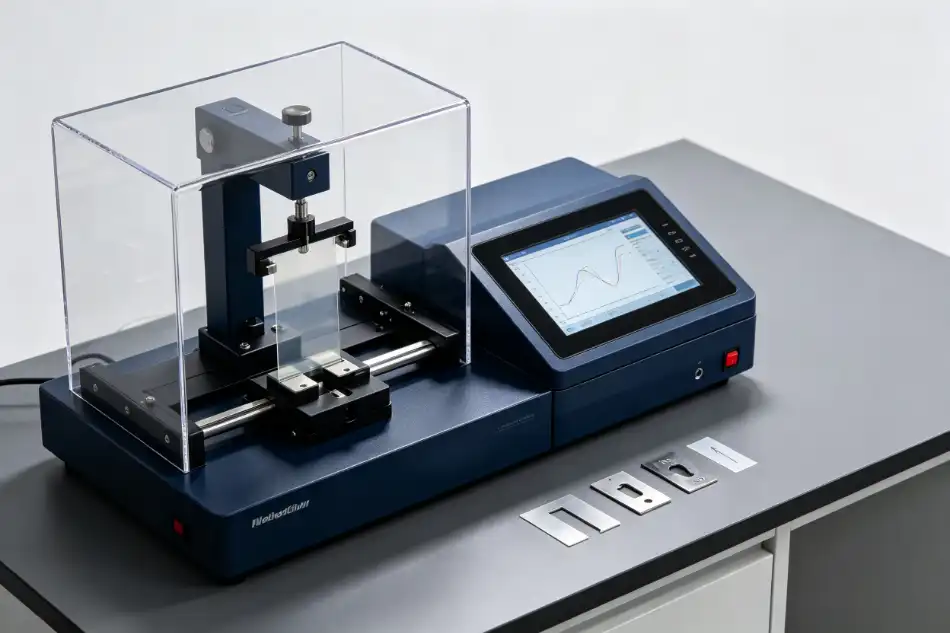
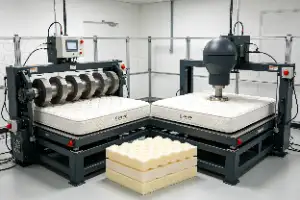
A mechanical transport simulation vibration tester may be appropriate when the required procedure calls for the repetitive-shock motion it can produce. Before purchasing, verify motion type, table displacement, usable frequency range, payload, table size and the method-specific setup. A claim that a machine “supports ASTM D999” is incomplete unless the supplier identifies which procedure and configuration were evaluated.
How ASTM D4728 Random Vibration Works
A random-vibration profile is described statistically rather than as one repeating sinusoidal movement. The PSD assigns acceleration energy across frequency bands. The area under the PSD curve relates to the overall mean-square acceleration; its square root is the overall RMS acceleration. Two spectra can have the same overall RMS value while distributing energy differently, so Grms alone does not define the test.
During a test, one or more control accelerometers measure table or fixture response. The controller compares the measured spectrum with the target and continuously adjusts drive output. The complete system—not only the shaker—therefore includes the controller, accelerometers, signal conditioning, amplifier or hydraulic power, fixture, safety limits and data recording.
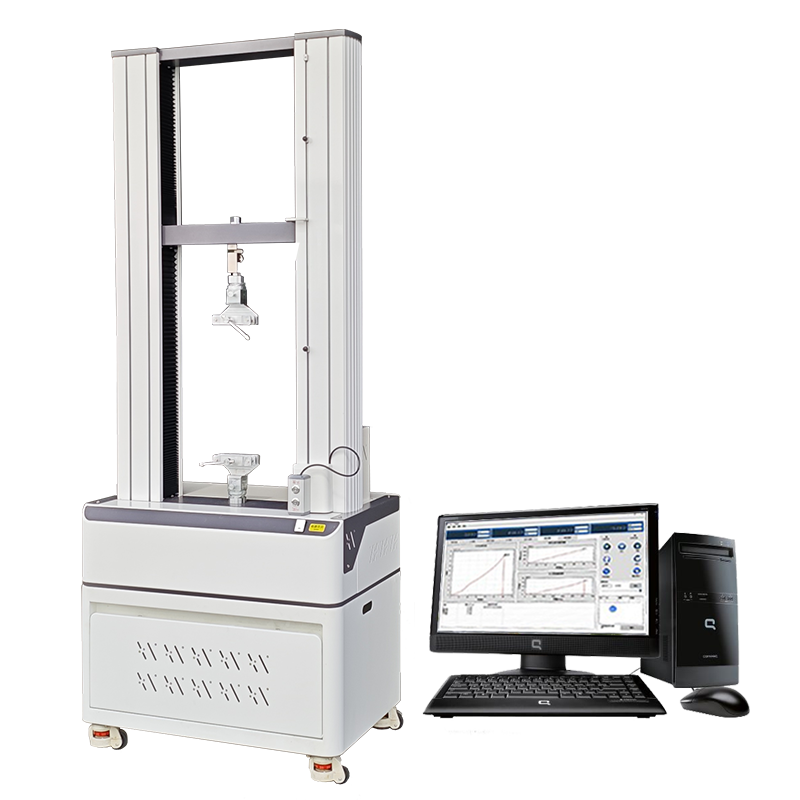
A random vibration test machine should be sized against the required spectrum and the combined moving mass of the specimen, fixture and armature/table. Maximum catalog force, displacement or acceleration values are not normally available at every frequency and load simultaneously; request a performance check for the actual test profile.
Where ISTA Fixed Displacement and Random Vibration Fit
ISTA describes fixed-displacement vibration as a simple, entry-level approach and uses the term “non-simulation” for this approach in its 1-Series context. It can be economical and useful for screening, but its constant mechanical movement may correlate poorly with a real distribution route. Actual vehicle vibration is complex and random, and PSD profiles can distinguish different vehicles and routes.
Random vibration can provide a more realistic laboratory representation when the spectrum is based on representative field data or when a distribution-test program supplies the required profile. That does not make every random test automatically “better.” A test is only suitable when its input, severity, duration, package orientation and acceptance criteria match the product's distribution objective.
The ISTA comparison of random and fixed-displacement vibration is helpful for understanding the distinction, but the actual project must follow the current purchased ISTA procedure named by the customer. Do not assume that one mechanical table, one PSD or one duration satisfies all ISTA programs.
A Defensible Laboratory Workflow
- Define the distribution question. Is the goal a minimum screening test, a named customer program, a resonance investigation, damage replication or correlation with a measured route?
- Identify the controlling document. Record the standard, edition, exact method or schedule, package category, assurance level where relevant and any customer deviations.
- Document the test item. Use the filled shipping unit required by the plan. Record product, packing, closure, gross mass, dimensions, centre of gravity and conditioning.
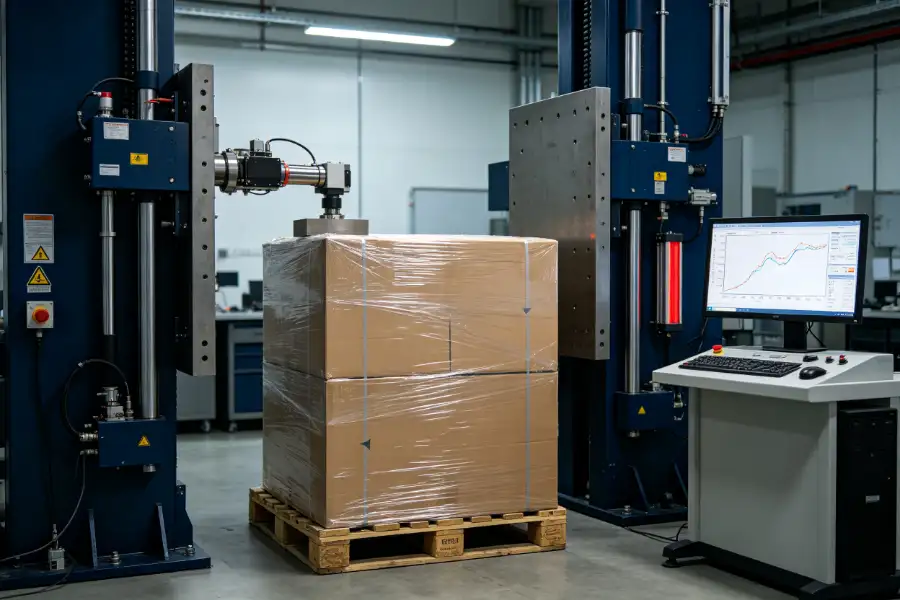
- Verify system capacity. Check table footprint, moving mass, payload, displacement, velocity, acceleration, frequency range and required fixture or restraints against the complete profile.
- Configure control and safety limits. For random testing, define control channels, notching/limiting if authorized, abort levels and response monitoring. For repetitive shock, verify motion and speed by the prescribed method.
- Run the specified axes and duration. Do not create a conversion between repetitive-shock time and random-vibration time unless the governing plan explicitly provides one.
- Inspect and report consistently. Record visible damage, product function, closure condition, packing displacement and the actual test input. Apply only pre-agreed acceptance criteria.
If the project also needs mechanical shocks such as drops or impacts, use a separate hazard assessment. Our vibration tester vs drop tester guide explains why vibration and drop tests answer different packaging questions.
Packaging Vibration Tester Selection Checklist
Use the following checklist when comparing systems. Ask the supplier to respond against the actual test item and profile instead of sending only a maximum-value catalog sheet.
| Parameter | What to provide or verify | Why it changes the configuration |
|---|---|---|
| Method and input | D999 procedure or D4728 PSD; include edition and customer deviations | Determines motion, controller and verification requirements. |
| Gross payload | Package plus fixture, restraints and adapters | Available acceleration and control authority decrease as moving mass rises. |
| Table and specimen | Package L × W × H, footprint, centre of gravity and required orientation | Controls table size, overturning moment and fixture design. |
| Frequency and motion | Frequency band plus displacement, velocity and acceleration demands | No shaker produces every maximum simultaneously across its full band. |
| Random control | PSD, overall Grms, channels, tolerances, lines of resolution and data export | Defines controller capability and measurement hardware. |
| Restraints and fixtures | Free-standing, fenced, strapped or rigidly fixed—only as the method permits | Restraints can change package motion and resonance response. |
| Axes and duration | Required orientation and test time for each axis | May require horizontal slip table, rotation or a larger facility plan. |
| Records and verification | Actual drive/control plots, alarms, calibration status and report format | Makes the result reviewable by customers and auditors. |
Review the broader vibration test equipment range only after defining these inputs. The same product name may cover materially different motion, force, controller and fixture capabilities.
Four Consequences of Choosing the Wrong System
A mechanical eccentric table cannot synthesize an arbitrary PSD with closed-loop spectral control. The test may run, but it is not the requested random test.
Rotary repetitive shock, vertical repetitive shock, resonance dwell and broadband random motion can stress the package differently.
A shaker that meets a headline acceleration without the specimen may clip, abort or fall outside tolerance after fixture and package mass are added.
If the method, edition, actual input and deviations are missing, a pass/fail statement may not be contractually or technically defensible.
What to Send Before Requesting a Configuration
A useful equipment proposal should begin with engineering inputs. Send the following information with your inquiry:
For a random profile, provide the original spectrum rather than a screenshot where possible. For D999, identify A1, A2, B or C rather than writing only “ASTM D999.” If a customer document is confidential, a redacted page showing the test inputs is usually more useful than a generic standard list.
Send the governing standard or test spectrum, package mass, dimensions, axis and duration. DERUI can review the required motion and propose a compatible table, controller, sensor and fixture configuration. Final compliance remains subject to the purchased standard and customer-approved procedure.
Frequently Asked Questions
Is ASTM D999 a fixed-displacement vibration test?
Only as a practical shorthand for some repetitive-shock equipment discussions. ASTM D999 includes A1 and A2 repetitive-shock methods plus B and C resonance methods. Always name the exact procedure.
Can a mechanical vibration table perform ASTM D4728?
A basic mechanical fixed-displacement or repetitive-shock table cannot reproduce an arbitrary PSD with closed-loop random control. D4728 normally requires a suitable shaker, controller and accelerometer feedback system.
Can ASTM D999 test time be converted into ASTM D4728 test time?
Do not assume a universal conversion. The motions, frequency content and damage mechanisms differ. Use only a conversion or accelerated duration that is defined and approved in the governing test plan.
Does the same Grms mean the same random vibration test?
No. Grms summarizes overall intensity, but two PSDs can distribute that energy across frequency differently and excite different package or product resonances. The full PSD and frequency band are essential.
Which method better simulates truck transport?
A representative, field-derived random PSD generally models complex vehicle vibration more closely than a constant mechanical motion. The correct choice still depends on the customer's program, route data, purpose and acceptance criteria.
What is the most important information for sizing a vibration tester?
Provide the exact method/profile, package and fixture mass, dimensions, frequency band, displacement, velocity, acceleration, axes and duration. For random testing, send the PSD file and control requirements.
ASTM D999-08(2023) ·
ASTM D4728-17(2022) ·
ISTA: Random vs Fixed-Displacement Vibration
This guide explains method selection and does not reproduce the copyrighted procedures. Standards are revised; use the current authorized document, contract requirements and laboratory scope for the actual test.