
Foam Fatigue Testing
Date: July 14, 2026 Categories: Technical Guides & Blog Views: 2783
Foam Fatigue Testing: Why It Matters
Foam fatigue testing simulates years of real-world use in hours, measuring how polyurethane foam loses its firmness, height, and support over time. Manufacturers who skip fatigue testing face warranty claims, brand damage, and product returns that cost 5–15× more than the testing would have. The core standard — ASTM D3574 I3 — subjects foam to 80,000 compression cycles at 750 N, then measures hardness loss and height loss. Key thresholds: hardness loss <15% = excellent, 15–25% = acceptable, >25% = fail. This guide covers all four fatigue test types, industry-specific requirements (furniture, automotive, bedding, medical), a 5-step testing program checklist, and how to choose foam fatigue testing equipment that fits your budget and throughput.
1. The Cost of Skipping Fatigue Testing
2. What Is Foam Fatigue Testing?
3. 5 Business Reasons It Matters
4. 4 Types of Foam Fatigue Tests
5. Real-World Failure Modes
6. How to Interpret Results
7. Equipment: What to Look For
8. Industry-Specific Requirements
9. 5-Step Fatigue Testing Program
10. Frequently Asked
The Cost of Skipping Fatigue Testing
Picture this: a furniture brand ships 10,000 sofas. Six months later, customers start complaining — cushions have gone flat, the once-firm seat now bottoms out, and 1-star reviews are piling up. The root cause? The foam supplier changed a polyol formulation, and nobody tested for fatigue.
This is not hypothetical. Studies from the Polyurethane Foam Association (PFA) document that foam durability — specifically flex fatigue performance — is among the top three factors consumers cite in mattress and furniture warranty claims. A single batch of under-performing foam can trigger returns costing 5–15× the price of the fatigue testing that would have caught it.
At Derui Testing Equipment, a material testing equipment manufacturer serving foam and furniture industries worldwide, we see the same pattern: companies that invest in fatigue testing save an average of $80,000–$250,000 per year in avoided warranty claims, depending on production volume. Fatigue testing is not an overhead cost — it is an insurance policy that pays for itself within the first quality incident it prevents.
| Fatigue test equipment (one-time) | $6,000–$18,000 |
| Annual calibration + consumables | ~$500–$1,200 |
| Operator time per test batch (monthly) | ~4–8 hours |
| Average cost of ONE warranty batch recall | $35,000–$150,000+ |
What Is Foam Fatigue Testing?
Foam fatigue testing is not a single compression measurement. It is a process that repeatedly loads foam thousands or tens of thousands of times — simulating months or years of real-world use — then measures how much the foam has permanently changed.
The core logic is simple:
→
Fatigue Cycling (8,000–80,000 cycles, 750 N, 70 cycles/min)
→
Post-Fatigue Measurement (IFD Loss %, Height Loss %, Visual Inspection)
→
Predicted Product Lifetime
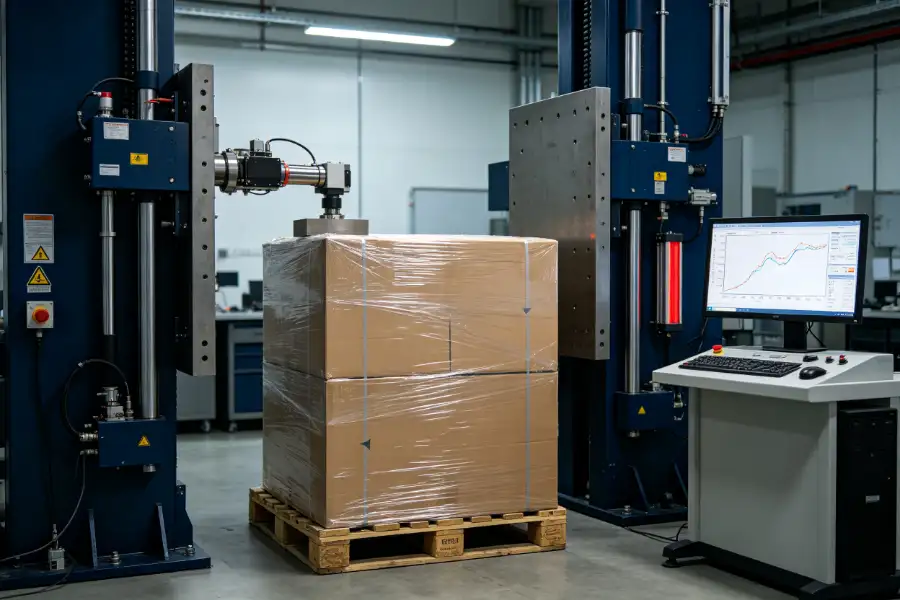
Under ASTM D3574 I3, the definitive foam fatigue standard, the procedure has three phases: (1) Measure initial Indentation Force Deflection (IFD) at 25% and 65% deflection; (2) Cycle the foam 80,000 times at 750 ± 20 N, 70 cycles per minute, using a perforated platen to allow airflow; (3) Re-measure IFD and calculate the percentage loss in hardness and height. The foam sample sits on a flat support plate while the indenter foot — a 203 mm diameter circular platen with ventilation holes — strikes it at 1.17 Hz.
Importantly, fatigue testing reveals degradation mechanisms that single-point tests miss entirely. A foam might pass its initial IFD specification perfectly — firm, supportive, within tolerance — then collapse to half that firmness after simulated use. Without fatigue testing, you are shipping a product whose performance you do not actually know.
Measures how foam keeps its properties over simulated use. Predicts real-world product lifespan.
Measures foam properties at one point in time. Tells you nothing about durability.
5 Business Reasons It Matters
Foam compression set exceeding 10% correlates directly with customer complaints within 12–18 months. A fatigue testing program catches bad batches before they reach the production line. One manufacturer we work with reduced mattress warranty claims by 62% in the first year after implementing incoming-foam fatigue testing.
In the age of Amazon reviews and social media, one bad foam batch can generate hundreds of negative reviews in weeks. The PFA notes that consumer perception of foam quality is overwhelmingly driven by durability — a sofa that "still feels new after 3 years" drives repeat purchases. One that sags after 6 months loses the customer permanently.
80,000 fatigue cycles at 70 cycles/min takes approximately 19 hours — compressing 5–10 years of use into a single day. R&D teams can iterate foam formulations, compare suppliers, and validate new designs in days instead of waiting for field data. This speed advantage is especially critical when launching products in new markets or responding to cost pressures on raw materials.
Not all foam is created equal — even from the same supplier, batch-to-batch variation in polyol/isocyanate ratios, catalyst levels, and water content can shift fatigue performance by 15–30%. A consistent incoming-fatigue testing protocol lets you grade suppliers objectively and negotiate with data, not guesswork.
Major retailers (IKEA, Costco, Walmart) and automotive OEMs increasingly mandate fatigue test data as part of supplier qualification. Having an accredited in-house fatigue testing program — rather than outsourcing — reduces qualification lead time from weeks to days and positions your company as a quality-first supplier. The standard to target: ISO 3385 (flexible cellular polymeric materials — determination of fatigue by constant-load pounding) for international acceptance.
4 Types of Foam Fatigue Tests
Not all fatigue tests are equivalent. Each reveals a different aspect of foam degradation. The right choice depends on your product, your market, and what failure mode you are defending against.
Test A: Constant Force Pounding — ASTM D3574 I3 / ISO 3385
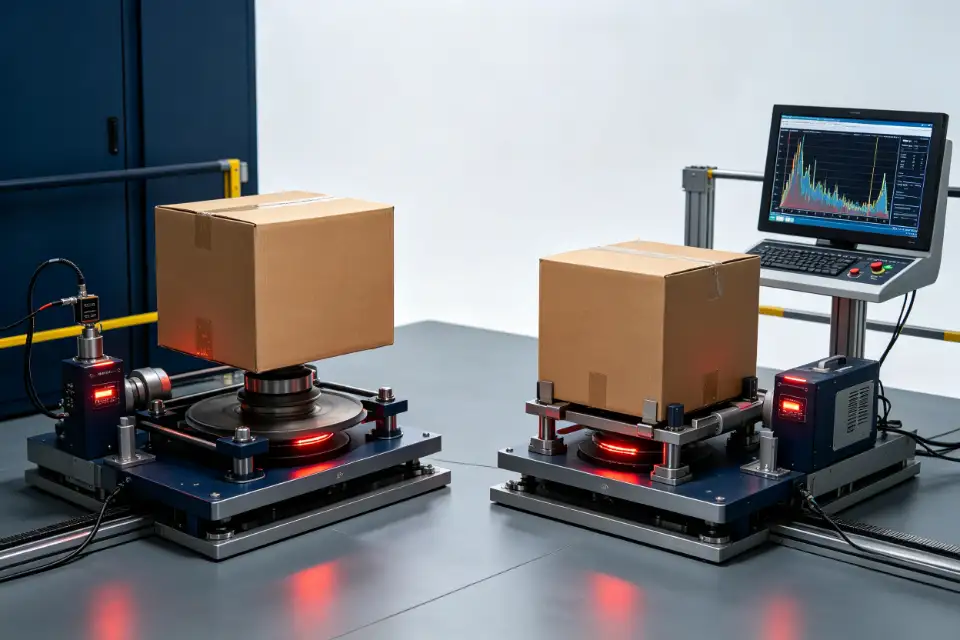
The gold standard for seating foam and mattress cores. A perforated circular indenter (203 mm diameter) pounds the foam at 70 cycles/min under 750 N of force.
| Cycle Options | 8,000 (≈2h) — screening; 80,000 (≈19h) — full durability; 12,000 (≈3h) — viscoelastic foam |
| Force | 750 ± 20 N |
| Speed | 70 cycles/min (1.17 Hz) |
| Measures | Hardness loss (IFD loss %) + Height loss (% of original thickness) |
| Best For | Sofa cushions, mattress cores, automotive seats, office chairs |
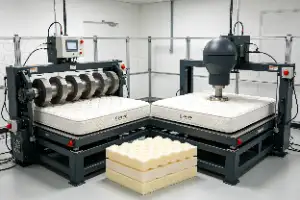
Test B: Roller Shear Fatigue
A rolling load applies both compression and shear forces simultaneously — simulating the worst-case scenario of someone shifting weight on a cushion. More severe than pure compression fatigue.
| Typical Cycles | 25,000 (commercial-grade furniture) |
| Mechanism | Weighted roller traverses the foam surface — compression + shear + abrasion |
| Best For | Commercial furniture (hotels, airports), high-traffic seating, carpet underlay |
Test C: Compression Set — ASTM D3574 B1 (Static Fatigue)
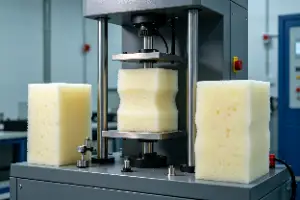
The fastest screening test for long-term durability. Foam is compressed to 50% of its thickness and held at elevated temperature for 22 hours. The permanent deformation after release predicts how foam will hold up over 5+ years.
| Duration | 22 hours at 50% compression, 70°C |
| Measures | Compression set (%) = unrecovered thickness / original thickness × 100 |
| Best For | Fast QC screening, incoming material checks, gasket and sealing foam |
Test D: Hysteresis Energy Loss — ASTM D3574 N
Measures the energy absorbed (and lost as heat) during a loading-unloading cycle. Foam with high hysteresis heats up during repeated use, accelerating chemical degradation. This test predicts which foams are fatigue-prone.
| Measures | Area between load and unload curves ÷ area under load curve (%) |
| Speed | Single cycle — minutes |
| Best For | R&D screening, material comparison, predicting fatigue tendency without running full 80k cycles |
Fatigue Test Method Comparison at a Glance
| Test | Duration | Standard | Predicts | Best Use |
| I3 — Constant Force | 2–19 h | ASTM D3574 / ISO 3385 | 5–10 yr durability | Seating, mattresses |
| Roller Shear | ~7 h | Custom / PFA method | Surface + shear durability | Commercial furniture |
| Compression Set | 22 h | ASTM D3574 B1 | Long-term sag | QC screening |
| Hysteresis Loss | Minutes | ASTM D3574 N | Fatigue tendency | R&D screening |
What Happens When You DON'T Test
Real-world foam fatigue failures follow predictable patterns. Here are the four most common — and what fatigue testing would have revealed:
| Failure Mode | What Happens | Fatigue Test That Catches It |
| 🔴 Cushion "Bottoming Out" | Foam loses so much firmness that users feel the frame. Most common complaint in upholstered furniture. | I3 — IFD loss >25% |
| 🔴 Mattress Body Impressions | Permanent troughs form where sleepers lie. Irreversible thickness loss. | I3 — Height loss >10% |
| 🟡 Automotive Seat Collapse | Lateral support degrades, comfort drops sharply on long drives. OEM warranty: 3 yr / 36,000 mi minimum. | I3 + Roller Shear — IFD loss >20% |
| 🟡 Packaging Foam Degradation | Protective foam loses cushioning after prolonged compression during storage. Product damage in transit. | Compression Set >10% |
IFD 180 N
Support Factor 2.1
IFD 148 N
IFD Loss 18%
⚠ Acceptable
IFD 121 N
IFD Loss 33%
🔴 Fail — Warranty Risk
How to Interpret Fatigue Test Results
Running a fatigue test produces numbers. Knowing what they mean — and what threshold your specific application demands — is where the value lives.
| Metric | Excellent | Acceptable | Fail |
| Hardness Loss (IFD Loss %) | <15% | 15–25% | >25% |
| Height Loss (% of original) | <5% | 5–10% | >10% |
| Support Factor Change (65%IFD ÷ 25%IFD) | Change <0.2 | Change 0.2–0.4 | Change >0.4 |
| Compression Set (%) | <5% | 5–10% | >10% |
Support Factor: The Hidden Fatigue Indicator
Support Factor (65% IFD ÷ 25% IFD) is one of the most underused fatigue metrics. A foam can lose IFD uniformly at both 25% and 65% deflection — its numbers drop but the support factor stays stable. Or it can lose IFD disproportionately at 65% — meaning the foam "gives up" when you sit deeply into it. This second failure mode is far worse for perceived comfort but often goes undetected when labs only measure 25% IFD. Always measure both.
Why Hysteresis Matters for Fatigue Prediction
High hysteresis foam (energy loss >40%) converts mechanical work into heat during repeated compression. This heat accelerates chemical degradation — hydrolysis of ester-based foams, oxidative breakdown of ether-based foams — creating a self-reinforcing failure loop. A quick hysteresis test can flag high-risk foam formulations before you invest 19 hours in a full I3 fatigue run. This is the single biggest time-saver for R&D labs testing multiple formulations. For a deeper dive into the full spectrum of foam testing standards, see our complete guide to ASTM D3574 foam testing standards.
Fatigue Testing Equipment: What to Look For
Choosing the right foam fatigue testing equipment comes down to five specifications. Getting any of them wrong means unreliable data or a machine that cannot run the standards you need.
5 Key Specifications
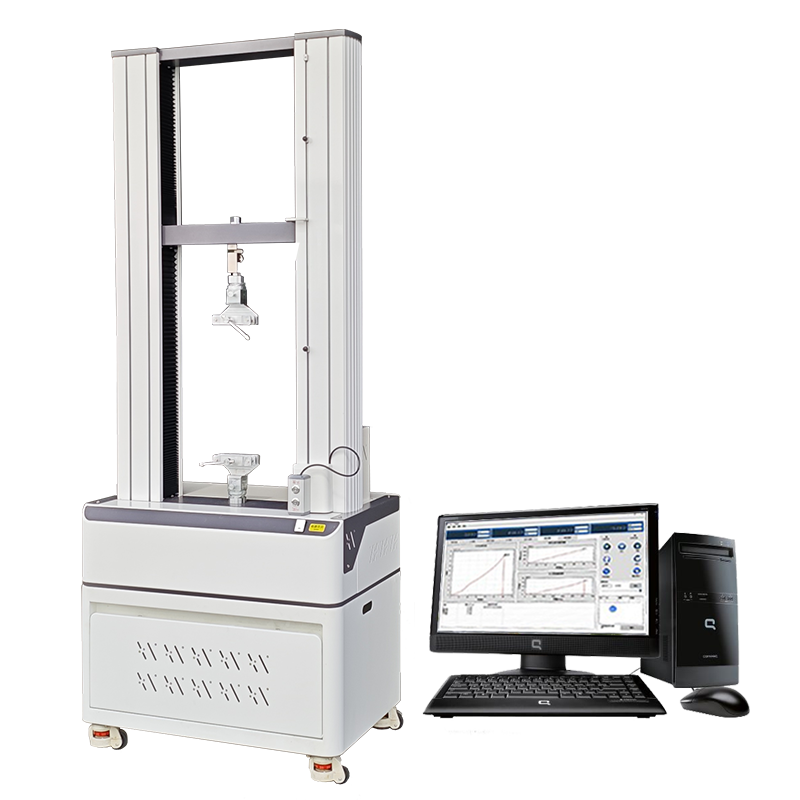
| 1. Force Capacity | 750 N minimum for ASTM D3574 I3. Machines rated 1 kN give headroom for larger samples. The foam dynamic fatigue tester from Derui is built for this exact load band. |
| 2. Cycle Speed | 70 ± 5 cycles/min (ASTM D3574 I3). Must be adjustable — some standards use 60 or 100 cpm. Servo-driven is preferred over pneumatic: more consistent cycle-to-cycle force control. |
| 3. Indenter Foot | Circular, 203 mm diameter, with ventilation holes (perforated platen). The holes prevent air-cushion effects that artificially reduce measured fatigue. |
| 4. Auto-Stop & Cycle Counter | The machine must stop automatically at the set cycle count — 8,000, 12,000, or 80,000. A digital counter visible during the run is essential. |
| 5. Data Output | At minimum: load-displacement curves, cycle count log, and CSV export. For R&D: software that tracks IFD loss trends across multiple test intervals (e.g., measure IFD at 1k, 10k, 40k, 80k cycles). |
The indenter foot must strike perpendicular to the foam surface. Off-angle impact creates shear forces not prescribed by I3, skewing results.
Foam properties are temperature-sensitive. Test at 23 ± 2°C and 50 ± 5% RH per ASTM D3574 preconditioning requirements.
Single-station testers run one sample at a time (19h per 80k-cycle test). Multi-station machines test 2-4 samples simultaneously — essential for production QC.
For foam products requiring combined fatigue and compression testing, the sponge foam compression fatigue tester offers a versatile alternative that covers both ASTM D3574 I3 fatigue and static compression measurement on a single platform.
For high-throughput labs processing dozens of samples per week, automated foam testing systems — such as those discussed in ZwickRoell's ASTM D3574 flexible foam testing overview — can reduce operator time by 70% compared to manual single-station machines. While automated systems carry a higher upfront cost, for labs running 100+ fatigue tests monthly the labor savings alone justify the investment within 12-18 months.
Industry-Specific Fatigue Requirements
Every industry has different failure tolerances. What passes for a furniture cushion would fail in an automotive seat. Use this table to calibrate your testing program to your market.
| Industry | Recommended Test | Cycles | Hardness Loss Limit | Height Loss Limit |
| 🪑 Furniture (Residential) | I3 or B1 | 80,000 | <20% | <10% |
| 🏨 Furniture (Commercial) | I3 + Roller Shear | 80,000 + 25,000 | <15% | <5% |
| 🚗 Automotive | I3 + Roller Shear | 80,000 + 25,000 | <15% | <5% |
| 🛏️ Mattress / Bedding | I3 (large platen) | 80,000 | <20% | <10% |
| 🏥 Medical Cushions | I3 + Compression Set | 80,000 + 22 h | <10% | <5% |
| 📦 Packaging Foam | Compression Set | 22 h static | N/A (CS <10%) | N/A |
Note: Automotive seats face the most demanding fatigue requirements in any foam application. A typical OEM specification requires IFD loss <15% after 80,000 I3 cycles plus passing a separate roller shear test — a dual-gate requirement that screens out foams with adequate pure compression fatigue but poor shear durability. This is why automotive foam formulations are typically higher density and use more resilient polyol blends than residential furniture foam. For details on how foam testing fits into broader testing systems & solutions, including universal testing machines for IFD and tensile measurement, see our full equipment catalog.
Building a Fatigue Testing Program: 5-Step Checklist
Step 1: Identify Your Applicable Standards
Which standard applies to your product? ASTM D3574 I3 (North America / global), ISO 3385 (Europe / international), or a customer-specific test protocol? Your equipment must match the standard — verify force, cycle speed, indenter dimensions, and conditioning requirements before purchasing.
Step 2: Define Your Critical Metrics & Thresholds
Hardness loss only? Height loss only? Both? Support factor change? Choose based on your product's failure mode. Set clear Pass/Fail thresholds before you start testing — adjusting thresholds to match test results invalidates the entire QC program.
Step 3: Set Your Sampling Plan
Incoming inspection: 1 sample per foam batch / supplier lot. Production QC: 1 sample per shift or per 1,000 units (whichever is more frequent). R&D: 3-5 samples per formulation for statistical significance. Document your sampling rationale — it will be the first thing an auditor asks for.
Step 4: Establish Baseline Performance
Before testing new materials, test 5-10 samples of your current production foam. This creates your baseline — the reference point that tells you whether a new supplier or formulation is better or worse than what you are already shipping. Without a baseline, fatigue data has no context.
Step 5: Close the Loop — From Data to Decision
The most important step — and the one most labs skip. When fatigue test data shows a failure: (a) Quarantine the affected batch; (b) Notify the foam supplier with supporting data; (c) Investigate root cause (formulation drift? process variation? storage conditions?); (d) Document the corrective action. A testing program without a closed-loop corrective action process is just expensive paperwork.
| Equipment needed | Fatigue tester (I3-capable) + IFD measurement + compression set fixture |
| Sample conditioning | 23 ± 2°C, 50 ± 5% RH, minimum 16 h before testing |
| Key documents | Test procedure SOP, calibration schedule, pass/fail criteria sheet, corrective action log |
| Calibration cadence | Load cell: annual (ISO 17025 semi-annual). Indenter dimensions: annual. Cycle counter: verification every 50 tests. |
Foam fatigue testing separates products that last from products that get returned. Invest in the test — not the warranty claims.
Related: Testing Machine Calibration Guide: ASTM E4 & ISO 7500-1
Frequently Asked
| How long does a foam fatigue test take? | 8,000 cycles ≈ 2 hours (screening). 80,000 cycles ≈ 19 hours (full durability). 12,000 cycles ≈ 3 hours (viscoelastic foam per ASTM D3574 I3). |
| Fatigue testing vs compression set — what's the difference? | Fatigue testing (I3) uses dynamic, repeated pounding to simulate real-world use. Compression set (B1) uses static compression at elevated temperature to predict long-term sag. They measure different degradation mechanisms — the best QC programs use both. |
| Can I use a regular compression tester for fatigue testing? | No. A standard compression tester applies one cycle and measures peak force. A fatigue tester cycles thousands of times at controlled speed and force — the mechanical demands are fundamentally different. Using a UTM for fatigue will destroy its load cell within weeks. |
| How many samples do I need for reliable data? | ASTM D3574 requires 3 test specimens per condition plus 3 reference specimens. For incoming QC, 1 sample per batch is standard. For R&D formulation screening, 3-5 per formulation gives statistically meaningful results. |
| What IFD loss percentage is acceptable? | It depends on your industry. Residential furniture: <20% is generally acceptable. Commercial furniture and automotive: <15%. Medical cushions: <10%. The stricter your application, the lower the acceptable IFD loss. |
| Is fatigue testing required by any regulations? | No government regulation mandates foam fatigue testing for consumer products. However, major retailers (IKEA, Costco, Walmart) and automotive OEMs require it as part of supplier qualification programs. It is a market requirement, not a legal one — and arguably more important because it directly affects your commercial relationships. |