

.jpg)
.jpg)
.jpg)
Foam Compression Set Testing: ASTM D3574 Test D Complete Guide
Date: June 11, 2026 Categories: Blog Views: 9146
Key Takeaways
- Compression set measures the permanent deformation foam retains after being compressed for a defined time at a defined temperature — it is the single most important indicator of long-term foam durability
- ASTM D3574 Test D compresses foam specimens to 50% of their original thickness for 22 hours at either 23°C (Condition A) or 70°C (Condition B)
- A compression set below 10% indicates excellent recovery quality; 10–20% is acceptable for most applications; above 20% generally means the foam will fail prematurely in service
- Elevated-temperature testing (70°C) is critical for automotive and bedding applications where foam is exposed to sustained heat
- ISO 1856 uses the same fundamental method but specifies specimen geometry and conditioning requirements that differ from ASTM D3574
What Is Foam Compression Set?
Compression set is a standardized mechanical test that measures the percentage of permanent thickness loss a foam specimen retains after being compressed to a specific percentage of its original height for a defined period under controlled temperature conditions. The test answers one fundamental question: After the load is removed, how much of the original thickness does the foam recover — and how much deformation is permanent? A low compression set (close to 0%) means the foam springs back almost completely. A high compression set (approaching 100%) means the foam has essentially collapsed and will not recover. This property directly predicts whether seat cushions will flatten over time, packaging foam will stop absorbing shocks, or gasket material will lose its sealing force.
Compression set testing is defined by two major international standards: ASTM D3574 Test D (widely used in North America) and ISO 1856 (used in Europe and Asia). Both methods follow the same principle — compress, hold, release, measure — but differ in specimen conditioning, temperature options, and acceptance criteria. Understanding these differences is essential for manufacturers who supply foam products across global markets.
As a leading Material Testing Equipment Manufacturer, Derui provides precision compression set testing instruments designed for ASTM D3574 and ISO 1856 compliance. Our equipment integrates automated force control, digital thickness measurement, and temperature conditioning for laboratory-grade accuracy.
Table of Contents
- Why Compression Set Matters
- ASTM D3574 Test D: Methods and Conditions
- ISO 1856 vs ASTM D3574: Key Differences
- Compression Set Calculation: Formula and Example
- Equipment Selection Guide
- Industry Applications and Acceptance Criteria
- Step-by-Step Testing Procedure
- Common Testing Errors and How to Avoid Them
- Frequently Asked Questions
1. Why Compression Set Matters
Compression set is the most frequently specified durability test for flexible polyurethane foam across all major industries. Unlike tensile strength or tear resistance — which measure maximum stress a foam can withstand — compression set measures what happens after stress is removed. It predicts real-world performance in ways that no other single test can.
✅ TRUE
Compression set is a durability predictor, not a strength measurement. A foam with excellent tensile strength can still have poor compression set if its cell structure collapses under sustained load.
❌ FALSE
Compression set measures how much foam compresses under load. In reality, it measures how much permanent deformation remains after the load is removed — it is a recovery metric, not a compression metric.
Consider a car seat cushion rated for 10 years of service. Over that period, the foam is compressed by the occupant's weight every single day, and it sits in a hot cabin (often 70–85°C) for hours. If the foam has a compression set of 25%, the cushion will lose a quarter of its thickness within the first few years — becoming uncomfortable and potentially failing OEM warranty specifications. This is why compression set is one of the first tests automotive OEMs specify when qualifying foam suppliers.
Key insight: Compression set correlates directly with foam density and cell structure. High-density foams (≥ 50 kg/m³) with uniform cell structure consistently show lower compression set values than low-density foams. However, formulation chemistry (polyol type, isocyanate index, silicone surfactant level) has an equally significant impact.
2. ASTM D3574 Test D: Methods and Conditions
ASTM D3574 is the comprehensive standard for testing flexible cellular materials (polyurethane foam). Within this standard, Test D — Compression Set defines the procedure for measuring permanent deformation. The current active version is ASTM D3574-25, published in 2025.
The standard defines two test conditions that simulate different service environments:
Condition A tests foam at standard laboratory temperature. It is used for general-purpose applications where foam operates at room temperature — furniture cushions, packaging inserts, acoustic panels, and general industrial components.
Best for: Furniture, office seating, acoustic foam, general packaging, medical cushioning, and any application where ambient temperature remains between 15–35°C.
Condition B tests foam at elevated temperature to simulate hot environments. It is the preferred condition for automotive interiors, bedding (body heat), outdoor cushioning, and any application where foam is exposed to sustained temperatures above 40°C.
Critical for automotive: Cabin temperatures in parked vehicles routinely exceed 70°C in summer. Foam that passes Condition A (room temperature) may fail Condition B dramatically — compression set can increase by 5–15 percentage points at elevated temperature.
| Parameter | ASTM D3574 Test D Requirement | Notes |
|---|---|---|
| Specimen Shape | 50 × 50 mm square (minimum) | Circular specimens also acceptable |
| Minimum Thickness | 25 mm (if foam thickness allows) | Thinner foam tested at full thickness |
| Number of Specimens | Minimum 3 per test condition | 5 specimens recommended for statistical reliability |
| Conditioning | Minimum 24 hours at 23 ± 2°C, 50% RH | Before testing, per ASTM D3574 Section 7 |
| Compression Deflection | 50% of original thickness | Applied via parallel plates |
| Compression Time | 22 ± 0.5 hours | Timed from full compression |
| Recovery Time | 30 ± 1 minutes | Before final thickness measurement |
3. ISO 1856 vs ASTM D3574: Key Differences
For manufacturers supplying foam to both North American and European markets, understanding the differences between ASTM D3574 Test D and ISO 1856 is critical. While both standards measure compression set using the same fundamental principle, the specimen geometry, conditioning requirements, and reporting format differ in ways that can lead to different results for the same foam sample.
| Parameter | ASTM D3574 Test D | ISO 1856 |
|---|---|---|
| Compression Deflection | 50% of original thickness | 50% of original thickness (Method A) or 75% (Method B) |
| Duration | 22 hours | 22 hours (standard) or 72 hours (extended) |
| Temperature Options | 23°C (A) or 70°C (B) | 23°C, 70°C, or custom per specification |
| Specimen Size | 50 × 50 mm minimum | 100 × 100 mm or 50 mm diameter |
| Recovery Time | 30 minutes | 30 minutes |
| Conditioning RH | 50 ± 5% RH specified | 65 ± 5% RH specified |
| Result Expression | Percentage of original deflection | Percentage of original thickness |
Important: ISO 1856 includes a 72-hour extended duration option that ASTM D3574 does not. The 72-hour test is commonly specified in European automotive applications (especially BMW and Volkswagen group standards) and provides a more severe assessment of long-term recovery performance. If you are supplying to European OEMs, verify which duration is required in the purchase specification.
4. Compression Set Calculation: Formula and Example
Both ASTM D3574 and ISO 1856 use a straightforward formula to calculate compression set. The critical point is understanding what the percentage represents — it is not simply "thickness lost," but rather the proportion of the applied deflection that becomes permanent.
Compression Set Formula
CS (%) = [(t₀ − tᵣ) / (t₀ − tₛ)] × 100
t₀ = Original thickness (mm)
tₛ = Compressed thickness = t₀ × 0.50 (mm)
tᵣ = Recovered thickness after 30 min (mm)
Worked Example
A foam specimen for automotive seat cushion testing yields the following measurements:
| Measurement | Value | Description |
|---|---|---|
| t₀ (Original) | 50.0 mm | Measured after 24h conditioning at 23°C |
| tₛ (Compressed) | 25.0 mm | 50% deflection applied (50.0 × 0.50) |
| tᵣ (Recovered) | 46.5 mm | Measured 30 min after releasing compression |
| Compression Set | 7.0% | [(50.0 − 46.5) / (50.0 − 25.0)] × 100 = 7.0% |
Interpretation: A compression set of 7.0% means the foam recovered 93% of the applied deflection. For automotive seat cushion applications, this result falls within the "excellent" range (below 10%) and would pass most OEM specifications.
Compression Set Interpretation Guide
| Compression Set Range | Rating | Typical Applications | Risk Level |
|---|---|---|---|
| 0–5% | Excellent | Aerospace seating, medical devices, precision gaskets | No risk |
| 5–10% | Good | Automotive seats, premium mattresses, high-end furniture | Very low |
| 10–20% | Acceptable | Residential furniture, packaging, acoustic panels | Moderate |
| 20–30% | Poor | Disposable packaging, single-use cushioning | High |
| > 30% | Unacceptable | Not recommended for structural or load-bearing use | Failure likely |
5. Equipment Selection Guide
Compression set testing requires relatively simple equipment compared to dynamic fatigue or tensile testing. The core requirement is a mechanism to apply and maintain a precise 50% deflection on foam specimens while controlling temperature. However, the quality of your results depends directly on the precision of your thickness measurement and the stability of your compression force during the 22-hour hold period.
The most common and cost-effective approach. A dedicated fixture holds specimens at exactly 50% deflection between parallel steel plates. The fixture is placed inside a forced-air circulating oven for the 22-hour hold period. After removal, specimens recover for 30 minutes before measurement.
Best for: Labs testing foam regularly but not at high volume. The fixture approach is ASTM-compliant, affordable, and easy to validate. Requires a separate thickness gauge (digital caliper or dial indicator).
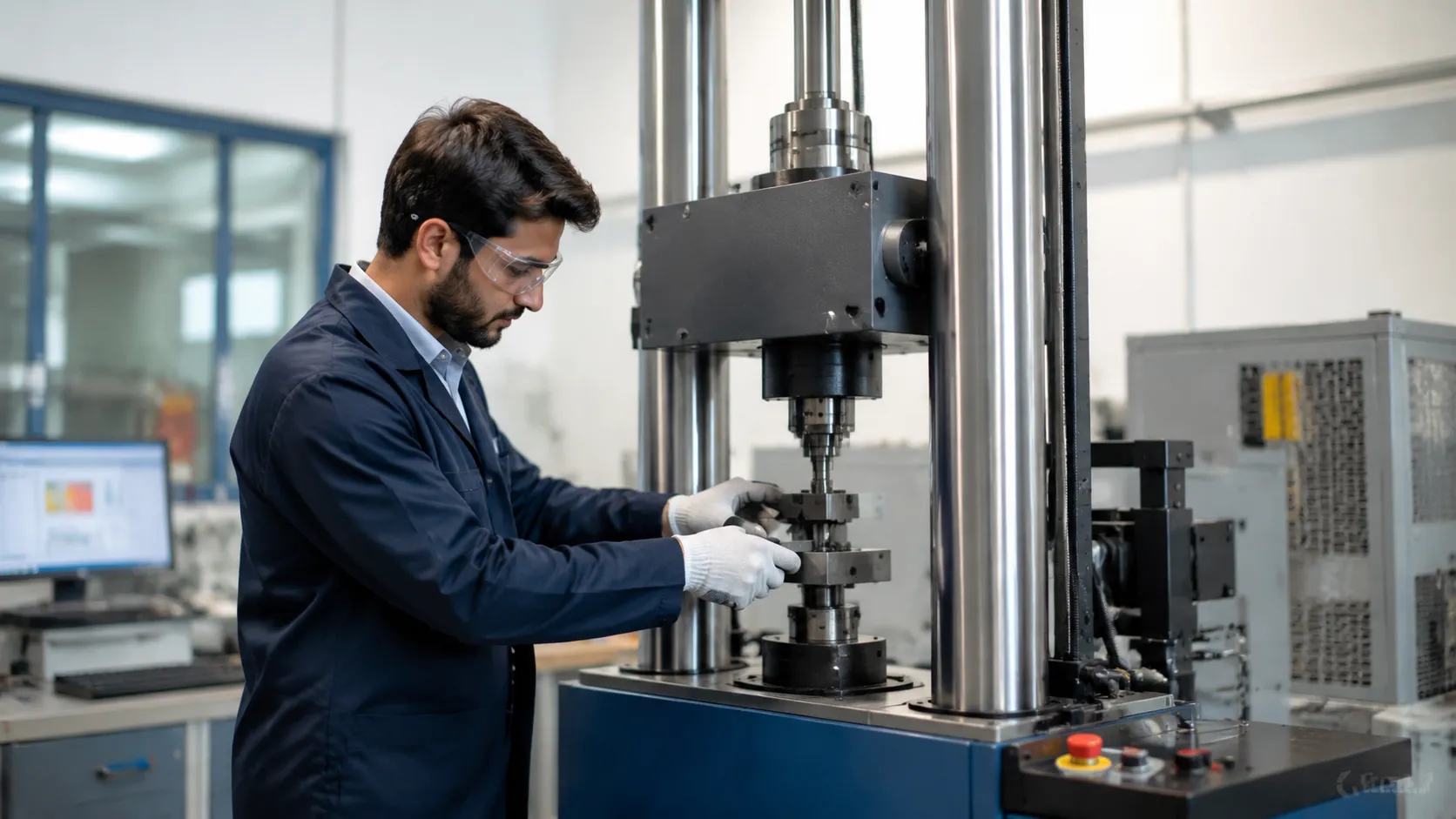
A universal testing machine (UTM) equipped with compression platens and an environmental chamber provides the highest precision. The machine applies force electronically, maintains deflection with closed-loop control, and measures thickness continuously. Environmental chambers provide precise temperature control from -40°C to +150°C.
Best for: Labs that also perform IFD, tensile, tear, and fatigue testing on foam. A UTM with environmental chamber consolidates multiple ASTM D3574 tests into one platform. Ideal for OEM Tier 1 suppliers and accredited testing laboratories.
Fully automated systems combine temperature control, deflection application, timing, and thickness measurement in a single instrument. Specimens are loaded into individual stations, and the system runs the complete test sequence (compress → hold 22h → release → wait 30min → measure) without operator intervention.
Best for: High-volume foam manufacturers and QA laboratories running compression set tests daily. Automation eliminates operator-dependent variability in timing and measurement, improving both throughput and data consistency.
6. Industry Applications and Acceptance Criteria
Compression set acceptance criteria vary significantly by industry. What qualifies as "passing" in furniture may be "failing" in automotive. The table and cards below summarize the most common industry-specific requirements that foam manufacturers must meet.
| Industry | Test Condition | Max Compression Set | Standard Reference |
|---|---|---|---|
| Automotive Seating | 70°C, 22h | ≤ 10% | OEM-specific (Ford WSS-M99P35) |
| Automotive Headrests | 70°C, 22h | ≤ 15% | GMW14559 / Toyota TSH5603G |
| Premium Mattresses | 23°C, 22h | ≤ 8% | ASTM D3574 Test D |
| Residential Furniture | 23°C, 22h | ≤ 15% | ASTM D3574 Test D |
| Packaging Foam | 23°C, 22h | ≤ 20% | ASTM D3574 Test D |
| Medical Cushioning | 37°C, 22h | ≤ 5% | ISO 1856 / ISO 10993 |
| Gasket & Sealing | 23°C, 72h | ≤ 10% | ISO 1856 (72h method) |
Automotive
Seat cushions, headrests, armrests, and door panel inserts. Tested at 70°C to simulate hot cabin conditions. OEMs require ≤10% compression set, with some luxury brands tightening to ≤7%.
Furniture
Sofa cushions, office chairs, and upholstered seating. Room-temperature testing (23°C) is standard. Premium furniture brands specify ≤12%, while budget products may accept up to 20%.
Bedding
Mattress toppers, pillow cores, and bed base cushioning. Body heat elevates foam temperature to 30–35°C during sleep, so some manufacturers test at intermediate temperatures.
Packaging
Protective inserts for electronics, instruments, and fragile goods. Compression set determines whether packaging foam maintains its shock-absorbing capacity after repeated load cycles in transit.
Medical
Wheelchair cushions, prosthetic liners, and patient positioning devices. Compression set requirements are the tightest in any industry — typically ≤5% — because patient safety depends on consistent pressure distribution.
Sealing & Gaskets
Compression set predicts long-term sealing force retention for gaskets in doors, windows, and mechanical assemblies. ISO 1856 72-hour testing is commonly specified.
7. Step-by-Step Testing Procedure
Following the correct test procedure is essential for obtaining reproducible compression set results. Each step in the ASTM D3574 Test D method has a specific rationale — skipping or modifying any step introduces variability that can make results unreliable.
Specimen Preparation
Cut foam specimens to at least 50 × 50 mm using a sharp blade or die cutter. Avoid compressing or deforming edges during cutting — damaged cell structure at specimen edges will affect results. For foam thinner than 25 mm, test at full thickness without stacking specimens.
Initial Thickness Measurement (t₀)
Measure each specimen's thickness at three points using a digital caliper or dial thickness gauge (0.01 mm resolution). Record the average as t₀. Apply only enough contact force to seat the gauge — typically 0.5 kPa — without compressing the foam surface.
Conditioning
Place specimens in a controlled environment at 23 ± 2°C and 50 ± 5% relative humidity for a minimum of 24 hours. This ensures all specimens start from the same moisture and temperature baseline. Do not stack specimens during conditioning — allow free air circulation around each one.
Apply Compression
Place each specimen between parallel plates in the compression set fixture. Compress to exactly 50% of t₀. For fixture-based testing, verify deflection with feeler gauges. For UTM testing, use the machine's displacement control to reach 50% deflection and confirm with the digital readout.
Temperature Hold (22 Hours)
For Condition A, leave the fixture at room temperature (23 ± 2°C). For Condition B, place the fixture inside a preheated forced-air oven at 70 ± 2°C. Start timing when the oven chamber returns to setpoint after loading. Maintain temperature within ±2°C throughout the 22 ± 0.5 hour hold period.
Release and Recover (30 Minutes)
Remove specimens from the fixture and allow them to recover on a flat, non-absorbent surface for exactly 30 ± 1 minutes at 23 ± 2°C. Do not handle, restack, or otherwise disturb specimens during recovery. After 30 minutes, measure the recovered thickness (tᵣ) at the same three points used for t₀.
Critical timing: The 30-minute recovery time starts immediately upon removal from the fixture — not after the specimen cools to room temperature. For Condition B (70°C testing), specimens will still be warm during recovery. This is intentional and per the standard. Measuring too early or too late introduces significant error.
8. Common Testing Errors and How to Avoid Them
Compression set testing is conceptually simple, but several common mistakes lead to inaccurate or non-reproducible results. Based on interlaboratory studies and proficiency testing data, the following errors account for the majority of out-of-specification disputes between foam suppliers and their customers.
| Error | Effect on Result | How to Prevent |
|---|---|---|
| Insufficient conditioning time | Variable moisture content → inconsistent results | Always condition for minimum 24h at 23°C, 50% RH; log start time |
| Incorrect 50% deflection | Over-compression (high CS) or under-compression (low CS) | Verify deflection with gauges; use calibrated UTM for precision |
| Temperature overshoot in oven | Overheating → artificially high compression set | Use oven with ±1°C stability; place thermocouple near specimens |
| Measuring tᵣ too early/late | Early = high CS; late = artificially low CS | Use a calibrated timer; ±1 minute tolerance |
| Stacking thin specimens | Interface effects → non-representative recovery | Test at full thickness; never stack |
| Damaged specimen edges | Collapsed cells at edges → variable recovery | Use sharp die cutter; inspect edges before testing |
| Measuring force too high | Gauge compresses foam → t₀ and tᵣ both low | Use contact force ≤ 0.5 kPa (ASTM D3574 Section 7.2) |
Best practice: Run a reference foam (known compression set) alongside test specimens as a process control. If the reference material yields a result outside its established range, investigate before accepting the test data. This is especially important when testing at elevated temperature (Condition B) where oven variability has the greatest impact.
9. Frequently Asked Questions
What is the difference between compression set and compression deflection?
Compression set measures permanent deformation after a sustained load is removed — it quantifies how well foam recovers. Compression deflection (also called IFD — Indentation Force Deflection) measures the force required to compress foam to a specific percentage of its thickness. They are different properties measured by different tests (Test D vs Test C in ASTM D3574).
Can compression set be tested at temperatures other than 23°C and 70°C?
ASTM D3574 Test D officially specifies only two conditions (23°C and 70°C). However, ISO 1856 allows custom temperature selection, and many OEM specifications define additional test temperatures. Common examples include 85°C for under-hood automotive applications, 40°C for tropical climate furniture, and 37°C for medical body-contact applications. The test procedure remains identical — only the temperature changes.
Why does my foam pass at 23°C but fail at 70°C?
This is the most common finding in automotive foam qualification. At elevated temperature, the polyurethane polymer chains gain mobility and cell walls soften under sustained compression. The foam's viscoelastic recovery mechanism is temperature-dependent — higher temperatures reduce the polymer's ability to "spring back" after deformation. A 5–15 percentage point increase in compression set between 23°C and 70°C is typical and expected.
How many specimens should I test?
ASTM D3574 requires a minimum of 3 specimens per condition. However, for quality control and supplier qualification, 5 specimens provide better statistical reliability. The standard deviation of compression set results for quality foam is typically 1–2 percentage points — with only 3 specimens, a single outlier can skew the average significantly.
Is a 22-hour compression set result predictive of long-term performance?
Partially. A 22-hour test provides a reliable indication of foam quality relative to specification limits, but it does not directly predict performance over years of service. For applications requiring long-term prediction (automotive 10-year warranty, medical device lifecycle), manufacturers supplement compression set with accelerated aging tests (1000+ hours at elevated temperature) and dynamic fatigue testing.
Can I use the same fixture for ASTM D3574 and ISO 1856 compression set tests?
The fixture itself (parallel plates at 50% deflection) is compatible with both standards. However, you must use the correct specimen dimensions and conditioning parameters for each standard. ISO 1856 specifies larger specimens (100 × 100 mm vs 50 × 50 mm for ASTM) and different relative humidity conditioning (65% vs 50%). Using ASTM-sized specimens for an ISO 1856 report would be a non-conformance.
Authoritative Sources and Research Resources
Need Help with Foam Compression Set Testing?
Our team provides ASTM D3574 and ISO 1856 compliant testing equipment, method validation support, and foam quality analysis for manufacturers across automotive, furniture, bedding, and packaging industries.
Foam Test Equipment Foam Compression Testing Foam Testing Standards Material Strength Testing foam compression set testing guide foam tensile and tear strength testing guide