
UTM Selection Guide
Date: July 14, 2026 Categories: Technical Guides & Blog Views: 9861
Universal Testing Machine Selection Guide
Buying a universal testing machine (UTM) is a 10-to-15-year capital decision, and most first-time buyers over-spec force capacity while under-spec grip compatibility and software. This guide gives you a complete decision framework: electromechanical vs servo-hydraulic — not just "electronic for low force, hydraulic for high" but when the gray zone between 100 kN and 300 kN demands a deeper look; a force-capacity-by-industry table so you never buy 300 kN for plastics or 5 kN for rebar; a 5-year total cost of ownership model that reveals electro-mechanical can be 40-60% cheaper over a half-decade even when the sticker price is higher; a material strength testing standards compliance checklist covering ASTM E4, ISO 7500-1, and 12 common material-specific standards; and the 7-question decision tree that rules out 90% of wrong choices in 2 minutes. The single most expensive mistake: buying a machine that meets your current test requirements but cannot accommodate the next material or standard your lab will need in year 3.
1. What Is a Universal Testing Machine?
2. Electromechanical vs Servo-Hydraulic
3. Force Capacity: Match kN to Material
4. Frame Types: 1-Column, 2-Column, 4-Column
5. Grips & Fixtures: The Real Decision
6. Control Systems & Software
7. Standards Compliance Checklist
8. Budget & 5-Year TCO
9. The 7-Question UTM Decision Tree
10. 10 Questions for UTM Suppliers
What Is a Universal Testing Machine?
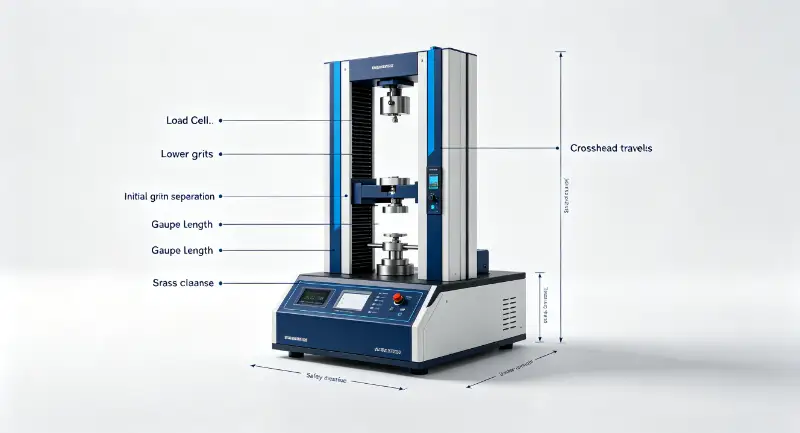
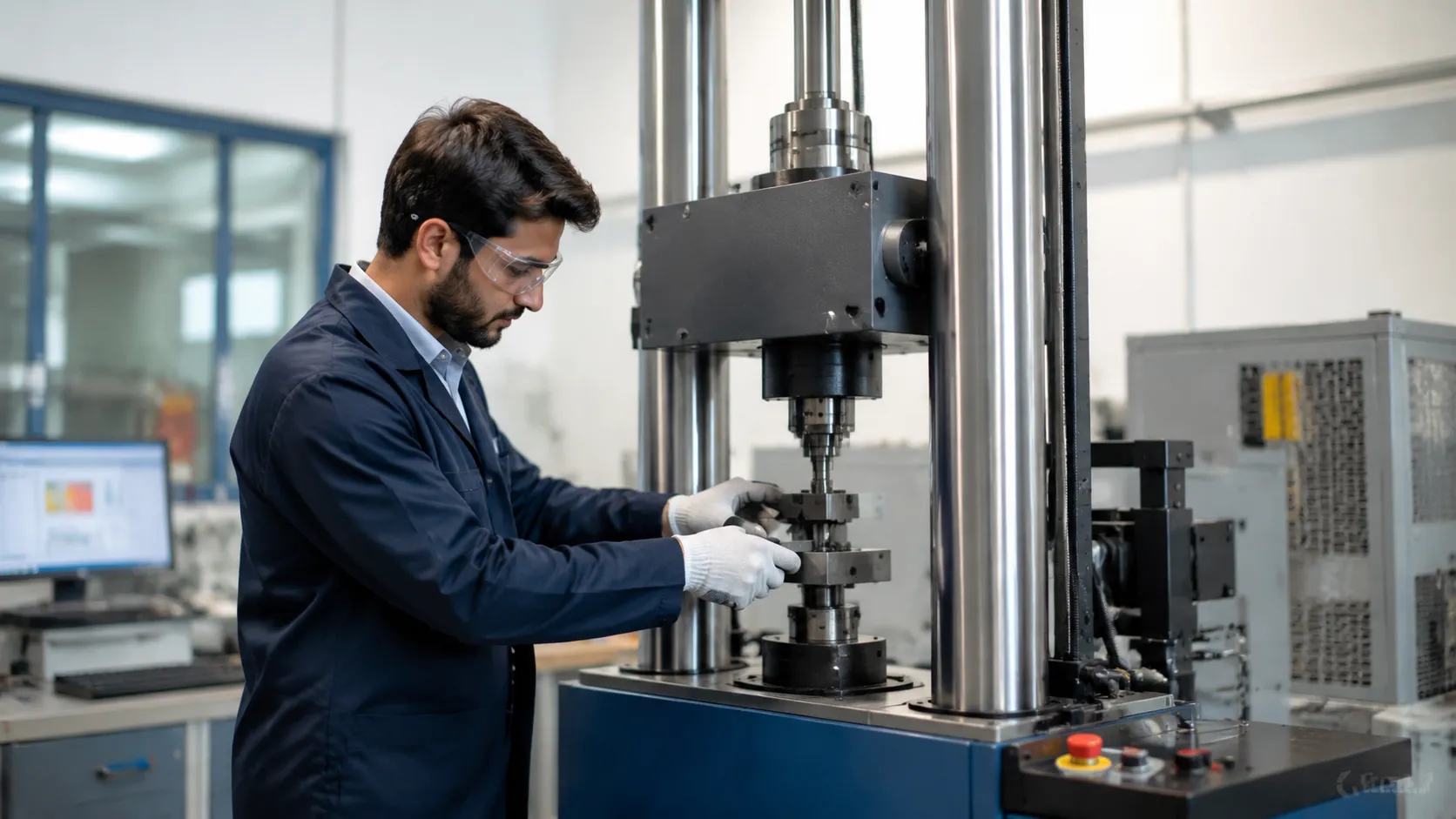
A universal testing machine (UTM) — also called a universal tensile testing machine or materials testing system — is a precision instrument that applies controlled tension, compression, bending, shear, and peel forces to material samples and measures their mechanical response. Originally named "universal" because one frame could perform many test types with interchangeable fixtures, the UTM is the single most versatile instrument in any material testing equipment manufacturer's portfolio — and almost certainly the most expensive single purchase a quality lab will make.
At its core, every UTM has four subsystems:
A well-chosen universal testing machine will run 30,000-50,000 tests across 15-20 years. Derui offers a comprehensive range of testing systems and solutions spanning electromechanical, servo-hydraulic, and specialized configurations. A poorly chosen one becomes a $40,000 paperweight within 18 months — oversized for daily work, or under-equipped for the standard your biggest customer just adopted. The rest of this guide is about making sure yours is the former.
Electromechanical vs Servo-Hydraulic: The Decision That Shapes Everything
This single choice determines your machine's force ceiling, speed precision, noise level, maintenance burden, and roughly 60% of your 5-year total cost of ownership. The conventional wisdom — "electromechanical for low force, servo-hydraulic for high" — is directionally correct but dangerously incomplete. Here is the full picture.
Electromechanical UTM
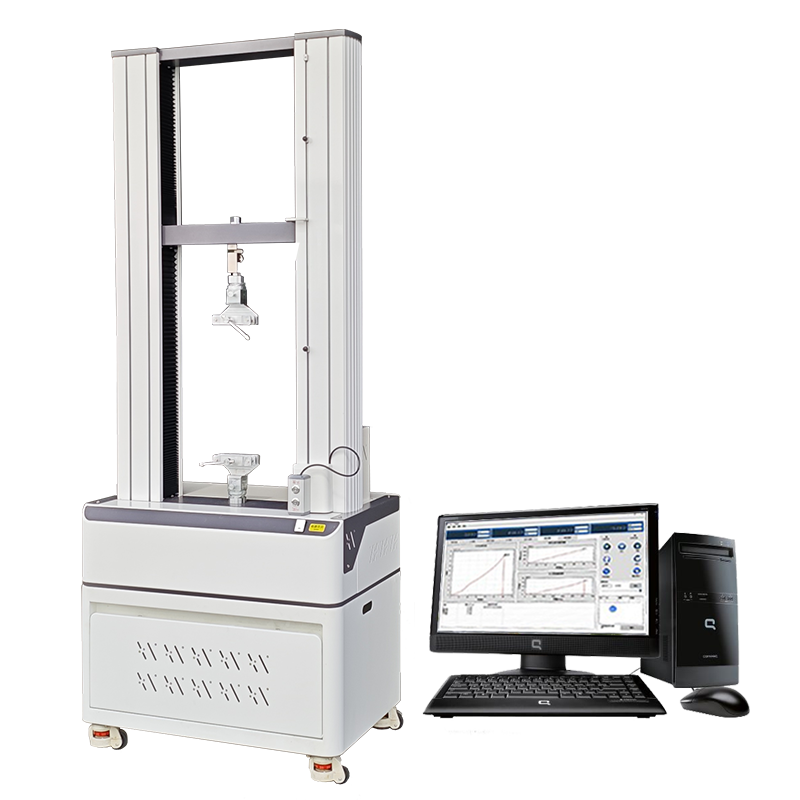
Uses a precision ballscrew driven by a servo motor. Force is generated mechanically — no hydraulic oil, no pump, no high-pressure hoses. The motor rotates the ballscrew, which moves the crosshead up or down at precisely controlled speeds.
Servo-Hydraulic UTM
Uses a hydraulic power pack to pressurize oil, driving a piston actuator. Force is generated hydraulically — capable of much higher forces and, critically, dynamic (cyclic) loading at frequencies up to 50 Hz or more.
Head-to-Head Comparison
| Dimension | Electromechanical | Servo-Hydraulic |
|---|---|---|
| Typical Force Range | 0.1 N – 300 kN | 10 kN – 2000+ kN |
| Speed Precision | ±0.1% of set speed | ±0.5% of set speed |
| Position Accuracy | ±1 μm | ±10 μm |
| Dynamic/Fatigue Capable | No | Yes (up to 50+ Hz) |
| Force Accuracy (Class) | Class 0.5 or 1 (ISO 7500-1) | Class 1 (ISO 7500-1) |
| Noise Level | <55 dB (near-silent) | 65–80 dB (pump audible) |
| Annual Maintenance | $200–500 (grease + calibration) | $800–2,500 (oil + filters + seals + calibration) |
| Power Consumption | 0.4–2 kW | 3–15 kW |
| Lifespan | 15–25 years | 15–25 years (with proper maintenance) |
| Entry Price (100 kN) | $12,000–$25,000 | $18,000–$40,000 |
| Best For | Plastics, textiles, rubber, adhesives, films, composites, light metals | Structural steel, rebar, concrete, rock, fasteners, fatigue testing |
The Gray Zone: 100–300 kN
Between 100 kN and 300 kN, both technologies are viable — and this is where most buyers get stuck. Here is how to decide:
| Choose Electromechanical at 100–300 kN if… | Choose Servo-Hydraulic at 100–300 kN if… |
|---|---|
| Your tests are static or quasi-static only (no fatigue) | You need cyclic/fatigue testing — even occasional |
| Speed precision at low rates matters (e.g., ASTM D638 for plastics at 5 mm/min) | You test high-elongation metals where crosshead travel >500 mm |
| Low noise and clean operation are non-negotiable (lab next to offices) | You expect to grow beyond 300 kN within 5 years |
| You run 20+ tests/day and want near-zero downtime from oil changes | Your lab already has hydraulic infrastructure (pump, oil disposal) |
If you are testing metals above 300 kN or any dynamic/fatigue application, the decision is made for you: go servo-hydraulic. For everything else under 300 kN with static-only testing, electromechanical is almost always the better total cost of ownership choice. If your testing profile spans both static precision work and occasional high-force requirements, a hybrid lab with one hydraulic universal testing machine for heavy work plus a benchtop electromechanical unit for daily plastics and textiles gives you the best of both worlds — and is more cost-effective than one over-spec'd machine trying to do everything.
Force Capacity: Match Your kN to Your Material
The single most common UTM buying mistake: purchasing a 300 kN machine "just in case," then realizing 95% of your daily tests need only 5 kN — and the machine cannot hold Class 1 accuracy at the low end of its range. Load cells are accurate between 2% and 100% of their rated capacity. A 300 kN load cell gives unreliable data below 6 kN.
| Industry / Material | Typical Force Range | Recommended Capacity | Key Standards |
|---|---|---|---|
| Plastics (films, sheets, molded parts) | 0.05–5 kN | 5–10 kN | ASTM D638, D882, D790, ISO 527 |
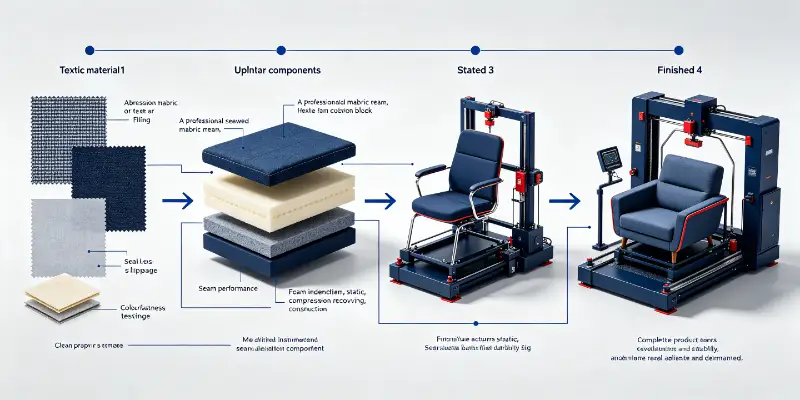
| Textiles, nonwovens, yarns | 0.01–5 kN | 1–5 kN | ASTM D5034, D5035, ISO 13934 |
| Rubber, elastomers, silicone | 0.1–10 kN | 5–20 kN | ASTM D412, D624, ISO 37 |
| Adhesives, tapes, peel tests | 0.01–2 kN | 1–5 kN | ASTM D3330, D903, ISO 11339 |
| Light metals (aluminum, copper, magnesium alloys) | 5–100 kN | 50–150 kN | ASTM E8, B557, ISO 6892-1 |
| Steel, fasteners, welded joints | 20–300 kN | 150–300 kN | ASTM A370, E8, F606, ISO 898-1 |
| Composites (CFRP, GFRP) | 1–250 kN | 50–250 kN | ASTM D3039, D3518, D790 |
| Construction rebar, structural steel | 100–600 kN | 300–600 kN | ASTM A615, A706, ISO 15630-1 |
| Wire rope, chain, lifting gear | 50–2000 kN | 300–2000 kN | ASTM A931, EN 12385, ISO 2408 |
| Concrete, rock cores, geotechnical | 50–2000 kN | 300–2000 kN | ASTM C39, C109, ISRM |
| Medical devices, sutures, stents | 0.001–1 kN | 0.5–2 kN | ASTM F2516, ISO 7198, USP <881> |
Rule of thumb: Your force capacity should be 1.5× to 2× your highest expected test load, never more than 4×. If your heaviest sample breaks at 50 kN, buy a 100 kN machine — do not spec 300 kN "for future proofing." The load cell accuracy penalty on low-range tests will damage your data quality immediately, and that damage compounds for years. If you genuinely need both 1 kN precision and 300 kN capacity, budget for two interchangeable load cells (e.g., 5 kN + 300 kN) that you swap with a quick-change coupling. This adds ~$1,500-$3,000 to your budget and solves the problem that "one machine to do everything" cannot.
Frame Types: Single-Column, Dual-Column, Four-Column
The load frame is the machine's skeleton. Its configuration determines what fits between the grips — and what does not.
Best for: plastics, films, textiles, adhesives, elastomers, medical devices.
Force range: 0.1 N – 5 kN (occasionally 10 kN).
Advantages: smallest footprint (fits on a lab bench), lowest cost, easiest to operate.
Limitation: limited vertical test space (~500-800 mm), cannot handle large specimens or high forces.
Best for: metals, composites, fasteners, rubber, rigid plastics.
Force range: 5 kN – 300 kN (electromechanical) or 10 kN – 600 kN (hydraulic).
Advantages: the workhorse configuration — best stiffness-to-cost ratio, ample test space (1000-1500 mm typical).
Limitation: floor-standing (needs dedicated space), heavier and pricier than single-column.
Best for: structural steel, rebar, wire rope, concrete, rock, geotechnical.
Force range: 300 kN – 2000 kN+ (servo-hydraulic).
Advantages: maximum frame stiffness, large test space, superior alignment under extreme load.
Limitation: heavy (2-8 tons), requires reinforced floor, dedicated hydraulic setup, highest cost.
Key spec to check: frame stiffness. A UTM's frame deflects under load — typically 1/30,000 to 1/100,000 of the applied force. A 100 kN machine with 1/50,000 stiffness deflects ~2 mm at full load. For most static tests this is acceptable because the extensometer measures strain directly on the specimen. But for brittle materials (ceramics, some composites) and tests where crosshead displacement is used as the strain measurement, insufficient stiffness introduces systematic error. Always ask the supplier for the frame stiffness coefficient in kN/mm.
Grips & Fixtures: The Part That Actually Touches Your Sample
The load frame and drive system get all the attention during procurement. But in day-to-day operation, grips are the #1 source of test failure, data scatter, and operator frustration. A $40,000 UTM with the wrong grips will produce worse data than a $10,000 machine with perfectly matched ones.
| Grip Type | Best For | Force Range | Watch Out For |
|---|---|---|---|
| Wedge / Serrated | Metals, composites, rigid plastics | 1–2000 kN | Can damage soft specimens; jaw face material must match specimen hardness |
| Pneumatic / Hydraulic | High-throughput labs, textiles, rubber | 0.1–100 kN | Requires compressed air or hydraulic supply; gripping pressure must be consistent test-to-test |
| Vise / Screw-Action | General purpose, low-to-mid volume labs | 1–50 kN | Operator-dependent — inconsistent tightening = scatter in results |
| Roller / Capstan | Textiles, films, geotextiles, wire | 0.05–10 kN | Specimen must be flexible enough to wrap around rollers |
| Compression Platens | Concrete, foam, cardboard, rubber | 0.5–2000 kN | Platen parallelism is critical — uneven contact = invalid results |
| Bend / Flexure Fixtures | Plastics, composites, ceramics, metals | 0.1–100 kN | Support span must match standard; wrong span = wrong flexural modulus |
Three grip questions every buyer must answer before purchasing:
Control Systems & Software: What You Are Actually Buying
The controller and software determine your daily experience with the machine. A poor software interface can turn a precision instrument into a source of constant friction — operators develop workarounds, skip calibration checks, and data quality degrades.
Minimum: 100 Hz for quasi-static tests.
Recommended: 500 Hz – 1 kHz for metals (yield point detection).
Required: 2–5 kHz for composites, fast fracture, dynamic events.
A 10 Hz system will miss the upper yield point on mild steel entirely — a classic rookie error that produces systematically low yield strength values.
Look for pre-configured test methods for your standards (ASTM / ISO / EN / GB/T).
A pre-built ASTM E8 method with all parameters (test speed, preload, extensometer removal point, calculation formulas) saves 15-20 minutes of setup per test type and eliminates parameter-entry errors.
Software evaluation checklist: Can you export raw data to CSV/Excel? Does it support multi-step test sequences (e.g., preload → hold → ramp to failure)? Can you customize the report template with your company logo? Does it support 21 CFR Part 11 compliance (audit trail, electronic signatures) if you are in pharma/medical? Can the software control an extensometer and automatically remove it at a specified strain? These are not "nice to have" — they are "miserable without" after 6 months of daily use.
If your lab handles diverse materials, invest in modular controller architecture — a system that accepts strain gauge load cells, LVDT extensometers, and digital encoders on the same interface. This prevents the need for a separate controller box for each accessory and dramatically simplifies calibration workflows.
Standards Compliance: The Non-Negotiable Checklist
Your UTM does not need to comply with every standard. It needs to comply with the standards your customers' specifications reference. Here is the minimum compliance layer every UTM should pass, plus the material-specific standards that drive purchasing decisions.
Universal Calibration Standards (Every UTM Must Meet)
| Standard | What It Covers | Minimum Class |
|---|---|---|
| ASTM E4 | Force verification of testing machines | Class 1 (±1% of reading) |
| ISO 7500-1 | Calibration of static uniaxial testing machines | Class 1 or 0.5 |
| ASTM E83 | Verification of extensometers | Class B-1 or B-2 |
| ISO 9513 | Calibration of extensometers | Class 0.5 or 1 |
Material-Specific Standards (Match to Your Industry)
| Industry | Key Standards | UTM Requirement Drivers |
|---|---|---|
| Metals | ASTM E8, ISO 6892-1, ASTM A370 | Strain rate control (Method A1 closed-loop), Class B-2 extensometer, serrated wedge grips, 500 Hz+ data rate for yield detection |
| Plastics | ASTM D638, ISO 527, ASTM D790 | 1-500 mm/min test speeds, flat-faced grips, extensometer for modulus, environmental chamber for temperature conditioning |
| Rubber / Elastomers | ASTM D412, ISO 37 | Long-travel extensometer (500%+ strain), non-contact preferred, pneumatic grips with controlled pressure |
| Composites | ASTM D3039, D3518, D790 | High-stiffness frame, alignment-critical fixtures, strain gauges or biaxial extensometer, 2 kHz+ data rate |
| Adhesives | ASTM D1002, D3163, ISO 4587 | Low-force load cell (1-2 kN), precision alignment, shear test fixtures, temperature chamber |
| Fasteners | ASTM F606, ISO 898-1 | Wedge tensile fixture, proof load testing capability, thread-specific grips, hardness correlation |
| Medical Devices | ASTM F2516, ISO 7198 | Sub-newton resolution, specialized micro-grips, 21 CFR Part 11 software, environmental bath |
| Construction | ASTM A615, ASTM C39 | High capacity (300-2000 kN), four-column frame, compression platens with spherical seating |
Warning: Do NOT accept a supplier's verbal claim that their machine "complies with ASTM E8." Ask for the calibration certificate from an ISO 17025-accredited laboratory, traceable to NIST (USA) or NIM (China). If they cannot produce one, the machine is uncalibrated — and no auditor will accept its data. Budget $300-$800/year for annual force calibration and $200-$500/year for extensometer verification.
Budget Planning & 5-Year Total Cost of Ownership
The sticker price is the smallest number that matters. Over a 5-year lifecycle, an electromechanical UTM that costs $8,000 more at purchase can come out $15,000 cheaper overall — once you account for electricity, hydraulic oil, filter replacements, seal kits, pump maintenance, and the lost productivity of oil-change downtime.
| Cost Category | Electromechanical 100 kN | Servo-Hydraulic 100 kN | Servo-Hydraulic 600 kN |
|---|---|---|---|
| Equipment Purchase | $12,000–$25,000 | $18,000–$40,000 | $35,000–$80,000 |
| Installation + Commissioning | $500–$1,500 | $1,500–$3,000 | $3,000–$8,000 |
| Grips & Fixtures (initial) | $1,500–$5,000 | $2,000–$6,000 | $3,000–$12,000 |
| Extensometer (1×) | $1,500–$4,000 | $1,500–$4,000 | $2,000–$6,000 |
| 5-Year Electricity | $300–$800 | $1,200–$4,500 | $2,500–$9,000 |
| 5-Year Maintenance | $1,000–$2,500 | $4,000–$12,500 | $6,000–$20,000 |
| 5-Year Calibration | $1,500–$4,000 | $2,000–$5,000 | $3,000–$7,000 |
| Consumables (oil, filters, seals) | $0 | $2,000–$6,000 | $3,000–$8,000 |
| 5-Year TCO (estimated range) | $18,000–$43,000 | $31,000–$81,000 | $55,000–$150,000 |
At 100 kN, the 5-year TCO spread is dramatic: electromechanical costs 40-55% less to own — even if the purchase price is only 20-30% lower. The gap widens with every hydraulic oil change, every pump seal replacement, and every day of downtime while you wait for a hydraulic technician. The savings are so significant that some labs buy a 100 kN electromechanical UTM for daily QC work and a separate 600 kN servo-hydraulic machine for the 5% of tests that need it — and still come out ahead versus trying to run everything on one oversized hydraulic machine.
Budget rule of thumb: Allocate 60% of your budget to the machine + load cell, 20% to grips and fixtures, 10% to software and controller options, and 10% to first-year calibration and training. When comparing quotes, ask suppliers to itemize what is included — many "all-inclusive" packages do not include the grips or extensometer you actually need. A properly spec'd universal tensile testing machine is worth the upfront investment over a stripped-down base model that requires $5,000+ in add-ons to meet your standard. The most common budget mistake: buying the machine and realizing you have nothing left for the extensometer that the standard requires.
The 7-Question UTM Decision Tree
Answer these seven questions in order. By question 4, you will have ruled out 80% of wrong choices. By question 7, you will know exactly what to request in your RFQ.
→ Answer in kN. Multiply by 1.5-2× for your machine capacity. This sets the floor.
→ If YES: servo-hydraulic mandatory. If NO: electromechanical preferred unless Q1 says >300 kN.
→ If the ratio of heaviest:lightest >10:1, you need interchangeable load cells. One load cell cannot cover both accurately.
→ ASTM E8 Method A1 (strain rate control) needs closed-loop control at 100 Hz minimum. Composites fracture toughness needs 2 kHz+. Check before buying.
→ If YES: budget $1,500-$6,000 for a clip-on or non-contact extensometer. Crosshead displacement is NOT accepted for modulus or yield strength on metals/plastics/composites.
→ Determines test space height × width. Add 150 mm clearance above/below grips for installation and fracture travel. Under-spec'd test space is the #2 regret after wrong force capacity.
→ If YES: environmental chamber adds $3,000-$15,000. Must be specified at purchase — retrofitting is mechanically invasive and often costs more than the chamber itself. Verify the chamber's temperature range (-70°C to +350°C typical) and ramp rate.
Example decision path: A medical device manufacturer testing Nitinol stents at 0-500 N. Q1 → 1 kN. Q2 → NO (static tensile only). Q3 → 0.01 N minimum (very light), ratio >100:1 → two load cells (5 N + 1 kN). Q4 → ASTM F2516 requires 100 Hz. Q5 → YES (extensometer for strain). Q6 → stent + grips ≈ 200 mm test space. Q7 → YES (37°C body temperature testing). Result: Single-column electromechanical UTM, 1 kN, dual load cells, clip-on extensometer, temperature-controlled water bath — approximately $18,000-$25,000 all-in with accessories.
10 Questions to Ask Any UTM Supplier
Send these to three suppliers. Compare answers. The supplier who cannot or will not answer specific technical questions — versus the one who replies with calibration certificates and test data — tells you everything you need to know before the purchase order.
| # | Question | Why It Matters |
|---|---|---|
| 1 | What is the frame stiffness coefficient (kN/mm)? | Reveals build quality — cheap frames deflect more, skewing brittle-material results |
| 2 | Do you provide ISO 17025-accredited calibration certificates with the machine? | "Yes but extra cost" = honest. "Our machines are factory calibrated" = run. |
| 3 | What is the data acquisition rate (Hz) and can the system do closed-loop strain rate control? | Below 100 Hz and no closed-loop → cannot run ASTM E8 Method A1 for metals |
| 4 | Can you supply load cells calibrated to the specific test ranges we need, and are they quick-change? | Non-interchangeable load cells lock you into one range |
| 5 | Show me a sample test report for [your material + your standard]. | If they cannot produce one, they have likely never tested your material |
| 6 | What grips and jaw faces do you recommend for our specimens — and why? | Tests whether they understand your application or are selling from a catalog |
| 7 | What is the warranty period and what does it cover? What is excluded? | Standard: 12-24 months on frame, 12 months on electronics. Hydraulic seals often excluded. |
| 8 | Do you offer on-site installation, commissioning, and operator training? Included or extra? | Factory-direct suppliers typically include this; distributors often charge extra |
| 9 | What is the lead time from PO to delivery? What about spare parts availability? | Standard: 4-8 weeks for common configurations. Ask about grip jaw faces, load cells, seals. |
| 10 | Can you provide references from labs testing similar materials to ours? | A supplier who cannot name three customers in your industry is learning on your dime |
The UTM you buy this year will define your lab's capability for the next 15 years. Let us help you get it right the first time.
We manufacture electromechanical and servo-hydraulic UTMs from 0.1 N to 2000 kN, with in-house grip and fixture fabrication, ISO 17025 calibration, and on-site commissioning worldwide. Send us your material, your standard, and your budget — we will return a complete specification with no obligation.