


Foam Hardness Testing: Methods, Equipment, and Quality Control Applications
Date: May 14, 2026 Categories: Technical Guides & Blog Views: 2873
Excerpt:
Foam hardness testing measures resistance to compression via IFD, CLD, Ball Indentation, and Shore durometer methods. Learn ASTM D3574/ISO 2439 standards, equipment selection, and quality control.
Key Takeaways
- Foam hardness is quantified using IFD (Indentation Force Deflection) and CLD (Constant Force Deflection) methods, both defined in ASTM D3574 and ISO 2439
- IFD25 and IFD65 are the most widely referenced hardness indicators - 25% and 65% compression respectively
- Ball Indentation hardness provides localized hardness mapping, especially useful for multi-zone foam products
- Shore 00 scale is the industry standard for very soft foam (gel, memory foam); Shore A for firmer elastomers
- Consistent hardness testing ensures product uniformity, safety compliance, and customer satisfaction
- Derui offers precision IFD testers, CLD systems, Ball Indentation apparatus, and Shore durometers for lab and production use
What Is Foam Hardness Testing?
Foam hardness testing measures the resistance of flexible foam materials to compression under a defined force. The result informs manufacturers whether a foam product meets the firmness specifications required for its intended application - from automotive seating to mattress layers to packaging inserts.
Hardness is not the same as density. While density measures mass per unit volume, hardness quantifies how much force is needed to compress the foam to a specific deflection. A low-density memory foam can be very firm; a high-density HR foam can be surprisingly soft. Both properties must be tested independently.
Hardness = Force required to compress foam (measured in Newtons or lbf)
Density = Mass per unit volume (measured in kg/m3 or lb/ft3)
Primary Testing Methods
1. Indentation Force Deflection (IFD) Test
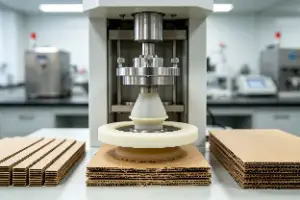
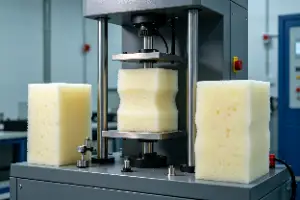
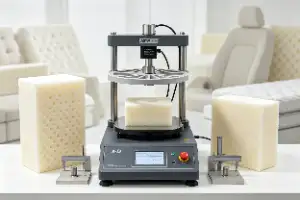
IFD is the most widely used method for flexible polyurethane foam. It measures the force required to compress a circular test sample to 25% or 65% of its original thickness.
Standard: ASTM D3574 - Test H (IFD) and ISO 2439
Procedure:
- Condition foam sample at 23+/-2C for at least 16 hours
- Place 100mm x 100mm x 50mm test specimen on a flat plate
- Lower a 50mm diameter circular indentor foot to 25% compression (IFD25)
- Record the force in Newtons after 60 seconds dwell time
- Repeat the cycle 4 times; report the 4th cycle force as IFD value
- Repeat with 65% compression for IFD65 measurement
Equipment: Compression plate, 50mm indentor foot, force gauge (+/-0.5N accuracy), digital height gauge
Sample size: 100x100x50mm (primary); 300x300x75mm (secondary per ASTM)
Temperature: 23+/-2C | Humidity: 50+/-5% RH
Pre-conditioning: 16-72 hours
The IFD test produces two primary values:
- IFD25: Firmness at light compression - relevant for seating comfort layers
- IFD65: Firmness at deep compression - relevant for load-bearing applications
The IFD ratio (IFD65 divided by IFD25) indicates foam support factor. A ratio above 2.0 indicates high-performance foam with superior support characteristics.
2. Constant Force Deflection (CLD) Test
CLD applies a constant known force to the foam specimen and measures the resulting deflection - the inverse of IFD. This method is particularly useful for quality control on production lines where rapid pass/fail decisions are required.
Standard: ASTM D3574 - Test H (CLD) and ISO 2439
Procedure:
- Condition the foam specimen as per IFD procedure
- Apply a pre-determined compression force (typically 35N or 65N)
- Hold for 60 seconds
- Measure the resulting thickness deflection
- Calculate CLD as: thickness reduction divided by original thickness times 100%
3. Ball Indentation Hardness Test
The Ball Indentation test uses a spherical indentor to measure the localized hardness of foam. It is particularly valuable for:
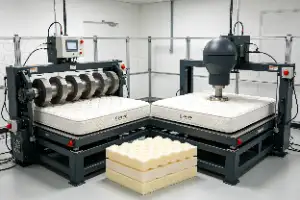
- Mapping firmness across multi-zone mattresses
- Testing large or non-uniform products
- Quality control of molded foam parts
Standard: ASTM D3574 - Test H (Ball Indentation)
A 200mm diameter sphere is pressed into the foam at a defined rate, and the depth of penetration at a fixed load (typically 490N) is recorded.
4. Shore Hardness Durometer
For very soft foams (including memory foam, gel foam, and textile-backed products), Shore 00 is the preferred scale. For firmer elastomeric foams, Shore A may be used.
| Scale | Application Range | Reading |
|---|---|---|
| Shore 00 | Very soft foam, gels, memory foam | 0-100 (softer = higher) |
| Shore A | Firmer flexible foam, rubber | 10-100 (firmer = higher) |
| Asker C | Medium-soft foam (Japan standard) | 20-100 |
Relevant Standards for Foam Hardness Testing
| Standard | Scope | Method |
|---|---|---|
| ASTM D3574 | Flexible polyurethane foam - US | IFD (H), CLD, Ball Indentation |
| ISO 2439 | Flexible cellular materials - International | IFD, CLD, Ball Indentation |
| BS 4443 | Flexible cellular polyurethane - UK | IFD, CLD |
| JIS K6400 | Flexible cellular materials - Japan | Asker FPC/C hardness |
| QB/T 2914 | Polyurethane foam - China (mattress) | IFD, compression force |
Equipment for Foam Hardness Testing
Hardness testing requires precision instrumentation that delivers repeatable, reproducible results across different operators and environments.
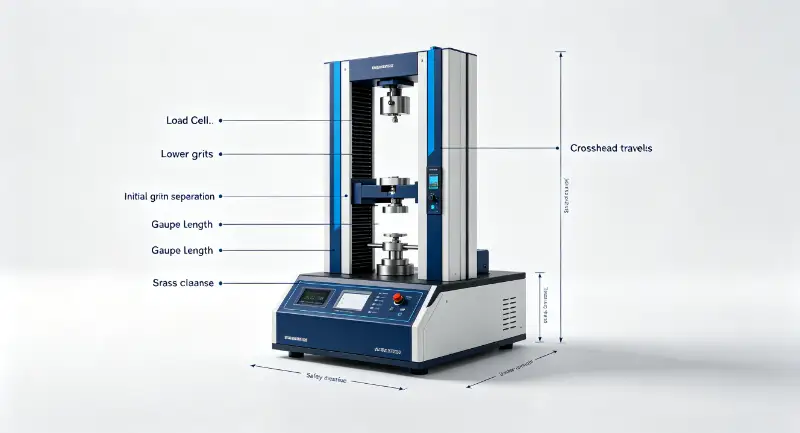
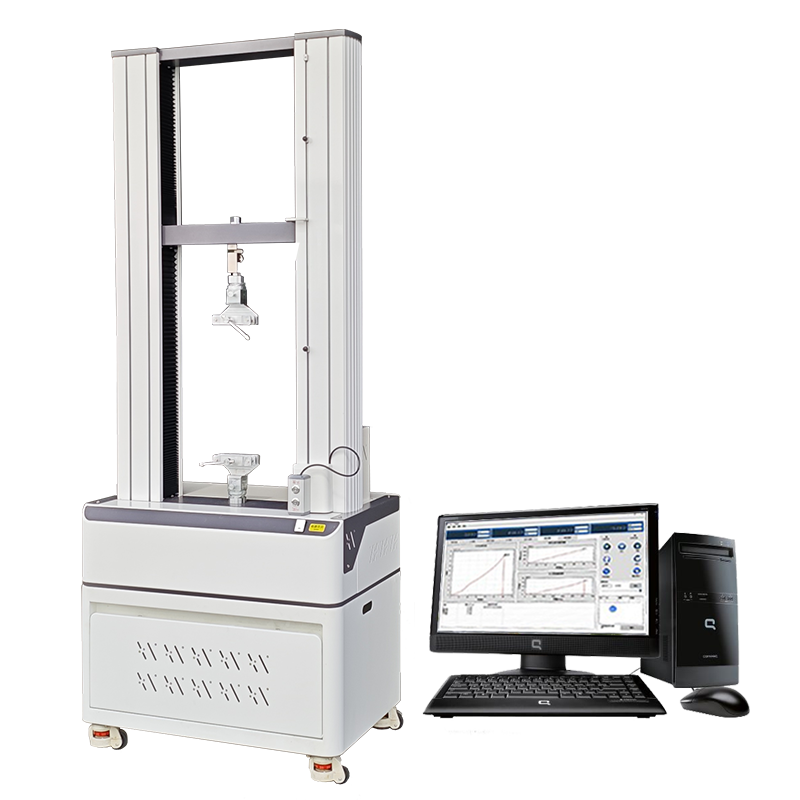
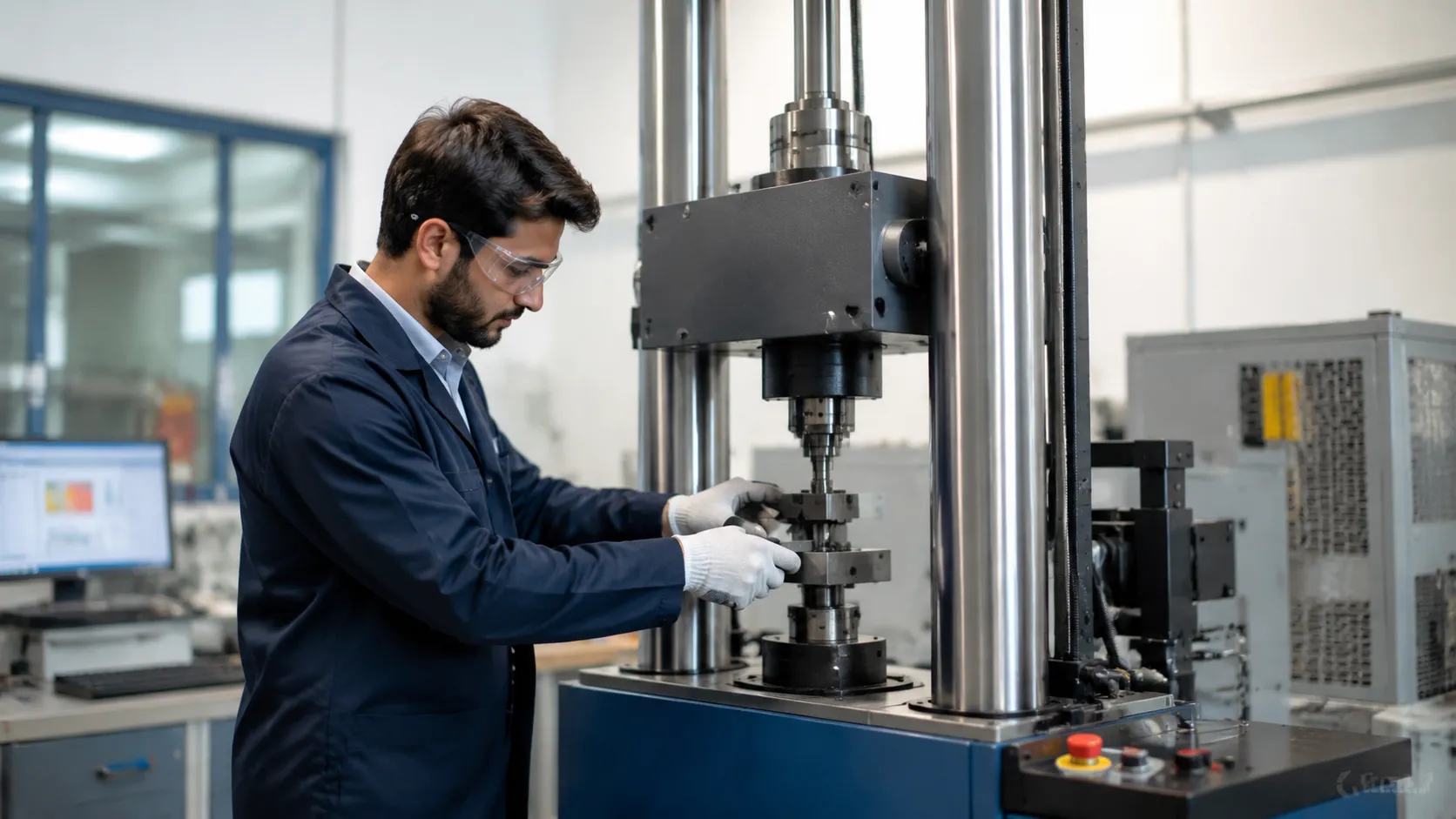
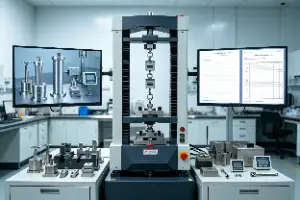
IFD / CLD Testing Machine
- Motorized crosshead for precise compression control
- High-accuracy load cell (+/-0.5% of reading)
- Digital displacement measurement (+/-0.01mm)
- Built-in thermal chamber for temperature-controlled testing
- Software for data logging, statistical analysis, and report generation
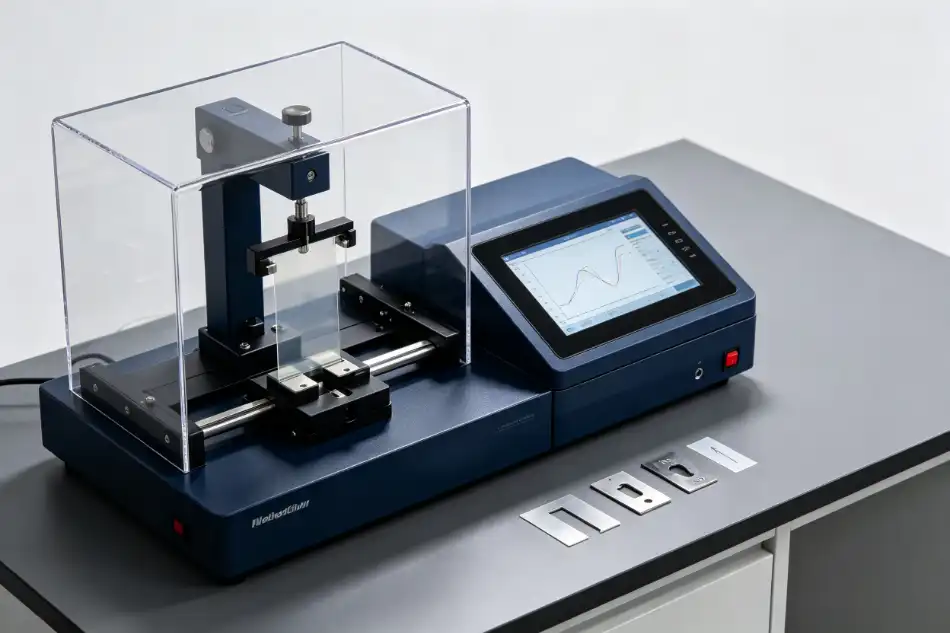
Shore Durometer
Handheld or bench-mounted durometers provide instant hardness readings. Spring-loaded tips ensure consistent contact force across measurements.
Applications by Industry
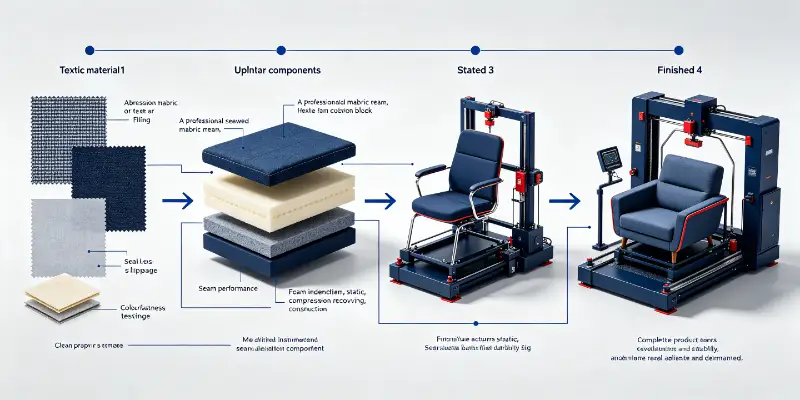
Furniture and Bedding
Mattress manufacturers use IFD25 to specify comfort layer firmness and IFD65 for support core hardness. A typical queen-size mattress might specify: Comfort layer IFD25 100-150N; Transition layer IFD25 180-250N; Support core IFD65 400-600N.
Automotive
Car seat cushions must maintain consistent hardness across production runs and after accelerated aging tests. Automotive OEMs specify IFD targets with +/-15N tolerance bands. Seat foams also undergo 75% IFD compression fatigue testing per ASTM D3574.
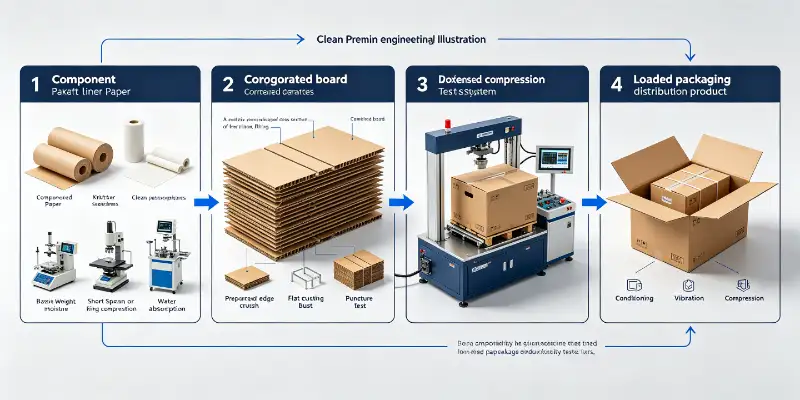
Packaging
Protective foam inserts require precise hardness calibration to absorb impact energy without allowing product contact damage. CLD testing at multiple force levels helps determine the optimal foam grade for each product.
Quality Control: Sampling and Frequency
Per ASTM D3574, IFD testing requires a minimum of 3 samples per test lot, with results reported as the arithmetic mean. Many manufacturers test every 100th produced unit; critical applications may require 100% testing.
Statistical Process Control (SPC) charts should track IFD values over time to detect process drift before out-of-spec product is produced.
Common Causes of Hardness Failures
- Wrong isocyanate index: Too high makes firm brittle foam; too low makes soft collapsed foam
- Moisture contamination: Water reacts with isocyanate, generating CO2 and reducing crosslink density - softer foam results
- TDI/MDI ratio variance: Affects cell wall rigidity and therefore compression resistance
- Temperature variation during cure: Too cold causes incomplete reaction; too hot causes excessive blow-out
- Mix head imbalance: Uneven polyol/isocyanate mixing produces hardness gradients
How to Interpret IFD Results
| IFD25 (N) | Firmness Level | Typical Application |
|---|---|---|
| Below 80 | Very soft | Top comfort layer, pressure relief |
| 80-180 | Soft to medium | Standard seating, mattress comfort layer |
| 180-300 | Medium to firm | High-density seating, back support |
| Above 300 | Firm | Industrial, load-bearing, automotive |