

Compression Set Testing: Why It Matters for Foam Quality Control
Date: May 8, 2026 Categories: Technical Guides & Blog Views: 10643
Excerpt:
Compression set testing reveals whether foam will recover after prolonged use. Learn the difference between constant deflection and constant load methods, acceptable values, and equipment requirements.
Compression set measures the permanent thickness change that remains after a foam specimen is held under a defined compression and allowed to recover. Lower results generally mean better recovery under the selected procedure, but there is no universal pass limit for every foam product. A valid report must identify the standard edition, method, specimen, compression level, exposure, recovery time and calculation used.
1. What Compression Set Measures
2. ASTM D3574 Test D & ISO 1856
3. Test Workflow
4. Formula & Calculation
5. Equipment & Fixtures
6. Variables That Change Results
7. Interpreting Results
8. Applications
9. Troubleshooting
10. Test Report Checklist
11. Frequently Asked
What Compression Set Measures
Flexible foam is expected to deform under load and recover after the load is removed. Compression set testing quantifies the portion of thickness that does not recover after a defined compression exposure.
The test is useful because a foam can meet its initial density and firmness specification yet recover poorly after being held in a compressed condition. That behavior matters in cushions, mattresses, seating components, packaging pads and other products where retained thickness supports fit, comfort or protection.
The specimen returns toward its original thickness after release.
A permanent thickness change remains after the specified recovery period.
Compression set is not the same as indentation hardness, compression-force deflection or repeated-load fatigue. Each answers a different question:
| Test | Primary question |
|---|---|
| Indentation hardness | How much force is required to indent the foam? |
| Compression set | How much thickness remains permanently lost after sustained compression? |
| Fatigue | How do thickness and load-bearing properties change after repeated loading? |
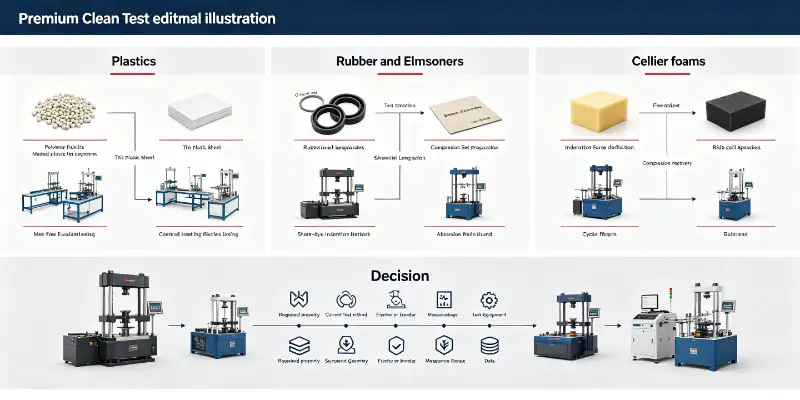
For the broader family of polyurethane foam methods, use the ASTM D3574 foam testing guide. For repeated loading, see the separate foam fatigue testing guide.
ASTM D3574 Test D and ISO 1856
ASTM D3574 contains test methods for slab, bonded and molded flexible polyurethane foams. Test D addresses constant-deflection compression set. ASTM currently lists D3574-25 as the active edition.
ISO 1856:2018 specifies methods for determining compression set of flexible cellular materials and applies to latex and polyurethane foams above the thickness stated in its scope. ISO lists this edition as current following review and confirmation.
The two standards address the same general property, but laboratories should not combine their parameters or assume that the reported results are interchangeable. Differences can include:
- specimen geometry and permitted material types;
- compression or deflection level;
- exposure time and temperature;
- conditioning and recovery requirements;
- measurement procedure and calculation;
- required number of specimens and report fields.
A Practical Compression Set Test Workflow
Record the standard, edition, procedure, customer modifications, required exposure and acceptance criteria before preparing specimens.
Cut clean specimens to the prescribed dimensions. Record material, batch, source location and orientation where applicable. Avoid crushed cells and damaged edges.
Condition specimens for the atmosphere and duration required by the method. Protect them from unintended compression during storage and handling.
Use the prescribed thickness-measurement system, contact force and measurement locations. Record the initial thickness for each specimen, not only a group average.
Use clean, rigid, parallel plates and the required spacer or stop arrangement. Confirm the final plate separation before starting exposure.
Hold the compressed specimens for the required time and temperature. Monitor the actual exposure environment and record interruptions or deviations.
Release the specimen as directed and begin the prescribed recovery interval. Timing matters because flexible foam continues recovering after unloading.
Measure recovered thickness using the same controlled technique. Apply the formula required by the selected method and report individual as well as summary results.
Compression Set Formula and Calculation
For a constant-deflection method, compression set is commonly expressed relative to the imposed deflection:
Where:
- t₀ = initial specimen thickness before compression;
- tᵣ = recovered specimen thickness after the specified recovery period;
- tₛ = spacer thickness or compressed plate separation used by the method.
Illustrative calculation: if a specimen starts at 50.0 mm, is held at a 25.0 mm plate separation, and recovers to 47.5 mm, the result using the formula above is:
Important: The example explains the variables; it does not prescribe specimen size, deflection, exposure or acceptance. Use the equation and rounding rules in the exact standard procedure being reported. Do not replace it with “thickness loss divided by original thickness” unless that is explicitly required by the selected method.
Equipment and Fixture Requirements
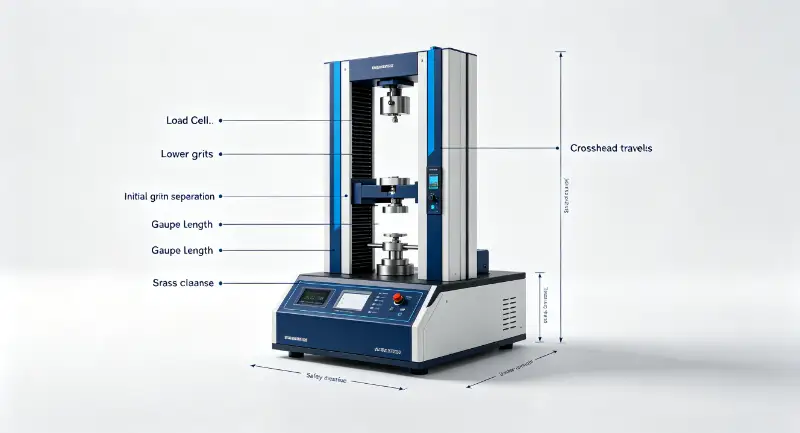
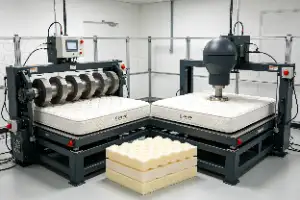
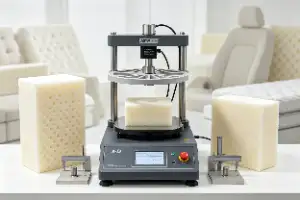
Compression set testing usually needs a preparation and measurement system, a constant-deflection fixture, and controlled exposure equipment. Buying only a compression test frame does not create a complete capability.
| Equipment | Purpose | What to verify |
|---|---|---|
| Specimen cutter | Produces controlled geometry without crushing edges | Dimensions, blade condition and repeatability |
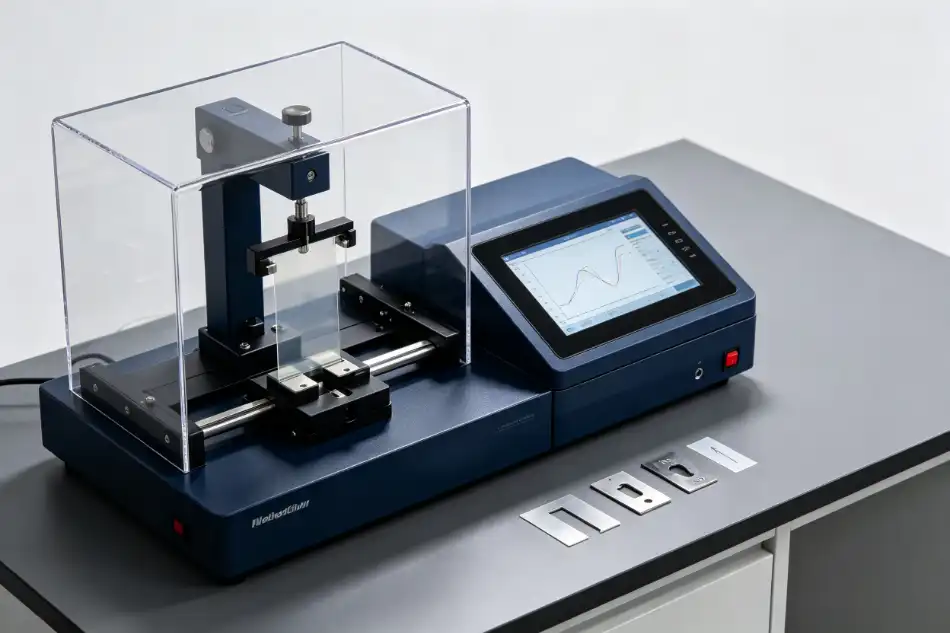
| Thickness gauge | Measures initial and recovered thickness | Resolution, contact foot, applied force, zero and calibration |
| Compression fixture | Maintains the prescribed plate separation | Parallelism, rigidity, flatness, spacer accuracy and locking |
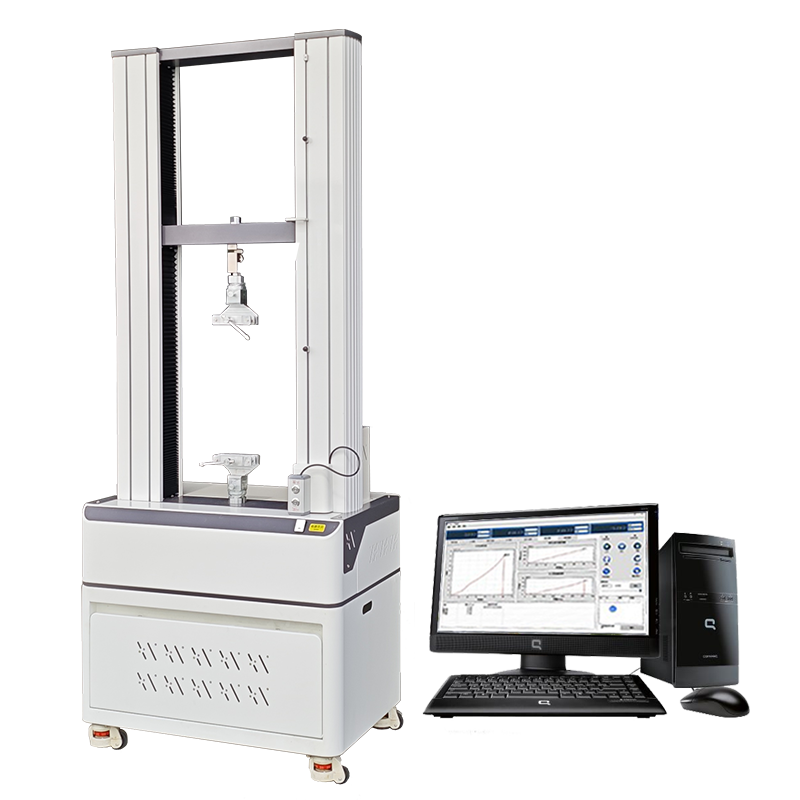
| Loading aid or test frame | Compresses the assembly safely and consistently | Travel, platen alignment, access and overload protection |
| Oven or chamber | Provides the specified exposure where required | Temperature range, uniformity, monitoring, recovery and fixture compatibility |
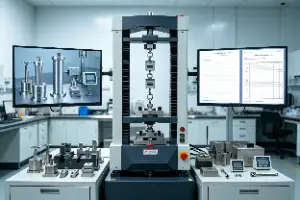
If the same laboratory also performs indentation-force, compression, tensile or tear measurements, review the foam hardness and tensile tester. Send the exact standard edition, test method and specimen range before ordering so Derui can confirm the required fixtures and auxiliary equipment.
Variables That Change the Result
An incorrect or uneven specimen changes the imposed deflection and the calculation.
Spacer error or fixture deflection changes the actual compression level.
Uneven loading creates different compression across one specimen.
Temperature, time and uniformity affect polymer recovery behavior.
Measuring too early or too late can change the reported residual thickness.
Excessive or inconsistent contact force can compress the specimen during measurement.
Skin, core, edge and rise-direction differences can increase within-batch variation.
Cure time, storage and previous compression can affect recovery.
How to Interpret Compression Set Results
A lower compression set normally indicates that the specimen recovered more of the imposed deflection under the selected test conditions. But the number is only meaningful when its method and context are known.
Compare results only when the following are equivalent:
- standard, edition and procedure;
- specimen dimensions, source and orientation;
- compression level and fixture arrangement;
- exposure time and temperature;
- recovery atmosphere and duration;
- thickness measurement and calculation.
Do not use a universal “good foam” threshold. Furniture cushioning, automotive seating, bedding, packaging and sealing products can have different performance requirements. The correct acceptance limit comes from the customer specification, applicable product standard or a validated internal requirement tied to actual product performance.
A result outside the limit should trigger a documented investigation, not an automatic claim about the cause. Review specimen preparation, exposure records, fixture spacing, material batch, cure history and other property data before concluding that formulation is responsible.
Where Compression Set Data Is Used
| Application | Why retained thickness matters | Use the result to |
|---|---|---|
| Furniture cushions | Supports cushion height and appearance | Compare materials and incoming batches |
| Mattresses and bedding | Influences loft and support consistency | Screen layers and formulation changes |
| Automotive seating | Helps maintain geometry and feel | Verify supplier and OEM-specific requirements |
| Protective packaging | Affects available cushioning thickness after storage | Evaluate sustained-compression risk with other packaging tests |
| Specialized foam components | Dimensional recovery may affect fit or function | Check the actual product or customer specification |
Compression set is one input—not a complete service-life prediction. Product geometry, assembly compression, dynamic loading, temperature, humidity and chemical exposure may require additional testing.
Troubleshooting High Variation or Unexpected Results
| Observation | Check first | Corrective action |
|---|---|---|
| Large variation within one batch | Specimen location, thickness, cutting and orientation | Standardize sampling and inspect individual results |
| All results shift suddenly | Gauge zero, spacer dimensions, chamber records and method revision | Verify equipment with controlled checks before retesting product |
| One side recovers differently | Plate parallelism, specimen placement and thickness uniformity | Inspect fixture surfaces and loading alignment |
| Results differ between laboratories | Edition, procedure, recovery timing, measurement force and calculation | Exchange complete procedures and compare raw measurements |
| Result changes when remeasured | Ongoing foam recovery and gauge contact force | Measure at the prescribed time using a controlled technique |
Compression Set Test Report Checklist
A reliable result begins with the exact method—not a generic machine description.
Send Derui your standard edition, specimen details, compression condition, throughput and reporting requirements for a technical configuration review.
Frequently Asked
Under the same controlled method, a lower result generally means the specimen recovered more of the imposed deflection. Compare only results produced with equivalent specimens, exposure, recovery and calculation.
There is no single limit for every foam product. Use the customer specification, applicable product standard or a validated internal criterion tied to the intended application.
No. Compression set evaluates permanent thickness change after a sustained compression exposure. Fatigue evaluates property changes after repeated loading. A durability program may require both.
Flexible foam continues to recover after release. Measuring at a different time can change the result, so the specified recovery interval must be controlled and recorded.
Not automatically. Confirm that the specimen, deflection, exposure, recovery, measurement and calculation are equivalent before making a comparison.
A typical setup includes controlled specimen preparation, a suitable thickness gauge, rigid parallel compression plates with the required spacer arrangement, a safe loading method and controlled environmental exposure where required.