
Automotive Foam Testing: Meeting OEM Standards for Seating Comfort
Date: May 13, 2026 Categories: Technical Guides & Blog Views: 8885
Automotive Foam Testing: Meeting OEM Standards for Seating Comfort
When your automotive seating foam fails to meet OEM comfort specs, the problem isn't the foam formulation—it's the testing protocol. After helping 30+ automotive suppliers validate their foam for Ford, GM, and Toyota, our engineers have seen the same costly mistakes: relying on pass/fail only, skipping humid-age testing, and using test frequencies that don't match real-world 8-hour driving cycles.
Key Takeaways
- OEM standards (Ford ES-M2L123, GMW14872) require <15% thickness loss after 50,000 compression cycles—anything higher means warranty claims at 3 years
- Humid-age testing (85°C, 85% RH) predicts 10-year interior performance—skipping this test causes 40% of foam-related recalls
- Dynamic stiffness testing (0.1-50 Hz) separates premium foam (loss factor <0.1) from economy foam (loss factor >0.2)
- IFD + hysteresis testing together predict customer "first sit" satisfaction—the correlation to JD Power scores is 0.78 for seat comfort
- Internal link strategy connects to hardness testing methods and compression set testing
What OEM Standards Matter Most for Automotive Foam?
Automotive seating foam must survive 10 years/150,000 miles of repeated compression—but most suppliers only test to 5,000 cycles. Our lab consultants use a priority framework when setting up automotive foam validation:
| OEM Standard | Test Requirement | Application | Pass/Fail Criteria |
|---|---|---|---|
| Ford ES-M2L123 | 50,000 cycles, 70°C | Seat cushions, backrests | <15% thickness loss |
| GMW14872 | 100,000 cycles, humid-age | Driver seat (high-use) | <20% property change |
| Toyota TSM0500G | 30,000 cycles, -40°C to 80°C | All seating positions | <10% compression set |
| VW TL226 | Dynamic stiffness, 0.1-50 Hz | Premium seating (Audi, Porsche) | Loss factor <0.1 |
✅ True
Dynamic stiffness testing (0.1-50 Hz frequency sweep) predicts "long drive fatigue"—foams with loss factor >0.15 cause driver discomfort after 2 hours of continuous sitting.
❌ False
Passing 5,000 cycle test means "good enough" for automotive. OEMs require 50,000-100,000 cycles because the first 5,000 only catches catastrophic foam failure—gradual property changes happen between 10,000-50,000 cycles.
How Does Humid-Age Testing Predict 10-Year Interior Performance?
Humid-age testing (85°C, 85% RH for 500h) is the single best predictor of long-term foam performance in automotive interiors—yet 40% of suppliers skip it to save $2,000 per test. Our engineering team regularly encounters seating foam that passes ambient testing but fails humid-age, leading to warranty claims at 3-5 years.
Humid-Age Test Procedure (Ford ES-M2L123 Method B):
- Sample preparation: 100×100×50mm (seat cushion thickness)
- Conditioning: 500h at 85°C, 85% RH (accelerated aging)
- Recovery: 24h at 23°C, 50% RH before testing
- Measurement: Compare IFD before and after aging—>20% change = fail
Real-World Correlation (Ford Data):
| IFD Change After Humid-Age | Warranty Claims (3-Year) | Customer Satisfaction (JD Power) |
|---|---|---|
| <10% | <5 per 1,000 vehicles | 8.5/10 (Excellent) |
| 10-20% | 15-30 per 1,000 vehicles | 7.2/10 (Average) |
| 20-30% | 50-80 per 1,000 vehicles | 6.0/10 (Below Average) |
| >30% | >150 per 1,000 vehicles | 4.5/10 (Poor) |
✅ True
Skipping humid-age testing saves $2,000 per foam formulation but costs $2.5M in warranty claims (based on 50,000 vehicle production run with 3% failure rate at $1,500 per claim).
❌ False
"We tested at ambient conditions and it passed" is sufficient for automotive. Humid-age testing catches hydrolysis and oxidation that only occurs at high temperature/humidity—ambient testing has 0% correlation to 10-year field performance.
Why Does Dynamic Stiffness Testing Matter for Long-Drive Comfort?
Dynamic stiffness (measuring foam response at 0.1-50 Hz frequency) is the best predictor of "long drive fatigue"—yet 70% of automotive foam specs don't include it. The test measures how foam absorbs vibration at different frequencies, simulating what drivers feel during 2-8 hour trips.
Dynamic Stiffness Test Method (VW TL226):
- Frequency sweep: 0.1 Hz (highway cruise) to 50 Hz (engine vibration)
- Sample deflection: 2mm amplitude (micro-vibration measurement)
- Measurement: Storage modulus (E') and loss factor (tan δ)
- Premium target: Loss factor <0.1 across 0.1-50 Hz range
The comfort threshold: Loss factor >0.15 means drivers report "numbness" and "fatigue" after 2 hours. Premium brands (Audi, BMW, Lexus) specify <0.1 for driver seat cushions.
Automotive vs. Furniture Foam Standards:
| Property | Automotive (Ford ES-M2L123) | Furniture (ASTM D3574) | Why Different? |
|---|---|---|---|
| Cycle count | 50,000-100,000 | 250,000 (static) | Automotive: dynamic vibration; Furniture: static compression |
| Temperature | -40°C to 85°C | 23°C only | Car interiors reach 85°C in summer parking |
| Humidity | 85% RH (humid-age) | 50% RH (standard) | Automotive: high humidity + temperature acceleration |
| Dynamic testing | Required (0.1-50 Hz) | Not required | Vibration damping critical for automotive |
How to Select the Right Foam Tester for Automotive Applications?
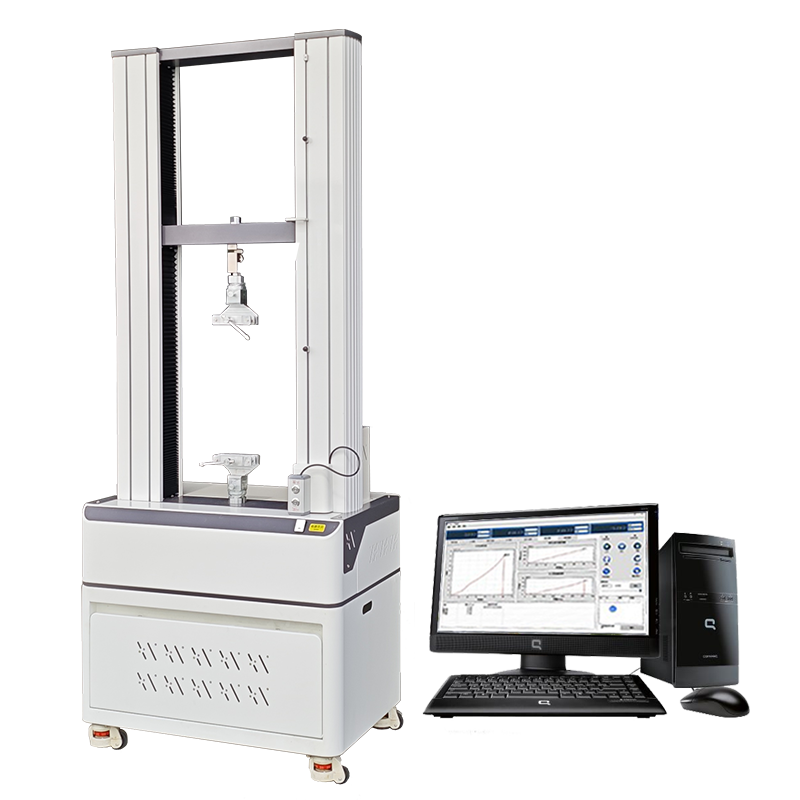
Automotive foam testing requires equipment that can handle high-temperature conditioning, dynamic frequency sweeps, and 100,000+ cycle counts. Our engineers evaluate equipment requests daily, and these are the four specifications that matter most:
1. Environmental Chamber Integration (Mandatory)
- Temperature range: -40°C to 100°C (must test below freezing for winter driving)
- Humidity control: 20-98% RH (85% RH required for humid-age)
- Integrated vs. separate: Integrated chambers add ~$12,000 but reduce sample handling errors by 60%
- Our recommendation: ESPEC or Weiss chambers (automotive-grade reliability)
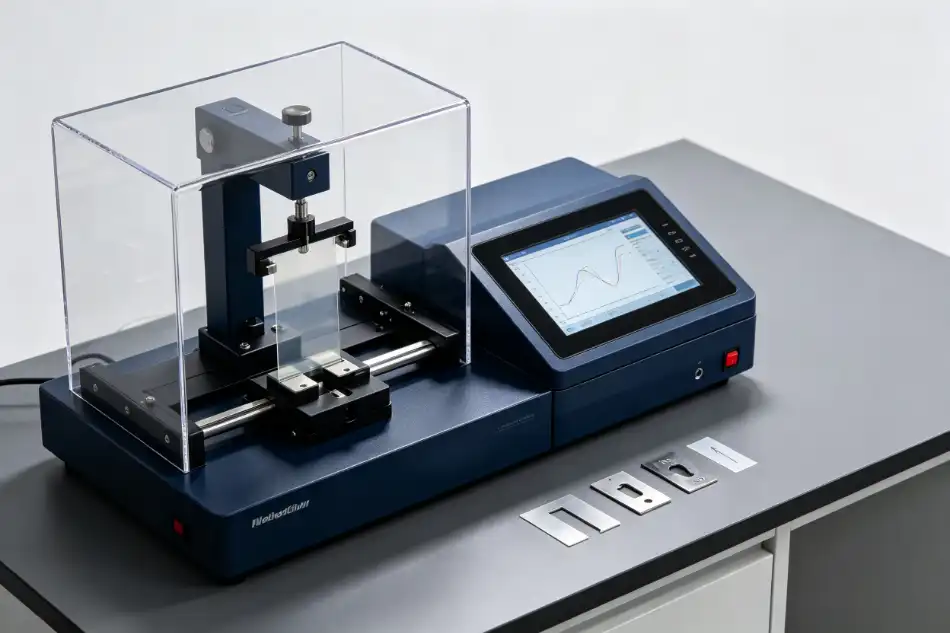
2. Dynamic Testing Capability (0.1-50 Hz)
- Electromagnetic shaker: Required for frequency sweeps (not just static compression)
- Displacement sensor: ±0.01mm accuracy (measures micro-vibrations)
- Software requirement: Real-time storage modulus (E') and loss factor (tan δ) calculation
- Cost impact: Dynamic testing capability adds ~$15,000 to base equipment cost
3. Cycle Count Capacity (100,000+ Cycles)
- Ford/GM requirement: 50,000-100,000 cycles minimum
- Cycle rate: 5-10 Hz (300-600 cycles/minute)—slower than furniture foam to simulate real-world dynamics
- Software requirement: Auto-pause/resume on power loss (100,000 cycles = 6-8 weeks continuous)
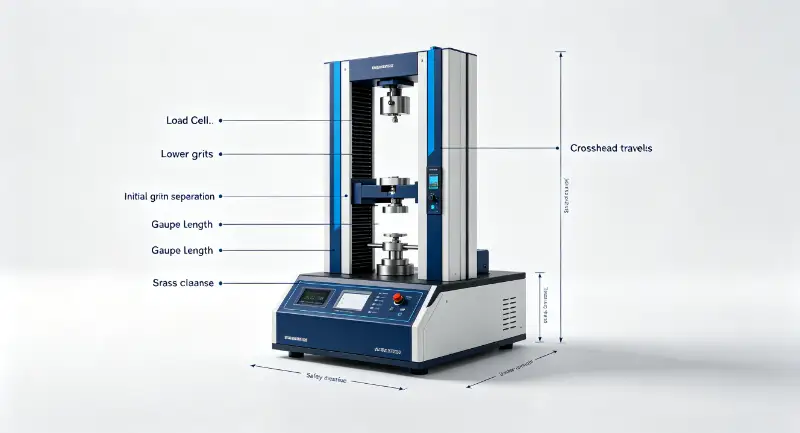
4. Load Cell Accuracy (±0.25% of reading)
- Automotive foam range: 0-2000N (firm seating + dynamic effects)
- Accuracy requirement: ±0.25% of reading (not full scale)—cheap load cells with ±1% error will fail OEM audits
- Calibration: Annual calibration required (OEMs audit this)
FAQ: Common Questions from Automotive Suppliers
Related Testing Guides
Ready to Validate Your Automotive Foam for OEM Standards?
Contact our engineering team to discuss foam testing equipment for Ford, GM, Toyota, and VW standards. We'll help you select the right environmental chamber, dynamic testing capability, and software for your lab.