


Mattress Testing Equipment: Complete Guide to IFD, Fatigue, and Quality Control
Date: May 14, 2026 Categories: Technical Guides & Blog Views: 8982
Excerpt:
Complete guide to mattress testing equipment covering IFD/ILD firmness testing, rollator fatigue testing, ASTM D3574 and ISO 2439 standards, and quality control procedures.
Key Takeaways
- Mattress testing evaluates comfort, support, durability, and safety across IFD, ILD, firmness, and fatigue performance metrics
- ASTM D3574, ISO 2439, and QB/T 2914-2007 are the primary standards governing mattress and foam component testing
- Core test categories include: Indentation Force Deflection (IFD/ILD), Compression Force Deflection, Fatigue (rollator), and Thickness Loss measurements
- Automated testing machines with precision load cells and digital displacement sensors provide the accuracy required for modern quality control
- Derui offers complete mattress testing solutions - from manual firmness testers to fully automated durability test rigs
Why Mattress Testing Matters
A mattress is one of the most important consumer products in terms of daily impact on health and quality of life. A mattress that fails prematurely - sagging, losing firmness, or developing body impressions - directly reduces sleep quality and can contribute to back pain and discomfort.
For manufacturers, consistent testing ensures that every mattress meets design specifications across production runs and across different raw material batches. For certification bodies and retailers, standardized testing provides the objective data needed to compare products fairly and enforce quality standards.
Mattress testing also supports marketing claims. IFD values, fatigue test results, and load-bearing data give consumers and B2B buyers confidence in the product they are purchasing.
Types of Mattress Testing Equipment
1. IFD / ILD Foam Tester
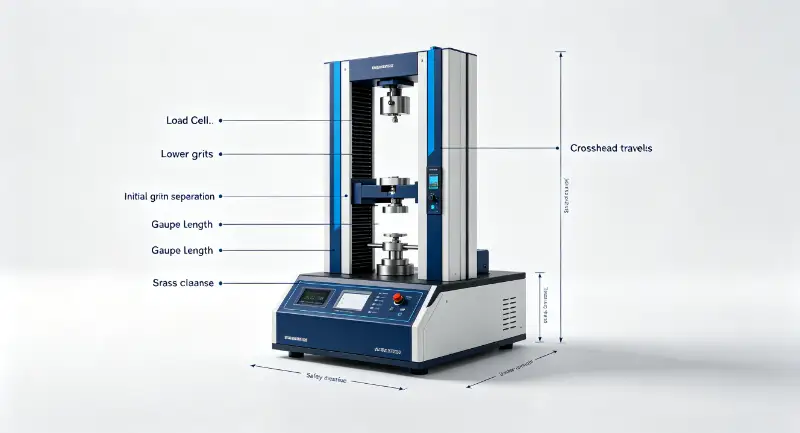
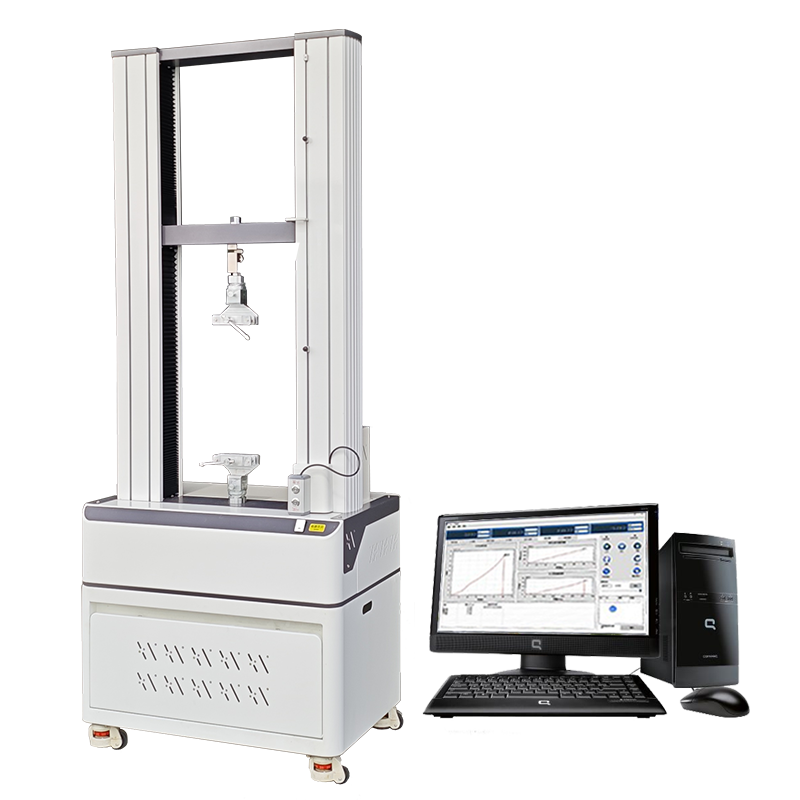
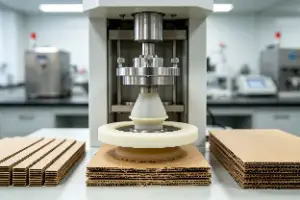
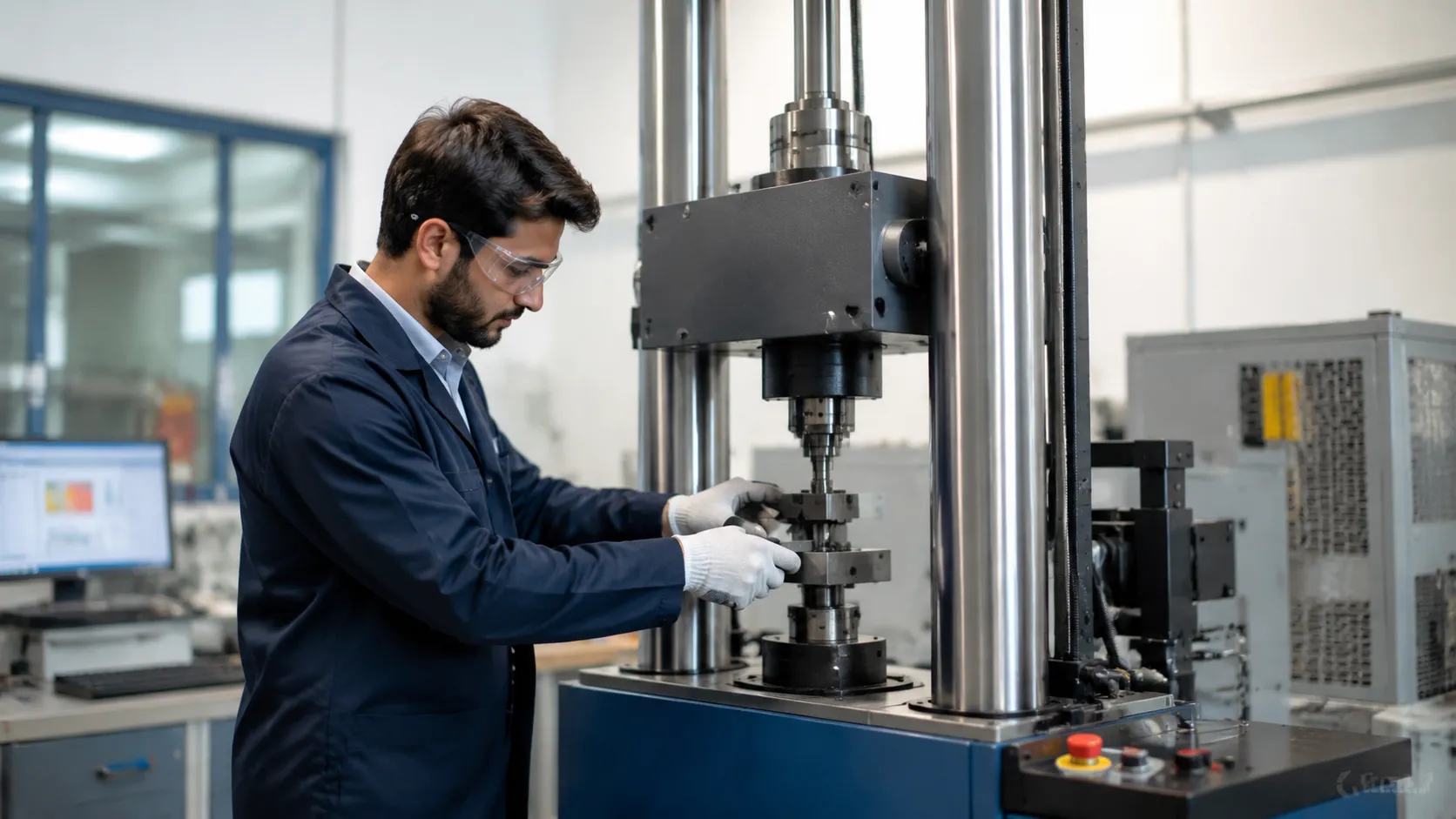
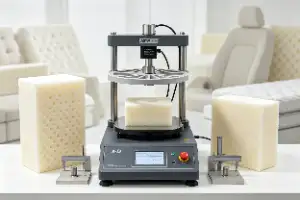
The Indentation Force Deflection (IFD) test - also known as Indentation Load Deflection (ILD) - measures the firmness of foam core materials used in mattresses. The test compresses a foam sample to 25% (IFD25) or 65% (IFD65) of its original thickness and records the force in Newtons.
For mattress applications, IFD25 indicates surface comfort firmness, while IFD65 characterizes the deep support layer. The ratio IFD65/IFD25 - called the support factor - indicates how well the foam resists compression under body weight. A support factor above 2.0 is considered high performance.
Standard: ASTM D3574 Test H, ISO 2439
Sample: 100mm x 100mm x 50mm (primary); 300mm x 300mm x 75mm (secondary)
Compression: 25% and 65% of original thickness
Cycle: 4 cycles, report 4th cycle value
Precondition: 23+/-2C, 50+/-5% RH, minimum 16 hours
2. Mattress Rollator Fatigue Tester
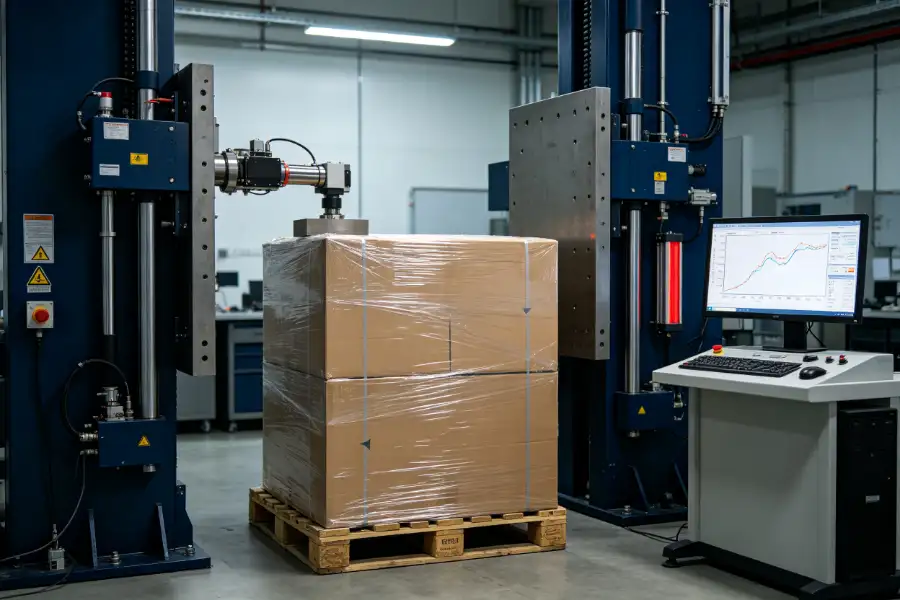
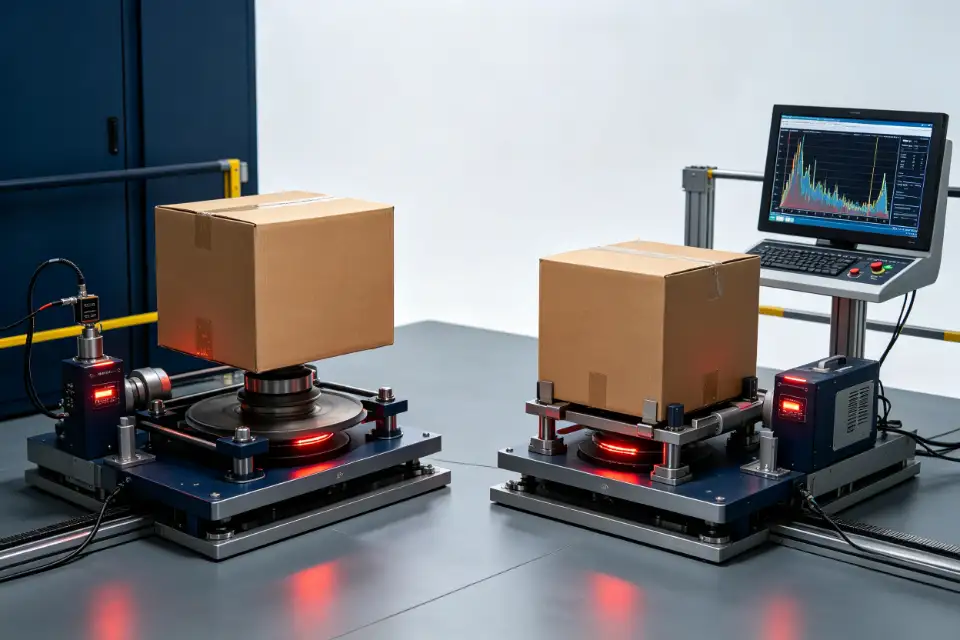
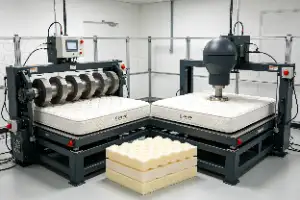
The rollator test simulates years of real-world use by repeatedly rolling a standardized drum across the mattress surface. This accelerated fatigue test reveals how quickly a mattress develops permanent impressions, loses thickness, and degrades in comfort.
Standard: ASTM D3574 Test H (90% IFD fatigue), QB/T 2914 (rollator)
A cylindrical roller (typically 50-80kg weight, 250-300mm wide) is rolled across the mattress surface for thousands of cycles. After the test, thickness loss, firmness loss, and visual impression depth are measured.
- QB/T 2914 Rollator: 30,000 cycles, 60kg roller, evaluates thickness loss and surface impression
- ASTM D3574 90% IFD: 80% compression fatigue, 25,000 cycles, evaluates force loss percentage
- EN 1957: European standard, simulates usage with specified roller geometry and cycle count
3. Mattress Firmness and Support Testing System
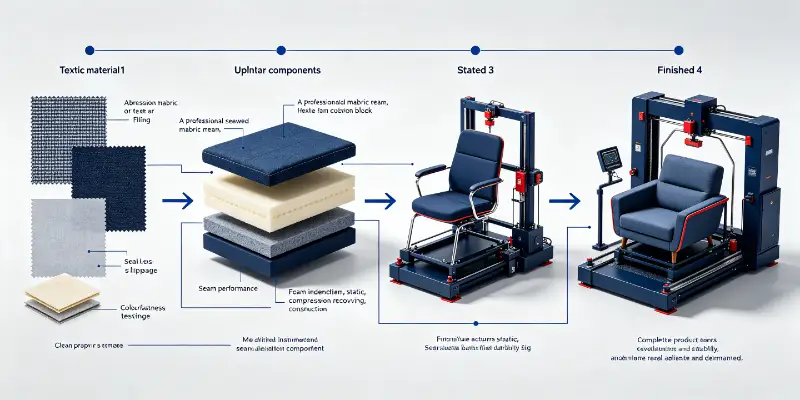
Beyond foam IFD, full mattress firmness testing measures the composite response of pillow-top layers, quilting, ticking, and support cores together. This is particularly important for innerspring mattresses and hybrid designs.
Testing systems use multiple load points to map the firmness profile across the entire sleeping surface, detecting firmness gradients, edge support weakness, and zoning irregularities.
4. Pressure Mapping System
While not a "hardness" test per se, pressure mapping systems complement firmness testing by visualizing how body weight distributes across the mattress surface. High-pressure zones indicate areas where the mattress may cause discomfort or restrict circulation.
5. Thickness and Dimension Gauge
Before and after fatigue testing, dimensional measurements confirm that the mattress maintains its intended thickness. Thickness loss exceeding 10% of original indicates inadequate durability.
Key Standards for Mattress Testing
| Standard | Region | Key Tests |
|---|---|---|
| ASTM D3574 | USA | IFD, CLD, 75% fatigue, 90% IFD fatigue, Ball Indentation |
| ISO 2439 | International | IFD, CLD, Ball Indentation, recovery |
| QB/T 2914-2007 | China | Rollator fatigue (30,000 cycles), IFD, thickness loss |
| EN 1957 | Europe | Rolling drum fatigue, hardness after fatigue |
| BS 4443 | UK | IFD, CLD, indentation, fatigue |
| 16 CFR 1632 | USA (federal) | Mattress fire retardancy - separate from hardness testing |
Testing Equipment Specifications
IFD Foam Firmness Tester
- Load range: 10N - 2000N (higher for automotive seating)
- Force accuracy: +/-0.5% of reading
- Displacement resolution: +/-0.01mm
- Compression speed: 50+/-5mm/min (per ASTM D3574)
- Crosshead: motorized with position control
- Data output: real-time force/displacement curve, peak values, IFD25/IFD65 ratio
Rollator Fatigue Tester
- Roller mass: 40kg - 100kg (adjustable)
- Roller width: 200mm - 400mm
- Stroke length: configurable per mattress size
- Cycle counter: digital, up to 99,999 cycles
- Speed: adjustable, typically 10-20 cycles/minute
- Safety: emergency stop, overload protection, cover guards
Industry-Specific Testing Applications
Mattress Manufacturers
Quality control testing for each production lot: foam core IFD sampling (every 100 units), rollator fatigue on new formulations, dimensional verification. Manufacturers typically target IFD65 retention above 85% after fatigue testing.
Automotive Seating
Car seat cushion testing requires higher force ranges (up to 5000N for heavy-duty truck seats) and stricter tolerance bands (+/-10N) than standard furniture applications. Automotive OEMs also require aging tests (heat, humidity) before production approval.
Medical and Healthcare
Hospital bed mattresses require testing for pressure redistribution (low pressure zone requirements), antimicrobial foam properties, and fire safety compliance (16 CFR 1632). Support surface testing may reference NPUAP/EPUAP standards for pressure ulcer prevention.
Furniture Retailers and Certification Labs
Third-party testing labs use standardized equipment to verify manufacturer claims. Testing reports with ASTM/ISO traceable calibration are required for CB scheme certification, CE marking, and major retailer approvals.
How to Choose Mattress Testing Equipment
Consider these factors when selecting testing equipment for your production or R&D facility:
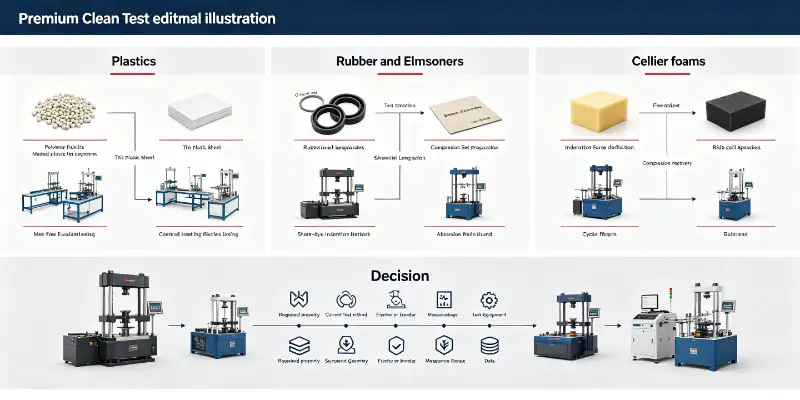
- Throughput requirements: High-volume production may require automated systems with batch processing capability
- Test standards: Ensure the equipment is designed for your target standards (ASTM D3574, ISO 2439, QB/T 2914)
- Force and displacement ranges: Match to your product range (lightweight memory foam vs heavy-duty HR foam)
- Calibration and traceability: ISO 17025 calibration traceability is essential for certification testing
- Software and data management: Cloud-connected systems with statistical analysis reduce manual processing
- Floor space and installation: Large rollator systems require significant floor space and foundation preparation
Troubleshooting Common Test Failures
| Problem | Possible Cause | Solution |
|---|---|---|
| IFD25 too high | Excessive isocyanate index; cure temperature too high | Reduce index by 2-5 points; lower press temperature |
| IFD25 too low | Water contamination; low index; expired chemicals | Check raw material moisture; verify TDI/MDI ratio |
| Fatigue thickness loss >15% | Low foam density; open cells; weak cell walls | Increase density by 5-10 kg/m3; adjust formulation |
| High IFD variance | Mix head imbalance; temperature gradient in block | Check mix head pressure balance; verify cure uniformity |
| Rollator roller slipping | Insufficient roller mass; low friction surface | Increase roller weight by 5-10kg; apply friction coating |
Certification and Compliance Requirements
Many mattress markets require third-party testing certification before products can be sold:
- China GB/T 27711: Requires QB/T 2914 fatigue testing for domestic mattress sales
- EU CE marking: EN 1957 testing required; EN 1335 for bed frames
- USA CertiPUR-US: Requires testing for emissions, durability, content
- UK BSI: BS 4443 and BS 5975 testing for domestic and contract mattresses