

ISO 3386 vs ASTM D3574: Understanding the Two Major Foam Compression Testing Standards
Date: May 8, 2026 Categories: Technical Guides & Blog Views: 2605
Excerpt:
ISO 3386 and ASTM D3574 are the two primary standards for foam compression testing. Learn the key differences, when to use each, and how to interpret results across both frameworks.
- ISO 3386 and ASTM D3574 are the two dominant international foam compression testing standards, each with distinct methodologies, units, and market applications
- ASTM D3574 is the primary standard for North American markets; ISO 3386 is required for European and most Asian market specifications
- The core difference is the measurement unit: IFD in Newtons (ASTM) vs. CLD in kPa (ISO), and specimen geometry differs significantly
- Results from ASTM D3574 and ISO 3386 are not directly interchangeable — conversion formulas provide approximate equivalence only
- Products sold in both markets should be tested to both standards to ensure compliance with each region's requirements
Why Two Major Foam Standards Exist
The global flexible polyurethane foam industry developed testing standards in parallel across different regions, resulting in two comprehensive and widely accepted frameworks: ASTM D3574 in North America and ISO 3386 in Europe and much of the international market. While both standards measure foam firmness under compression, they use different methodologies, units, specimen geometries, and reporting conventions that reflect regional engineering traditions and industry practices.
Understanding the differences between these standards is essential for foam manufacturers serving global markets, product companies sourcing foam internationally, and testing laboratories that need to accurately interpret specifications from different regions.
You cannot directly substitute an ISO 3386 CLD result for an ASTM D3574 IFD result, or vice versa. The different specimen geometries (50mm vs 100mm+ thickness), different indentor configurations, and different measurement conventions mean the numbers are not comparable without careful analysis. Always test to the specific standard required by your specification or customer.
ASTM D3574: The North American Standard
Overview and History
ASTM D3574 is published by ASTM International (formerly the American Society for Testing and Materials). It is the dominant foam testing standard in North America and is referenced by virtually all major US furniture, bedding, automotive, and packaging specifications. The standard was first published in the 1970s and has been revised multiple times to reflect industry developments. It covers flexible polyurethane foam in both slab and moulded forms.
Test Sections of ASTM D3574
ASTM D3574 consists of multiple test procedures (Sections A through I), each covering a different property:
IFD Measurement (Sections A and B)
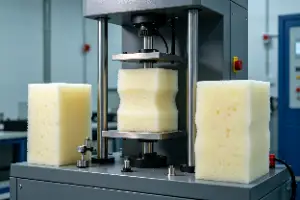
IFD (Indentation Force Deflection) is the primary firmness measurement in ASTM D3574. A 100mm diameter circular indentor compresses the foam specimen to 25% of its original thickness (Section A) and then to 65% of original thickness (Section B). The force required is recorded in Newtons (N). The ratio of 65% IFD to 25% IFD is the support factor.
ISO 3386: The International Standard
Overview and History
ISO 3386 is published by the International Organization for Standardization (ISO) and is the primary foam testing standard in European, Asian, and international markets. It consists of two parts: ISO 3386-1 (stress-strain relationship and compression load deflection) and ISO 3386-2 (Cold flex testing). The standard was developed to harmonize testing methods across national borders and is referenced by European Norm (EN) standards that adopt it as the European testing method.
ISO 3386-1: Compression Load Deflection
The primary measurement in ISO 3386-1 is Compression Load Deflection (CLD), expressed in kilopascals (kPa). CLD measures the stress (force per unit area) required to compress the foam to a specified percentage of its original thickness. Standard measurement points are 25% and 40% deflection.
ISO 3386-2: Cold Flex Testing
ISO 3386-2 measures the cold flex resistance of flexible foam — specifically the force required to cause cracking or breaking of the foam when bent at low temperatures (-10C to -40C). This test is particularly relevant for automotive foams that may be exposed to cold conditions in unheated vehicles.
Head-to-Head Comparison
| Parameter | ASTM D3574 | ISO 3386-1 |
|---|---|---|
| Region | North America (primary) | Europe, Asia, International |
| Primary Unit | IFD in Newtons (N) | CLD in kPa |
| Specimen Thickness | 50 mm minimum | 50 mm minimum |
| Specimen Area | 380 x 380 mm standard | 200 x 200 mm or 380 x 380 mm |
| Indentor Diameter | 100 mm | 200 mm |
| Primary Deflection Points | 25% and 65% | 25% and 40% |
| Support Factor Calculation | IFD 65% / IFD 25% | CLD 40% / CLD 25% |
| Test Speed | Controlled 50-300 mm/min | Controlled 50-500 mm/min |
| Fatigue Test | Section C: 80,000 cycles | Referenced separately (ISO 3385) |
| Temperature Range | Standard conditions (23C, 50% RH) | Standard conditions (23C, 50% RH) |
Converting Between Standards: Is It Possible?
While ASTM D3574 and ISO 3386 measure the same fundamental property (foam firmness under compression), direct numeric conversion is not straightforward due to the geometric and methodological differences. However, approximate correlations have been established through inter-laboratory studies:
- IFD 25% (N) to CLD 25% (kPa): For a 380x380x50mm specimen, IFD (N) divided by specimen area (0.1444 m²) gives approximately the CLD value in kPa. Example: 200N / 0.1444 m² = 1,385 Pa = 1.39 kPa — but this is theoretical and may differ from actual measured CLD due to indentor size differences.
- Indentor area effect: The 100mm ASTM indentor creates higher local stress than the 200mm ISO indentor at the same percentage deflection, which partially compensates for the area difference in the calculation.
- Industry rule of thumb: A foam with 25% IFD of 180N typically corresponds to approximately 3.5-4.5 kPa CLD at 40%, but this varies by foam type and formulation.
ge">
If your customer specifies a minimum firmness value, you must test to the standard they specify — you cannot substitute a converted result from the other standard. Conversion formulas are useful only for rough estimating during product development. Always confirm compliance by testing to the exact standard your customer or specification requires.
Fatigue Testing: Section C vs. ISO 3385
Both ASTM D3574 and ISO 3386 address foam fatigue, but through different methodologies and companion standards:
ASTM D3574 Section C: Static Fatigue (Cyclic Compression)
Uses 50mm thick, 380x380mm specimens compressed to 50% of original thickness for 80,000 cycles at a maximum rate of 20 cycles per minute. IFD is re-measured after fatigue to calculate percentage loss. This is the most widely referenced fatigue test in North American foam specifications.
ISO 3385: Constant Amplitude Cyclic Compression
The ISO equivalent covers similar cyclic compression fatigue testing. Parameters (compression level, cycle count, rate) are specified in the standard and may differ from ASTM D3574 requirements. Some OEM specifications reference ISO 3385 explicitly for European supplier qualification.
Which Standard Should You Use?
Use ASTM D3574 When:
- Your customer or specification explicitly requires ASTM D3574
- You are selling foam or foam-containing products in North America
- You are qualifying for CertiPUR-US, BIFMA, CAL 117, or other US market certifications
- Your target OEM is Ford, GM, Chrysler, or a major US furniture brand
Use ISO 3386 When:
- Your customer or specification explicitly requires ISO 3386 or EN standards
- You are selling foam or foam-containing products in Europe, Asia, or international markets
- You are qualifying for OEKO-TEX, EU Ecolabel, or European automotive OEM specs
- Your target OEM is Volkswagen, BMW, Toyota, or a major European/Asian brand with ISO requirements
Test to Both When:
- Your products will be sold in both North American and European/international markets
- You are a foam supplier to furniture or mattress brands with global supply chains
- You want to broaden your market reach and demonstrate international compliance
- Your customer specifications explicitly reference both standards
Other Standards Related to Foam Compression Testing
- BS 4443 (UK): British Standards Institution specification for flexible polyurethane foam. Adopts methods similar to ISO 3386 with some UK-specific variations. Widely used in the UK and former British Commonwealth markets.
- EN 1021-1/-2 (Europe): Furniture flammability standards that reference foam testing indirectly through cover fabric-substrate interaction tests. Not a compression test but often required alongside ISO 3386 for European furniture compliance.
- ISO 2439: Alternative ISO method for IFD measurement with different indentor geometries. Some European automotive specifications reference ISO 2439 in addition to or instead of ISO 3386.
- JIS K6400 (Japan): Japanese Industrial Standards for flexible cellular plastics, with methods similar to ISO 3386. Relevant for foam suppliers serving the Japanese market.
Frequently Asked Questions
What is the support factor in each standard?
Support factor (also called comfort factor) is the ratio of firmness at deeper compression to firmness at surface compression. In ASTM D3574, support factor = IFD 65% / IFD 25%. In ISO 3386, support factor = CLD 40% / CLD 25%. A support factor above 1.8-2.0 indicates the foam becomes progressively firmer under load — a desirable quality for mattresses and seat cushions. The different deflection points (65% vs. 40%) mean the numerical support factor values may differ between standards for the same foam.
Can I use the same testing equipment for ASTM D3574 and ISO 3386?
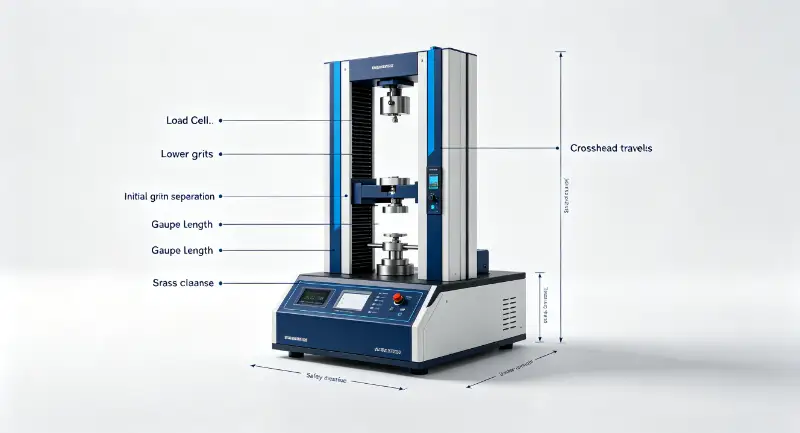
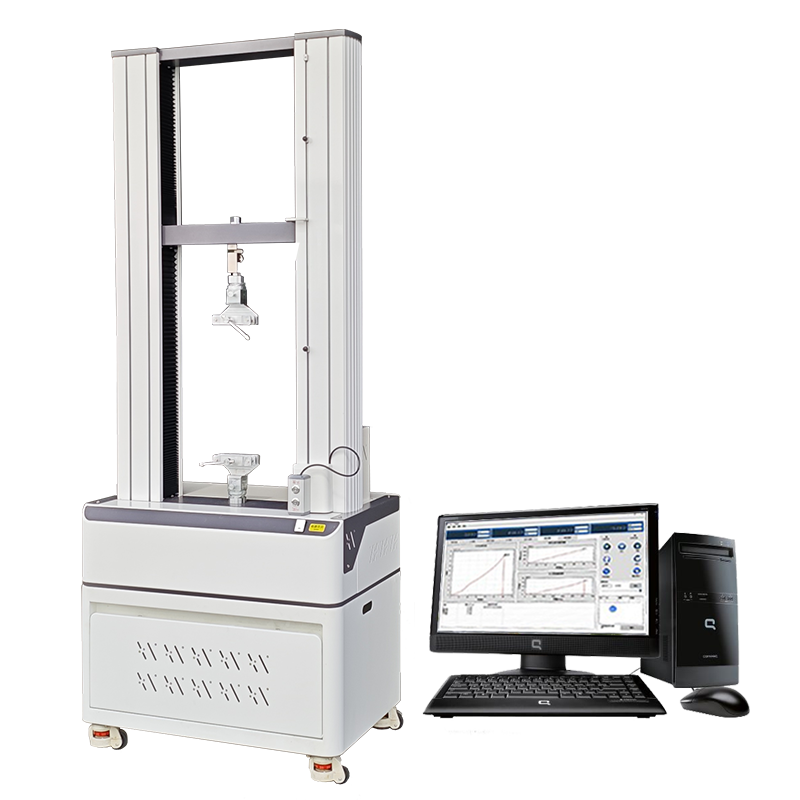
Yes, the same IFD/CLD tester can perform both ASTM D3574 and ISO 3386 tests with software configuration changes and different indentor feet. ASTM D3574 requires the 100mm indentor foot; ISO 3386 requires the 200mm indentor foot. Many testing machines are supplied with both indentors. Always verify that the machine's software can calculate both IFD (N) and CLD (kPa) results, and that the crosshead speed range covers both standards (ASTM typically runs slower).
Why does ISO 3386 use 40% deflection instead of 65%?
ISO 3386 was developed with a different engineering tradition than ASTM D3574. European standards were historically designed to characterize foam behaviour at moderate compression levels rather than the very deep 65% compression used in ASTM. The 40% deflection point was chosen as a practical mid-range measurement. Both approaches measure the same underlying material behaviour — they simply use different reference points. Some ISO standards do reference 65% deflection for specific applications (e.g., automotive).
What specimen thickness does each standard require?
ASTM D3574 requires a minimum thickness of 50mm for standard IFD testing. Thinner specimens may give artificially high IFD values because the indentor approaches the table surface. ISO 3386 also specifies 50mm minimum thickness, with 100mm recommended for very soft foams to avoid bottom-out effects. Always test specimens at the actual thickness planned for the production foam application — different thicknesses of the same foam will give different IFD/CLD values.
How do I know which standard my customer requires?
Check the purchase specification or material data sheet your customer has provided. Look for the standard number (ASTM D3574 or ISO 3386) in the "Test Methods" section. If no standard is specified, ask your customer directly. For mattress and furniture sold in major retail channels, ASTM D3574 is the default for US sales; ISO 3386 or EN standards are the default for European sales. Some global brands maintain separate specifications for each regional market.
What is the relationship between IFD and ILD?
IFD (Indentation Force Deflection) and ILD (Indentation Load Deflection) are the same measurement expressed in different units. IFD is measured in Newtons (SI units); ILD is measured in pounds-force (lbf, Imperial units). A foam with an IFD of 200N has an ILD of approximately 45 lbf. ASTM D3574 reports in IFD (Newtons); older US industry specifications and some commercial material data sheets may still use ILD. Always check which unit your specification requires.
Are ASTM D3574 and ISO 3386 being harmonized?
ASTM and ISO are separate organizations and there is no active harmonization program between D3574 and 3386. However, both standards are periodically revised and updated, and some individual test method details have converged over time (e.g., conditioning requirements). The fundamental structural differences in specimen geometry and units mean that full harmonization is unlikely in the near future. Manufacturers serving global markets must continue to maintain compliance with both standards.
Conclusion
ASTM D3574 and ISO 3386 are both comprehensive, well-established foam testing standards that serve the global foam industry. The choice between them is primarily driven by your target market: North American buyers default to ASTM D3574; European and most international buyers require ISO 3386. Both standards provide the data needed to specify, quality control, and certify foam performance — they simply use different methodologies and reporting conventions.
For foam manufacturers and product companies with global supply chains or international sales, testing to both standards is the most robust approach. This ensures compliance with regional specifications, enables broader market access, and provides customers in every market with the test data they require for their own quality assurance and certification programs.
Need help understanding which foam testing standard applies to your products, or selecting the right testing equipment to meet both ASTM D3574 and ISO 3386 requirements? Our technical team can provide guidance on standard interpretation, equipment selection, and testing procedures.
Related Testing Guides
Need help with ASTM D3574 or ISO 3386 testing equipment or procedures? Contact our technical team for personalized guidance.