
ASTM D3574 Testing Guide: Complete Methods, Equipment, and Compliance
Date: May 8, 2026 Categories: Technical Guides & Blog Views: 1927
Excerpt:
Complete guide to ASTM D3574 test methods for flexible polyurethane foam. Learn every test procedure, equipment requirements, and compliance tips.
────
Key Takeaways
- ASTM D3574 covers 8 test methods covering IFD, compression, tensile, tear, fatigue, and loss in height for polyurethane foam
- Test A (IFD) and Test D (Compression Set) are the most commonly performed — both require specific sample dimensions and conditioning
- Crosshead speed accuracy is critical for compliance — ASTM D3574 mandates 25 mm/min for compression and 50 mm/min for return
- Sample preconditioning at 23°C ± 2°C and 50% ± 5% RH for a minimum of 16 hours is mandatory before testing
- Complete documentation of test parameters, sample preparation, and environmental conditions is required for valid results
ASTM D3574 Testing Guide: Complete Methods, Equipment, and Compliance
ASTM D3574 is the definitive standard for testing flexible urethane cellular plastics — commonly known as polyurethane foam. Published by ASTM International, it defines a comprehensive suite of 8 test methods that cover virtually every mechanical property a foam manufacturer or quality control laboratory needs to measure.
Whether you're qualifying raw materials, validating production batches, or providing third-party testing services, ASTM D3574 compliance is typically non-negotiable. This guide walks through each test method, the equipment required, sample preparation requirements, and how to ensure your laboratory meets the standard's stringent procedural requirements.
Overview of ASTM D3574 Test Methods
The ASTM D3574 standard comprises eight distinct test procedures, each measuring a different physical property of flexible cellular urethane plastics. Not every lab needs to perform all eight — the tests you conduct depend on your product application, customer requirements, and target market regulations.
| Test Method | Property Measured | Common Applications |
|---|---|---|
| Test A | IFD — Indentation Force Deflection | Firmness rating, quality control, spec compliance |
| Test B | IFD — with 30-second dwell | Mattress and seating foam evaluation |
| Test C | CLD — Constant Load Deflection | Settled firmness under sustained load |
| Test D | Compression Set | Durability, long-term performance prediction |
| Test E | Tensile Strength and Elongation | Structural integrity, tear resistance |
| Test F | Tear Force | Cutting, fabrication, edge strength |
| Test G | Compression Force Deflection (CFD) | Load-bearing capacity at deflection depths |
| Test H | Loss in Height (Fatigue) | Long-term fatigue resistance, ILD loss under cyclic loading |
Test A: Indentation Force Deflection (IFD)
Test A is the most widely performed ASTM D3574 procedure. It measures the force required to compress a foam sample to 25% and 40% of its original thickness, providing a direct, quantifiable measure of foam firmness.
Sample Requirements
- Dimensions: 50 mm × 50 mm × 100 mm (thickness measured perpendicular to rise direction)
- Quantity: Minimum 3 specimens per sample set
- Conditioning: 16 hours minimum at 23°C ± 2°C and 50% ± 5% relative humidity
Test Procedure
- Place the conditioned specimen flat on the compression platen, centered under the indenter foot
- Pre-load the specimen to 4.5 N ± 0.1 N to establish zero reference point
- Compress at 25 ± 2 mm/min crosshead speed to 25% of original thickness
- Record the force reading at 25% compression
- Return the crosshead to the pre-load position at 50 ± 5 mm/min
- Hold for 60 seconds to allow material recovery
- Repeat compression to 40% of original thickness at the same speed
- Record the force reading at 40% compression
- Return crosshead and hold for another 60 seconds
Calculation and Reporting
IFD results are reported as the average force in Newtons (N) or pounds-force (lbf) at both 25% and 40% compression for each specimen. The overall sample result is the median of all valid tests. Report format should include:
- Individual specimen readings (25% and 40%)
- Calculated median for the sample set
- Sample dimensions and conditioning duration
- Crosshead speed verification
- Environmental conditions during testing
Test D: Compression Set
Compression Set measures how much permanent deformation a foam sample retains after being compressed to a specified percentage of its original thickness and held at elevated temperature for a defined period. It is one of the most predictive indicators of long-term foam performance in real-world applications.
Test D Specimens and Deflection Levels
- Method A — 50% deflection: Used for low-density foams and cushioning applications
- Method B — 50% deflection at 70°C for 22 hours: Standard elevated temperature test
- Method C — 75% deflection: For high-compression applications and mattress foams
- Method D — 90% deflection: Severe service conditions, automotive seating
Key Equipment Requirements
Critical equipment capabilities for ASTM D3574 Compression Set testing:
- Precision compression platens (minimum 100mm × 100mm)
- Force measurement accuracy: ±1% or better
- Crosshead speed accuracy: ±5 mm/min at 25 mm/min
- Environmental chamber capable of 70°C ± 1°C for Method B
- Thickness measurement accurate to ±0.1mm
Compression Set Calculation
The compression set percentage is calculated as:
Compression Set (%) = [(t₀ - t₁) / t₀] × 100
Where: t₀ = original thickness before compression, t₁ = recovered thickness 30 minutes after release. Lower compression set values indicate better recovery — a premium quality foam should show compression set below 10% under Method B conditions.
Test H: Loss in Height (Fatigue by Distributed Loading)
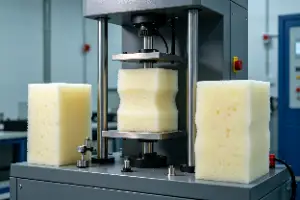
Test H measures the change in foam thickness after repeated compression cycles. It simulates real-world use conditions where foam is subjected to continuous loading and unloading — seating, mattresses, and automotive interiors are the most common applications.
Test H Procedure
- Measure initial thickness (t₀) of conditioned specimen
- Apply 50% compression deflection using the specified 330mm diameter indenters
- Cycle at a rate of 50-55 cycles per minute for 50,000 cycles
- Following the fatigue cycling, condition for 30 minutes at standard conditions
- Measure post-fatigue thickness (t₁)
- Calculate percent loss in height: [(t₀ - t₁) / t₀] × 100
Premium foam products typically show less than 5% loss in height after 50,000 cycles. Higher values indicate materials that will lose support characteristics faster in real-world use — a critical quality parameter for furniture and mattress manufacturers.
Required Equipment for ASTM D3574 Compliance
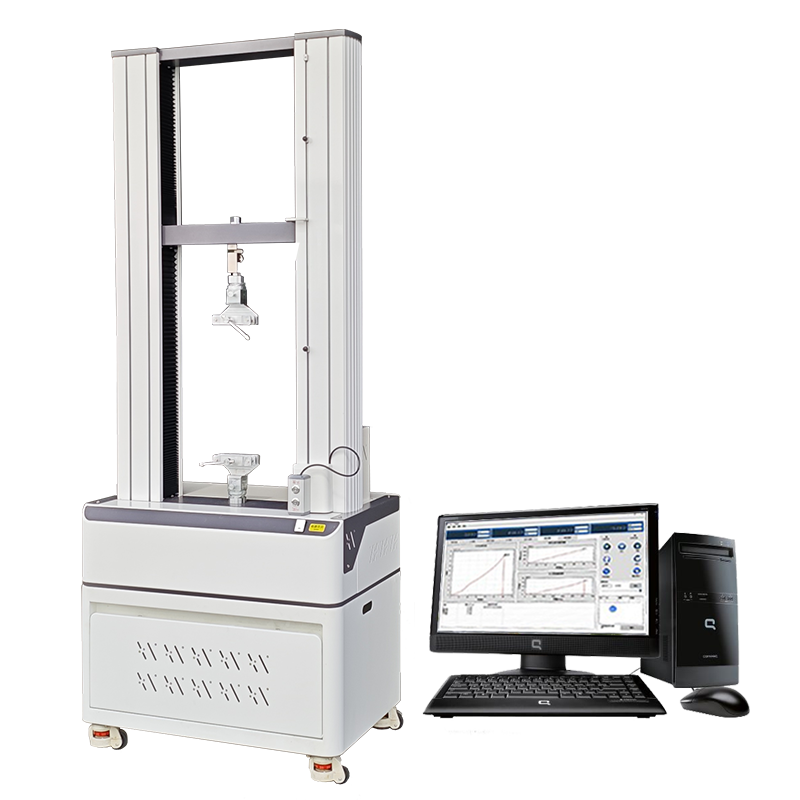
Universal Testing Machine (UTM)
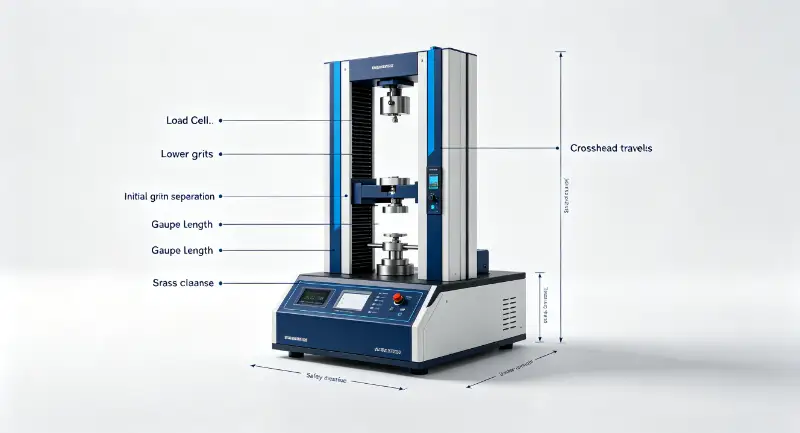
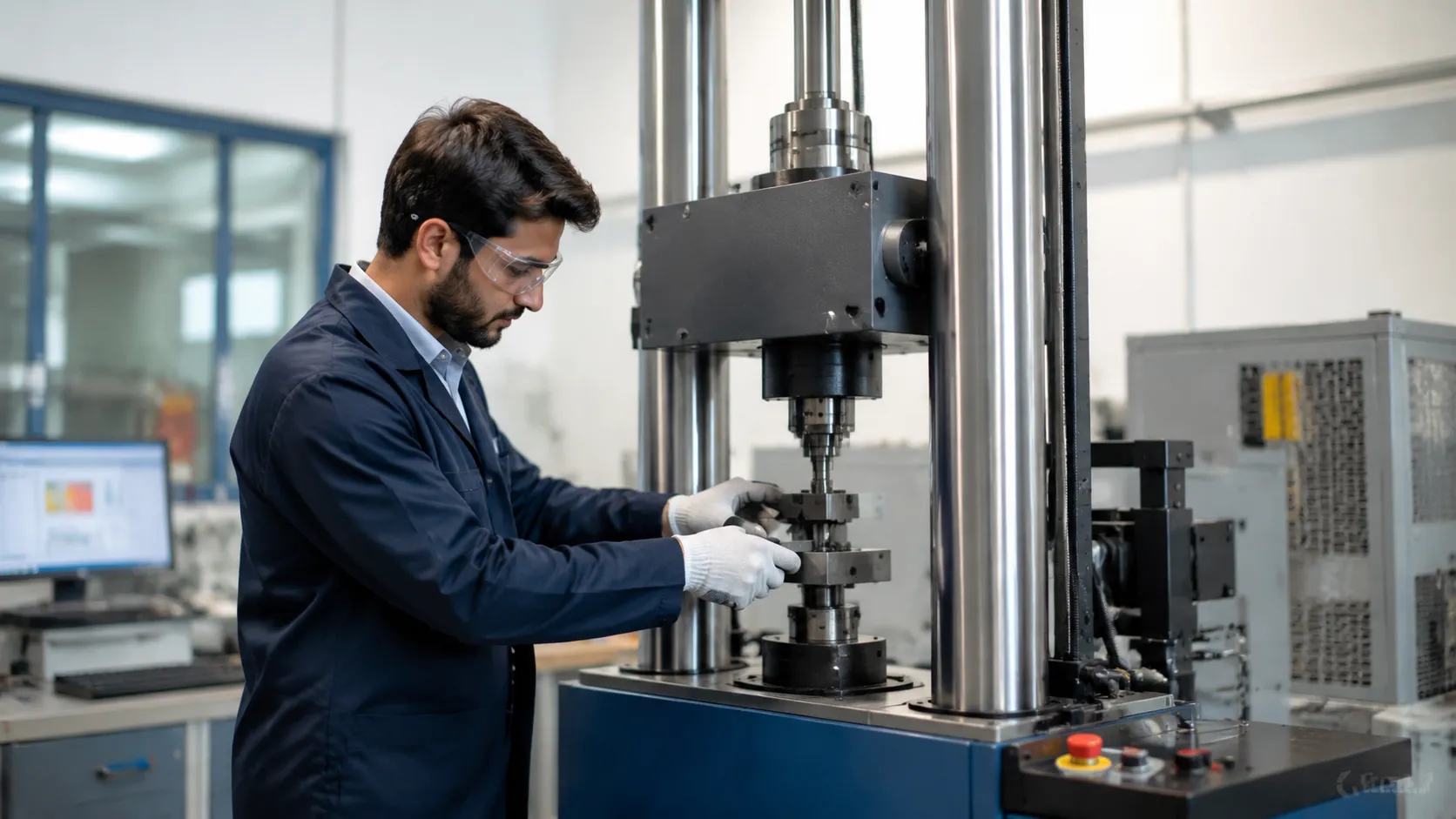
A UTM with compression testing capability is the core piece of equipment for most ASTM D3574 procedures. Requirements include:
- Minimum capacity: 5,000 N (for most standard foam testing)
- Crosshead speed range: 0.5-500 mm/min with ±1% accuracy
- Force measurement: ±0.5% of reading or better
- Platen size: minimum 200mm × 200mm (300mm recommended)
- Digital controller with data logging capability
Environmental Chamber / Conditioning Room
Temperature and humidity control is not optional — it's a mandatory part of the standard. Requirements:
- Temperature: 23°C ± 2°C (and elevated temperature capability for Compression Set)
- Relative humidity: 50% ± 5%
- Air circulation to ensure uniform conditions throughout the chamber
- Data logger to record actual conditions during conditioning
Calibration and Verification
ASTM D3574 requires documented verification of equipment performance. Your calibration program should include:
- Annual force calibration against NIST-traceable reference standards
- Quarterly crosshead speed verification
- Monthly platen flatness inspection
- Thickness gauge calibration at each use (or per batch)
Common Compliance Pitfalls and How to Avoid Them
Pitfall 1: Insufficient Preconditioning Time
Many labs rush the conditioning step, testing specimens before they've reached equilibrium with the laboratory environment. The 16-hour minimum exists because foam is hygroscopic — it absorbs and desorbs moisture, which directly affects both its mechanical properties and mass. Insufficient conditioning produces variable, non-representative results.
Pitfall 2: Incorrect Crosshead Speed
ASTM D3574 specifies 25 mm/min for compression and 50 mm/min for return. Machines that cannot maintain these speeds within the specified tolerances will produce results that do not comply with the standard. Speed verification should be performed with an independent measurement method, not rely solely on the machine's internal encoder.
Pitfall 3: Wrong Sample Orientation
Foam is anisotropic — its properties differ depending on the direction of loading relative to the foam rise direction. Test specimens must be cut with the thickness dimension perpendicular to the foam rise. Loading in the wrong direction can produce IFD readings that differ by 15-30% from the correct orientation.
Interpreting Your Test Results
ASTM D3574 provides specification ranges, but the actual acceptance criteria depend on your product requirements and customer specifications. Here's how to interpret common results:
| Test | Typical Polyurethane Mattress Foam | High-Density Seating Foam | Packaging/Industrial Foam |
|---|---|---|---|
| IFD @ 40% (N) | 100-220 N | 200-450 N | 50-150 N |
| Compression Set (%) | <10% | <8% | <15% |
| Loss in Height (%) | <5% | <8% | <10% |
| Tensile Strength (kPa) | 80-150 kPa | 100-200 kPa | 50-100 kPa |
ASTM D3574 vs. ISO 2439: Which Standard Applies?
ASTM D3574 and ISO 2439 both address foam indentation testing, but they differ in significant ways. Your choice depends primarily on your target market:
- United States: ASTM D3574 is the dominant standard — most U.S. customers, particularly in furniture, bedding, and automotive, require ASTM D3574 results
- Europe and Asia-Pacific: ISO 2439 is the accepted standard — required for CE marking and most export documentation
- Dual compliance: Many manufacturers perform both standards on the same equipment by following the more stringent requirements of both
Key difference in indentation tests:
ASTM D3574 Test A uses a 50mm × 100mm rectangular indenter foot with a flat plate. ISO 2439 uses a 100mm diameter circular indenter. The difference in contact area affects the force reading — direct comparison between standards requires conversion factors.
Summary: Your ASTM D3574 Compliance Checklist
- ☐ UTM with force accuracy ±0.5% or better and crosshead speed ±1%
- ☐ Compression platens minimum 200mm × 200mm
- ☐ Environmental chamber at 23°C ± 2°C, 50% ± 5% RH
- ☐ Elevated temperature capability for Compression Set testing (70°C)
- ☐ Thickness measurement accurate to ±0.1mm
- ☐ 16-hour minimum conditioning time documented for each test batch
- ☐ Sample preparation records showing specimen dimensions and orientation
- ☐ Annual force calibration certificate (NIST-traceable)
- ☐ Crosshead speed verification records
- ☐ At least 3 specimens per test, results reported as median
Need ASTM D3574 Equipment or Testing Services?
Whether you're setting up a new testing laboratory or need third-party ASTM D3574 testing services, our team can help. We offer a complete range of foam testing equipment including universal testing machines, compression fixtures, environmental chambers, and complete turnkey laboratory solutions.
Contact our technical team for equipment recommendations, testing service pricing, and laboratory design consultation.
Related Testing Guides
Need help with your foam testing equipment? Contact our team for product recommendations and pricing.