

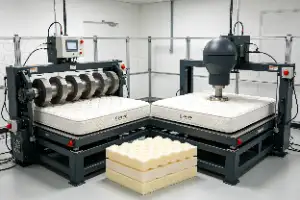
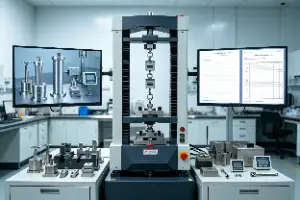
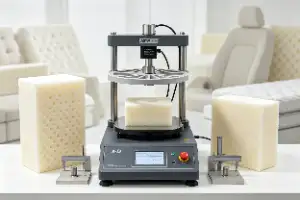
How to Choose the Right Foam Compression Tester for Your Lab: 2025 Buyer's Guide
Date: May 8, 2026 Categories: Technical Guides & Blog Views: 6245
Excerpt:
Learn how to choose the right foam compression tester for your lab. Compare ASTM D3574 standards, load capacities, and key features in this complete buyer's guide.
────
Key Takeaways
- Foam density (kg/m³ or lb/ft³) is the single most important factor determining foam quality, durability, and cost — it directly affects every mechanical property
- ASTM D3574 and ISO 845 provide the standard methods for measuring foam density, with the water displacement method being the most accurate for open-cell foams
- Higher density doesn't always mean better performance — the relationship between density and IFD, tensile strength, and compression set depends on the foam formulation
- Apparent density vs. true density: surface skin on foam sheets makes thickness-cut samples read higher than bulk material — use the correct sampling method
- Density testing is fast, inexpensive, and provides the foundation for all other foam quality control measurements
Foam Density Testing Methods: How to Measure and Why It Matters
If you could only measure one property of a foam sample, density is the one to choose. It's the most fundamental indicator of foam quality — a property that correlates directly with virtually every other mechanical characteristic including firmness, durability, tensile strength, and compression set. It's also the single most reliable predictor of foam cost, since density determines how much raw material goes into each cubic meter of finished foam.
This guide covers the standard density measurement methods according to ASTM D3574 and ISO 845, the equipment required, common pitfalls in measurement, and how to interpret your results for product specification and quality control.
What Foam Density Actually Measures
Foam density is the mass per unit volume of the foam material, expressed in kilograms per cubic meter (kg/m³) in SI units or pounds per cubic foot (lb/ft³) in US customary units. Unlike solid materials where density is uniform, foam density has two components that are important to understand:
- Open-cell foam density: The mass of the solid polymer plus the air trapped in the open cells, divided by the total foam volume including the cell air space
- Closed-cell foam density: When cells are closed, the air inside doesn't escape, creating different buoyancy effects during measurement
For quality control purposes, we measure apparent density — the density based on the total external dimensions of the specimen. This is the most practical measurement for production QC and is what both ASTM D3574 and ISO 845 specify.
Density Unit Conversion
To convert between units:
- kg/m³ to lb/ft³: multiply by 0.062428
- lb/ft³ to kg/m³: multiply by 16.018463
Example: 30 kg/m³ × 0.062428 = 1.87 lb/ft³
Standard Density Measurement Methods
Method 1: Dimensional Measurement (ASTM D3574)
The most straightforward method — measure the specimen dimensions, determine its mass on a precision scale, and calculate density:
- Cut foam specimen to known dimensions (minimum 50mm × 50mm × 25mm recommended)
- Condition specimen at 23°C ± 2°C, 50% ± 5% RH for minimum 16 hours
- Measure dimensions to ±0.1mm — measure length, width, and thickness at three points each, calculate average
- Weigh specimen on analytical balance to ±0.01g
- Calculate: Density = Mass (g) / Volume (cm³) × 1000 = kg/m³
Method 2: Water Displacement (ISO 845)
For open-cell foams, the water displacement method is more accurate because it accounts for the true foam volume including surface irregularities. The specimen is weighed in air and then weighed while submerged in water:
- Weigh conditioned specimen in air (W₁) on analytical balance
- Completely submerge specimen in water at 23°C ± 1°C using a thin wire support
- Weigh submerged specimen (W₂) — this is the buoyant force equivalent
- Volume = (W₁ - W₂) / (ρ_water) where ρ_water ≈ 0.998 g/cm³ at 23°C
- Density = W₁ / Volume
Important: For closed-cell foams, the water displacement method will give incorrect results because the enclosed air provides buoyancy. Use dimensional measurement for closed-cell materials.
Dimensional Measurement: Detailed Procedure
Sample Size Considerations
The size of your specimen affects measurement accuracy. Larger specimens reduce the impact of cutting errors, but practical considerations (balance capacity, handling) limit maximum size. Recommended minimum:
- Minimum size: 50mm × 50mm × 25mm — adequate for production QC
- Preferred size: 100mm × 100mm × 50mm — reduces cutting error impact
- Large specimens: 200mm × 200mm × 50mm — best for acceptance testing and certification
Step-by-Step Measurement Procedure
- Cut the specimen: Use a sharp knife or band saw. Avoid compressing the foam during cutting. Cut perpendicular to the foam rise direction for the thickness measurement.
- Condition: Place in standard environment (23°C ± 2°C, 50% ± 5% RH) for minimum 16 hours
- Measure dimensions: Use digital calipers accurate to ±0.1mm. Measure length and width at three points each (center, left, right for length; top, middle, bottom for width). Measure thickness at five points (four corners and center). Calculate averages.
- Weigh the specimen: Use an analytical balance accurate to ±0.01g. Record the mass in grams.
- Calculate volume: Volume = (average length) × (average width) × (average thickness), in cm³
- Calculate density: Density (kg/m³) = Mass (g) / Volume (cm³) × 1000
Example Calculation
Specimen dimensions: L = 100.2mm, W = 100.4mm, T = 50.1mm = 10.02cm × 10.04cm × 5.01cm = 505.1 cm³
Mass: 15.76g
Density = 15.76 / 505.1 × 1000 = 31.2 kg/m³
Interpreting Density Results
Density Ranges by Application
| Application | Typical Density (kg/m³) | Notes |
|---|---|---|
| Packaging / Void Fill | 10-18 kg/m³ | Single-use; cost-driven |
| Standard Cushioning | 18-30 kg/m³ | Consumer furniture, general use |
| Premium Comfort | 30-50 kg/m³ | Mattress comfort layers, high-end seating |
| High-Performance / Medical | 50-100+ kg/m³ | Specialty applications, high load-bearing |
Density vs. IFD: The Critical Relationship
Density and IFD are correlated but not interchangeable. Two foam samples with the same density can have very different firmness (IFD) depending on their cell structure, formulation, and processing. Conversely, two samples with the same IFD can have very different densities.
The relationship is: Higher density generally produces higher IFD, but the ratio varies with foam type. A high-resilience (HR) foam at 30 kg/m³ may have an IFD of 120N, while a conventional foam at the same density might show 180N IFD due to different cell structure. This is why both properties must be measured independently.
Quality Control Tip — Track Density Trends:
Measure density on every production batch. A gradual drift in average density over weeks or months is often the first indicator of a formulation or processing problem — before it shows up in IFD, tensile, or compression set results. Density measurement is fast enough (5 minutes per sample) to be used as a screening tool on every batch.
Equipment for Foam Density Testing
Analytical Balance
Requirements:
- Capacity: Minimum 200g (to accommodate larger specimens)
- Readability: 0.01g or better (0.001g preferred for precision work)
- Repeatability: ±0.01g
- Calibration: NIST-traceable, annual verification
Digital Calipers
Requirements:
- Range: 0-150mm minimum (0-200mm preferred)
- Resolution: 0.01mm (0.05mm is insufficient for precision work)
- Accuracy: ±0.02mm
- Jaws: Minimum 40mm depth for measuring foam thickness
Environmental Chamber / Room
Required for proper conditioning. Can be a dedicated chamber or a controlled laboratory room. Must maintain 23°C ± 2°C and 50% ± 5% RH with documented uniformity. Data logger recommended to record actual conditions during each conditioning period.
Common Density Measurement Errors
Error: Measuring Too Close to the Foam Skin
The outer surface of slab foam develops a skin during production — this skin is denser than the foam interior because it quenches against the mold surface. If your specimen is cut from near the surface (within 10-15mm), you may get artificially high density readings. Always cut from the interior of the foam block, away from surface skins.
Error: Not Accounting for Sample Thickness
Thinner samples have a higher surface-to-volume ratio, so the skin effect is proportionally larger. For thin slab foam (less than 25mm), use larger specimens to minimize the skin contribution to the overall measurement. Alternatively, use the water displacement method which is less sensitive to surface skin variations.
Error: Weighing Before Full Conditioning
Foam absorbs and releases moisture rapidly. A specimen that hasn't reached equilibrium with the laboratory environment will have a different mass than its fully conditioned state. Humidity variations of even 5-10% RH produce measurable changes in foam mass. Always condition for the full 16 hours minimum and weigh immediately after removing from the conditioning environment.
Density as a Quality Control Tool
Beyond individual measurements, density data tracked over time provides powerful quality control insights. Here's how to use density testing strategically:
Batch-to-Batch Consistency
Record density for every batch and calculate the rolling average and standard deviation. A batch that falls outside ±2σ from the rolling average should be investigated before going to IFD and compression testing. This early screening prevents wasted testing time on material that has obvious quality problems.
Supplier Qualification and Monitoring
If you purchase foam from external suppliers, density is the fastest way to verify batch consistency. Establish a specification range (e.g., 28-32 kg/m³ for a specific grade) and test incoming material against this specification. Supplier density trends tell you whether the supplier's process is stable before you run more expensive mechanical tests.
Formulation Development
During foam formulation development, density is the most sensitive indicator of changes in the chemical balance. A 1-2% change in isocyanate index produces a measurable shift in foam density before you see a change in IFD. This makes density an early warning tool for formulation adjustments.
Density Testing Checklist
- ☐ Specimen cut from interior of foam block (minimum 15mm from surface skin)
- ☐ Minimum 16 hours conditioning at 23°C ± 2°C, 50% ± 5% RH
- ☐ Dimensions measured with digital calipers (0.01mm resolution) — three points each dimension, average used
- ☐ Mass measured on analytical balance (0.01g readability), weighed immediately after conditioning
- ☐ Balance and calipers calibrated with NIST-traceable standards
- ☐ Minimum 3 specimens per sample, report average
- ☐ Environmental conditions logged during conditioning
- ☐ Results tracked in control chart format for trend analysis
Need Foam Density Testing Equipment?
We offer a complete range of density testing equipment including precision balances, digital calipers, environmental chambers, and complete QC laboratory setups. Our team can help you select the right equipment for your testing volume and accuracy requirements.
Contact our technical team for equipment recommendations, pricing, and laboratory design consultation.
Related Testing Guides
Need density testing equipment? Contact our team for product recommendations and pricing.