
Vibration Tester vs Drop Tester
Date: July 14, 2026 Categories: Technical Guides & Blog Views: 6894
Vibration Tester vs Drop Tester
Drop testers and vibration testers answer fundamentally different questions — and most packaging labs need both. A drop tester simulates single catastrophic impact events (courier drop, pallet slip, forklift mishandling) and is required by every major ISTA standard. A vibration tester simulates the cumulative fatigue damage of hours or days in a truck, train, or aircraft — the scuffing, loosening, and abrasion that single-drop tests miss entirely. If your budget allows only one machine, start with a drop tester. It passes/fails packaging against the most common regulatory requirements. Add a vibration tester when you start seeing damage that drop tests cannot reproduce — typically loose fasteners, surface wear, and product-on-product abrasion from long-haul transport.
1. Introduction: Two Tests, Two Stories
2. What Is a Drop Tester?
3. What Is a Vibration Tester?
4. Head-to-Head Comparison (12 Dimensions)
5. ISTA/ASTM Standards: Who Requires What
6. Decision Framework: When to Use Which
7. By Transport Mode: Road vs Air vs Sea
8. By Product Type: What Your Industry Needs
9. Combined Testing Strategy
10. Cost & ROI Analysis
11. FAQs
12. Conclusion & CTA
Introduction: Two Tests, Two Stories About How Packaging Fails
Every package tells two stories during transit. The first is the story of catastrophic impact — the moment a courier tosses your box onto a porch, a forklift misjudges a pallet, or a conveyor belt drops a carton three feet onto concrete. This is the domain of the drop tester: a single, violent, measurable event that either destroys the package or leaves it intact.
The second story is quieter but often more destructive over time. It is the story of cumulative fatigue — the 4,000 kilometers of truck vibration that slowly loosens every screw, the 12 hours of rail freight that scuffs product surfaces against each other, the aircraft turboprop frequency that resonates with your product's natural frequency until something cracks. This is the domain of the vibration tester: hours of controlled shaking that reveals failures no single drop test can reproduce.
Confusing these two stories is one of the most expensive mistakes in packaging engineering. A lab that relies solely on a drop tester will ship packages that survive a single drop — and arrive at the customer with loose lids, abraded labels, and product-on-product scuffing from 3,000 km of truck vibration. Conversely, a lab that only vibration-tests will pass packages that shatter on the first handling drop because vibration testing does not replicate peak impact forces. A complete material testing equipment manufacturer knows that the right question is not "which test do I need?" but "what failure modes does my distribution chain create — and which tests reproduce them?"
This guide is the most comprehensive vibration tester vs drop tester comparison available online. We compare working principles, standards requirements, cost structures, and decision frameworks across 12 dimensions. By the end, you will know exactly which machine to buy first, when to add the second, and how to build a testing program that catches both the catastrophic and the cumulative.
What Is a Drop Tester? Single-Impact Simulation
A drop tester (free-fall drop tester, package drop tester) lifts a packaged specimen to a controlled height and releases it in free-fall onto a rigid steel impact plate. The test simulates the peak acceleration and impact forces of handling events: a box falling off a conveyor, a courier toss, a pallet slip from a forklift.
Packaging structural integrity under peak impact forces. Will the box crush? Will the cushioning bottom out? Will the product survive a single worst-case handling event?
Drop height — determined by package weight per ISTA/ASTM tables. Heavier packages drop from lower heights because they carry more kinetic energy.
Seconds per drop. Typical protocol: 1–10 drops per package (face/edge/corner), completed in under 5 minutes.
ASTM D5276, ASTM D880, ASTM D4169, ISO 2248, ISTA 1A/2A/3A, ISTA 6-AMAZON
There are 7 distinct drop tester types — from $1,500 fixed-height testers for single-SKU operations to $80,000+ quick-release systems for military crates weighing over 1,500 kg. The most versatile and widely used type is the double-wing drop tester, which handles face, edge, and corner drops for packages up to 80 kg. For a complete breakdown of all 7 types, including a decision flowchart and standards compatibility matrix, see our drop tester types comparison guide. Production-grade models are available in our drop tester lineup.
What Is a Vibration Tester? Cumulative Fatigue Simulation
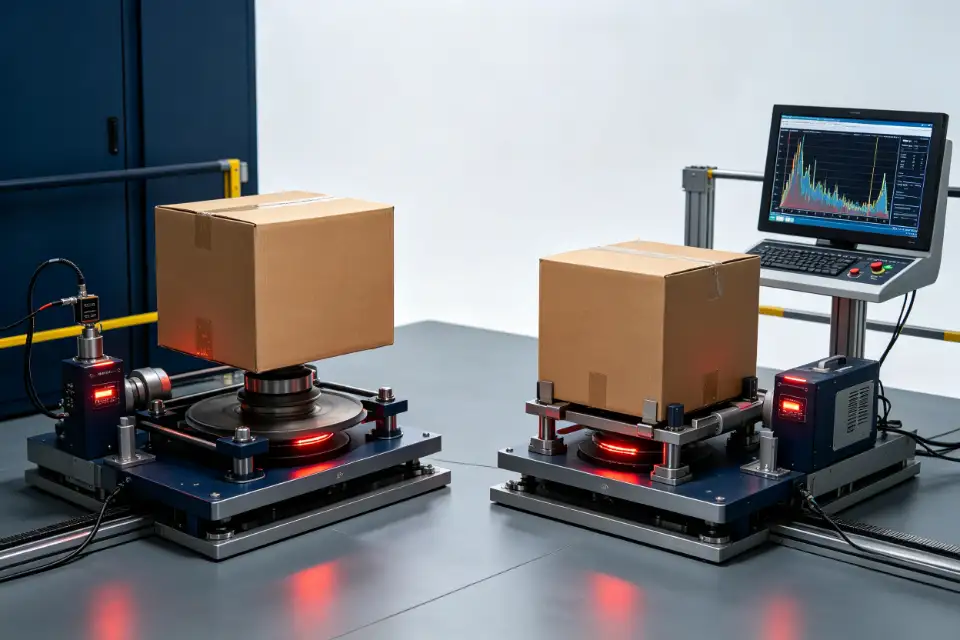
A vibration tester (vibration table, shaker table, transport simulator) subjects a packaged product to controlled, repetitive mechanical oscillations that replicate the vibration profiles of real-world transport vehicles — trucks, trains, aircraft, and ships. Unlike a drop tester that produces one sharp impact spike <100 milliseconds long, a vibration tester applies thousands to millions of low-amplitude cycles over minutes or hours.
Three Common Vibration Tester Types
Working Principle: Eccentric cam or crank mechanism drives the table at a fixed amplitude (typically 25.4 mm / 1 inch peak-to-peak). Frequency increases with motor speed, but displacement stays constant.
Best For: Basic ISTA 1A/2A transport simulation, corrugated box scuff testing.
Price: $3,000–$8,000
Limitation: Cannot match real-world vibration spectra — all frequencies receive the same displacement, which is physically unrealistic.
Working Principle: An electromagnetic driver produces a random vibration profile defined by a Power Spectral Density (PSD) curve that matches real transport data. The table can reproduce the exact frequency distribution of a specific truck route.
Best For: ISTA 3A, ISTA 6-AMAZON, ASTM D4169, ASTM D4728 — any standard requiring random vibration.
Price: $15,000–$60,000
Limitation: Higher cost, requires compressed air or water cooling for extended runs.
Working Principle: Applies vibration simultaneously or sequentially in vertical, lateral, and longitudinal axes. Electromagnetic or servo-hydraulic actuation replicates the full 3D vibration environment of a vehicle.
Best For: Military MIL-STD-810, aerospace, automotive components, complete vehicle simulation.
Price: $40,000–$150,000+
Limitation: High capital and operational cost, requires specialized facility (reinforced floor, cooling).
Head-to-Head Comparison: 12 Dimensions
This is the core of the vibration tester vs drop tester comparison. Each dimension reveals where one machine outperforms the other — and why the two are complementary, not competitive.
| Dimension | Drop Tester | Vibration Tester |
| 1. Failure Mode Simulated | Catastrophic impact — structural crush, cushion bottom-out, product breakage from a single high-energy event. | Cumulative fatigue — loose fasteners, abrasion, scuffing, seal creep, wire chafing from repetitive low-energy cycles. |
| 2. Physical Principle | Gravity-driven free-fall. Peak acceleration = instantaneous deceleration at impact (typically 50–500 G depending on surface and package stiffness). | Mechanical or electromagnetic oscillation. Acceleration = controlled amplitude × frequency². Typical transport levels: 0.3–1.5 Grms, peaking at specific resonant frequencies. |
| 3. Test Duration | Seconds per drop. 1–10 drops per package orientation. Full ISTA 1A protocol: <5 minutes per package. | Minutes to hours per test. ISTA 3A random vibration: 30–180 minutes. ASTM D4169 truck profile: up to 3 hours per axis. |
| 4. Acceleration Profile | Single sharp pulse (impact duration ~2–20 ms). Peak G depends on impact surface rigidity and package deformation. | Continuous random or swept-sine. PSD curve defines energy distribution across frequencies (1–200 Hz for transport). |
| 5. Load Capacity | 20–1,500 kg depending on type. Standard wing-type: ≤80 kg. Zero-distance: ≤300 kg. Quick-release: ≤1,500 kg. | 10–500 kg typical for packaging shakers. Large electrodynamic tables: 500–2,000 kg. Fixed-displacement tables: ≤150 kg. |
| 6. Standards Coverage | Required by every major ISTA standard (1A/2A/3A/6-AMAZON). Also ASTM D5276, D880, D4169, ISO 2248. | Required by ISTA 1B/1C/2A/2B/3A/3B/6-AMAZON, ASTM D4169, ASTM D4728, ASTM D999. Not required by basic ISTA 1A. |
| 7. Data Output | Pass/Fail (visual inspection, sometimes accelerometer data). Simple: "Did the package/product survive this drop?" | Multi-channel accelerometer data, PSD plots, transmissibility curves, resonance maps. Requires data acquisition system and trained interpretation. |
| 8. Operator Skill | Low — basic training (1–2 hours). Set height, place package, release, inspect. No data interpretation required. | Moderate to High — requires understanding of PSD profiles, accelerometer placement, resonance identification. Vibration test engineers command higher salaries. |
| 9. Capital Cost (2026) | $3,500–$12,000 (wing type, most common). Full range: $1,500–$80,000+. | $3,000–$8,000 (fixed-displacement). Random vibration: $15,000–$60,000. 3-axis: $40,000–$150,000+. |
| 10. Facility Requirements | Minimal — level floor, ~3m ceiling clearance. Quick-release needs recessed floor pit. | Moderate to extensive — reinforced floor for high-force shakers, compressed air (random), water cooling (large electrodynamic), acoustic enclosure for noise, isolated foundation to prevent building vibration transmission. |
| 11. Throughput | High — 10–20 packages/hour for standard ISTA 1A protocols. Quick-change between SKUs. | Low — 2–4 packages/hour for full ISTA 3A protocol (30+ min vibration sequence). Fixturing and accelerometer setup adds time. |
| 12. Failure Discovery | Immediately visible — crushed corners, torn boxes, broken products. Photograph and document. | Often hidden — loose screws, hairline cracks, abraded labels. Requires careful post-test inspection, sometimes teardown or functional testing. |
ISTA & ASTM Standards: Who Requires Drop vs Vibration?
Not all standards require both tests. The following matrix maps major packaging test standards to their drop and vibration requirements, so you can determine exactly which instruments your compliance program needs.
| Standard | Scope | Drop Test Required? | Vibration Required? | Vibration Type | Approx. Lab Cost |
| ISTA 1A | Non-simulation integrity, ≤68 kg | ✅ Yes | ✅ Yes | Fixed displacement (1 inch) | $8K–$20K |
| ISTA 2A | Partial simulation, ≤68 kg | ✅ Yes | ✅ Yes | Fixed displacement or random | $10K–$35K |
| ISTA 3A | Parcel delivery simulation, ≤70 kg | ✅ Yes | ✅ Yes | Random vibration required | $25K–$70K |
| ISTA 6-AMAZON | Amazon SIOC / Over-Boxing | ✅ Yes | ✅ Yes | Random vibration required + shock | $30K–$80K+ |
| ASTM D5276 | Drop test of loaded containers | ✅ Yes | ❌ No | N/A | $4K–$12K |
| ASTM D4169 | Performance testing of shipping containers | ✅ Yes | ✅ Yes | Random vibration (Schedule D) | $30K–$80K+ |
| ASTM D999 | Vibration testing of shipping containers | ❌ No | ✅ Yes | Sinusoidal or random | $3K–$60K |
| ASTM D4728 | Random vibration testing of shipping containers | ❌ No | ✅ Yes | Random vibration only | $15K–$60K |
Decision Framework: When to Use a Drop Tester, a Vibration Tester, or Both
Use this step-by-step vibration vs drop test comparison framework to determine exactly which instrument your lab needs — and in what order you should acquire them.
→ Go to Step 2
→ Both, but start with Drop
→ Both (Drop + Random Vibration)
→ Drop Tester only
→ Both (Drop + Fixed Vibration)
→ Both (Drop + Random Vibration)
→ Drop Tester suffices
→ Add Vibration Tester
→ Both, plus environmental chamber
→ Drop Tester (impact damage)
→ Vibration Tester (fatigue damage)
→ Both (different root causes)
→ Quality Wing-Type Drop Tester
→ Add Fixed-Displacement or Random Vibration
→ Add Environmental Chamber + Compression Tester
The decision framework converges on one consistent recommendation: buy the drop tester first, add vibration as a second purchase. A drop tester alone passes/fails against the most urgent compliance requirements; a vibration tester alone cannot. For multi-SKU labs testing to ISTA 2A or higher, budget for both from the start. See our drop testing equipment and vibration test systems for complete lab solutions.
By Transport Mode: What Testing Each Mode Demands
Different transport modes subject packages to fundamentally different physical environments. The dominant failure mechanism shifts with transport mode — and so does the testing priority.
| Transport Mode | Dominant Failure Mechanism | Primary Test | Vibration Profile | Severity |
| 🚛 Truck (Over-the-Road) | Vibration fatigue — loose fasteners, abrasion, scuffing from hours of continuous low-frequency (3–20 Hz) excitation from suspension and road surface. | Vibration Tester + Drop | ASTM D4169 Truck Profile: 0.56 Grms total, dominant energy at 3–8 Hz (suspension) and 15–25 Hz (tire/wheel) | Moderate (hours) |
| ✈️ Air Freight | High-frequency vibration — turboprop and jet engine frequencies (50–500 Hz) can resonate with electronic components, causing solder joint fatigue. Also: cargo hold pressure cycling. | Vibration Tester + Altitude Chamber | ASTM D6653 altitude profile. Vibration: low Grms (0.3–0.5) but broader frequency range (10–300 Hz) | Low-moderate intensity, high frequency |
| 🚢 Ocean Freight | Low-frequency rolling and pitching — strap loosening, load shifting, container stack creep. Corrosion from salt air is the silent killer. | Vibration Tester + Environmental Chamber | Very low frequency (0.1–1 Hz rolling, 2–8 Hz engine). Low Grms but long duration (weeks) | Low intensity, extreme duration |
| 🚂 Rail Freight | Impact + vibration combination — railcar coupling impacts (up to 4 G longitudinal) plus sustained vertical vibration from rail joints and wheel flats. | Drop Tester + Vibration Tester (Both) | ASTM D4169 Rail Profile: longitudinal shock + vertical random vibration, 0.44 Grms | High — combines both failure modes |
| 📦 Last-Mile / Parcel | Multiple low-height drops — conveyor transfers, sorting chutes, courier handling. Up to 20+ handling events per single package journey. | Drop Tester (primary) | ISTA 3A / 6-AMAZON drop schedule: 6–10 drops from height per weight class + random vibration | High — many events in short time |
By Product Type: What Your Industry Needs
Your product category determines which failure modes dominate — and therefore which testing investment delivers the fastest ROI.
| Industry | #1 Failure Mode | Drop Test Priority | Vibration Test Priority | Recommended First Purchase | Key Standards |
| 📱 Electronics | Drop impact → cracked screens, dislodged connectors. Vibration → solder fatigue, loose ribbon cables. | 🔴 Critical | 🟡 High | Drop Tester | IEC 60068-2-31 (drop), IEC 60068-2-6 (vibration) |
| 🛒 E-Commerce | Combined drop + vibration. Multiple handling drops + long-haul truck vibration. | 🔴 Critical | 🔴 Critical | Drop Tester first | ISTA 3A, ISTA 6-AMAZON |
| 🥫 Food & Beverage | Drop impact → seal rupture, glass breakage, can denting. Vibration → label scuffing (cosmetic). | 🔴 Critical | 🟢 Moderate | Drop Tester | ISTA 1A, ISO 2248 |
| 💊 Medical Devices | Drop impact → sterile barrier breach. Vibration → component loosening, package seal creep. | 🔴 Critical | 🔴 Critical | Both (regulatory requirement) | ASTM D4169, ISO 11607 |
| 🚛 Industrial Machinery | Drop impact → structural damage to crates/pallets. Vibration → bolt loosening, fastener fatigue. | 🔴 Critical | 🟡 High | Quick-Release Drop Tester | ASTM D4169, MIL-STD-810 |
Medical device and pharmaceutical manufacturers face regulatory requirements that effectively mandate both instruments — you cannot meet ISO 11607 or FDA packaging validation expectations with just a drop tester. For e-commerce sellers targeting Amazon's ISTA 6 certification, both drop and random vibration testing are non-negotiable. Food and beverage companies shipping primarily by pallet can often start with a drop tester and defer vibration investment.
Combined Testing Strategy: Why the Sequence Matters
When a lab has both a drop tester and a vibration tester, the test sequence dramatically affects results. Testing the same package in different orders produces different failure patterns — because vibration pre-conditions the packaging in ways that amplify or mask subsequent drop damage.
The ISTA-Prescribed Sequence
Most ISTA standards specify a specific test order based on real-world event chronology:
Temperature/humidity soak
→
Truck + air profiles
→
8–10 drops per protocol
→
Pass/Fail criteria
Note: ISTA 1A reverses this — drop test comes BEFORE vibration, reflecting the simpler "integrity first, fatigue second" philosophy of basic testing.
Why Sequence Matters: The Pre-Conditioning Effect
Vibration before drop testing is a more conservative, realistic approach — and most modern ISTA protocols use it. Here's why:
Vibration loosens fasteners, settles cushioning, and fatigues tape seals. When the subsequent drop hits, the package is already in a weakened state — producing more realistic failure thresholds. This matches real-world chronology: truck vibration occurs before the final handling drops at the delivery depot.
The package faces the most violent event while still in pristine, factory-fresh condition. This is less conservative but sometimes intentional — it tests whether the packaging can survive the worst-case scenario of a handling drop early in the journey before any fatigue has accumulated.
Cost & ROI Analysis: What You Really Pay for Drop + Vibration
Entry-Level to Full Compliance: Budget Scenarios
| Lab Tier | Drop Tester | Vibration Tester | Total Equipment | Standards Covered | Best For |
| 🟢 Basic QA | Fixed Height: $2,000–$4,000 | Fixed Displacement: $3,000–$5,000 | $5,000–$9,000 | ISTA 1A, basic ISO 2248 | Single-SKU box plants, startups |
| 🔵 Standard Lab ★ | Double-Wing: $5,000–$10,000 | Fixed Displacement: $3,000–$8,000 | $8,000–$18,000 | ISTA 1A/2A, ASTM D5276, ISO 2248 | Most packaging QA labs, e-commerce |
| 🟠 Advanced Lab | Zero-Distance: $12,000–$25,000 | Random Vibration: $15,000–$40,000 | $27,000–$65,000 | ISTA 3A, ASTM D4169, ISO 17025 | Accredited labs, medical devices |
| 🔴 Full Compliance | Zero-Distance + Quick Release: $35,000–$80,000 | Multi-Axis Random: $40,000–$100,000 | $75,000–$180,000 | ISTA 6-AMAZON, MIL-STD, UN/DOT | Amazon vendors, military contractors |
ROI: The Damage Reduction Payback
• Monthly shipments: 3,000 units
• Damage rate reduction: 4.8% → 1.5%
• Avg. product value: $38
• Monthly savings: $3,762
• Payback period: ~3.2 months
• Year 1 ROI: ~276%
• Monthly shipments: 500 units
• Damage rate reduction: 2.1% → 0.3%
• Avg. device value: $1,200
• Monthly savings: $10,800
• Payback period: ~5.1 months
• Avoided recall cost: Potentially $250K–$2M+ per incident
Frequently Asked Questions
| Can a vibration tester replace a drop tester? | No. Vibration testers operate in a fundamentally different acceleration regime. A vibration table at 1 Grms never produces the 50–500 G peak acceleration of a single drop. The failure mechanisms are different — fatigue vs. impact — and no ISTA or ASTM standard accepts vibration testing as a substitute for drop testing. Every major packaging standard that requires vibration also requires drop testing. They are complementary, not interchangeable. |
| Which should I buy first: drop tester or vibration tester? | Drop tester first, always. Three reasons: (1) Drop testing is required by every major ISTA and ASTM standard — it is the minimum bar for packaging compliance. A vibration tester alone cannot certify any ISTA protocol. (2) Impact damage is more visible and more catastrophic — a single drop can destroy a product, while vibration damage accumulates gradually. (3) Drop testers cost less, are simpler to operate, and require less facility preparation. Add a vibration tester as a second-phase purchase when you have established your testing workflow — or when a customer or marketplace mandates ISTA 3A or 6-AMAZON. |
| What's the difference between fixed-displacement and random vibration testing? | Fixed-displacement (rotary) vibration moves the table at a constant amplitude (typically 25.4 mm) while frequency varies. Every frequency gets the same displacement — physically unrealistic. A truck vibrates with a specific frequency spectrum, not equal displacement at all frequencies. Random vibration uses an electrodynamic shaker controlled by a Power Spectral Density (PSD) curve that replicates real transport data. It can reproduce the exact vibration profile of a specific truck route, rail line, or aircraft. ISTA 1A/2A accept fixed-displacement; ISTA 3A/6-AMAZON and ASTM D4169 require random vibration. Random vibration testers cost 3–5× more than fixed-displacement. |
| Do I need a vibration tester for ISTA 1A compliance? | Yes — ISTA 1A requires both drop and vibration testing. However, the vibration requirement is the simplest type: fixed-displacement at 1 inch (25.4 mm) peak-to-peak, with frequency increased until the package momentarily leaves the table surface. A basic rotary vibration table at $3,000–$5,000 satisfies this. You do not need a random vibration system for ISTA 1A. |
| How do I know if my damage is from drops or vibration? | Inspect the failure pattern: Drop damage is localized — one corner crushed, one face dented, one product edge broken. The damage is asymmetrical and catastrophic. Vibration damage is distributed — loose fasteners on multiple sides, symmetrical scuff marks where products rubbed, print delamination on all package faces, wire chafing at multiple contact points. If the damage is "everywhere, evenly," it is vibration. If it is "right here, badly," it is impact. When in doubt, run both tests — the damage pattern that reproduces in the lab tells you which test you were missing. |
| What maintenance do vibration testers require vs drop testers? | Drop testers are low-maintenance: annual height calibration, arm bearing lubrication (wing types), base plate flatness check, and safety interlock verification. Fixed-displacement vibration tables are moderate: eccentric cam bearing replacement every 2–3 years, belt inspection, table surface wear. Electrodynamic random vibration systems require the most: quarterly armature inspection, cooling system maintenance (air filters or water quality), accelerometer calibration (annual, ISO 17025), amplifier capacitor replacement (every 5–7 years), and PSD profile verification. Budget ~$500/yr for drop tester maintenance vs $1,500–$3,000/yr for a random vibration system. |
Conclusion & Next Steps
The vibration tester vs drop tester decision is not an either-or choice for most packaging labs — it is a question of sequence and priority. The industry consensus, embedded in every major ISTA and ASTM standard, is clear: you need both. But you do not need both on day one.
• Phase 2 — Add a Vibration Tester. Fixed-displacement ($3K–$8K) for ISTA 1A/2A. Random vibration ($15K–$40K) for ISTA 3A/6-AMAZON and ASTM D4169.
• Phase 3 — Add environmental conditioning. Temperature/humidity chamber for full ASTM D4169 and ISTA 3A compliance.
• Total Phase 1+2 investment: $8,000–$18,000 for a standard lab that covers ISTA 1A/2A — achievable for most manufacturers and e-commerce sellers.
If you take away one thing from this guide, let it be this: the drop tester answers "will it break?" and the vibration tester answers "will it degrade?" You need both answers to ship with confidence. But you only need the first answer to start reducing transit damage today.
For a complete packaging test lab, remember that a box compression tester completes the "big three" of packaging testing alongside drop and vibration — compression testing verifies stacking strength, which is essential for palletized and warehouse-stored products. A fully equipped lab tests impact, vibration, and compression — the three physical forces every package faces in distribution.
The right drop tester pays for itself in months. Adding vibration closes the gap between "lab-tested" and "real-world proven."