
Flexible PU Foam Testing for Mattresses and Seat Cushions
Date: October 21, 2026 Categories: Plastics, Rubber & Foam Testing Solutions Views: 9100
APPLICATION FOCUS
Specify the Foam, Not Just Its Density
Flexible polyurethane foam in a mattress comfort layer and foam in a frequently loaded seat cushion may need different performance profiles. A purchasing specification that names density alone leaves important questions about feel, recovery and retention of properties unanswered.
This guide helps foam producers, incoming-inspection teams and mattress or cushion buyers organize material-level quality checks. It concerns flexible PU foam specimens. Finished mattress systems, seat frames, covers and complete-product regulatory requirements need their own evaluation.
02 / APPLICATION GUIDE
Separate the Quality Decisions
Material buyer
Needs a reproducible incoming specification, a representative sample and a clear rule for handling a changed batch.
Foam producer
Needs to compare formulation, processing and batch variation under controlled test conditions.
Laboratory team
Needs a defined method, specimen preparation, equipment configuration and records that make comparisons meaningful.
Write the problem in practical terms: “the new lot feels firmer”, “the cushion loses height after repeated loading” or “the slow-recovery layer behaves differently”. Do not start by assuming all three problems are density failures.
03 / APPLICATION GUIDE
Match Each Property to Its Question
| Property | What it helps assess | Boundary |
|---|---|---|
| Apparent density | Mass per unit volume for the defined specimen. | Not a direct measurement of firmness; additives and specimen definition matter. |
| Indentation or compression response | Resistance at the specified deformation and loading conditions. | Method, thickness, geometry and timing affect comparisons. |
| Ball rebound | Resilience under the defined impact method. | Not the same result as slow recovery or fatigue retention. |
| Recovery behaviour | Return after a specified deformation and release. | Requires a defined timing and endpoint; not a generic comfort score. |
| Fatigue-related change | Change in selected properties after prescribed repeated loading. | Does not by itself establish years of service life. |
ASTM D3574 contains multiple flexible PU foam methods, not one universal test. Select the relevant method section and customer requirement. Do not convert an apparatus name into a claim that every method in the standard is covered.
04 / APPLICATION GUIDE
Make Incoming Lots Comparable
01Identify the material
Record foam type, supplier, lot, sampling location and whether skin or bonded layers are included. Keep the specimen definition consistent.
02Prepare and condition
Use the required dimensions, conditioning and preparation. Record any deviation that could change the response.
03Measure the specified properties
Use the same procedure, units and calculation definitions for the comparison. Retain individual results rather than only a rounded average.
04Review a change before release
Compare against the agreed limits and reference material. Investigate preparation, method and material changes before assigning a cause.
The conditioning, specimen count and numerical acceptance limits belong in the agreed procedure or purchase specification. There is no single limit in this article that applies to every foam grade.
05 / APPLICATION GUIDE
Investigate the Complaint Without Guessing
If a cushion feels different, first compare the specified indentation response under equivalent conditions. If the complaint is loss of height or firmness during repeated use, define initial and post-loading measurements with the required recovery interval. For slow-recovery materials, record the temperature and the timing used to judge return.
These checks can narrow the investigation, but they do not prove a single manufacturing cause. Density, chemistry, structure, processing and specimen preparation can interact. A useful report shows the observations and method rather than claiming that one number explains every comfort complaint.
For the wider equipment family, see foam testing equipment. Keep the material tests separate from complete-seat or complete-mattress performance claims.
06 / APPLICATION GUIDE
Select a Defined Set of Instruments
Density and rebound
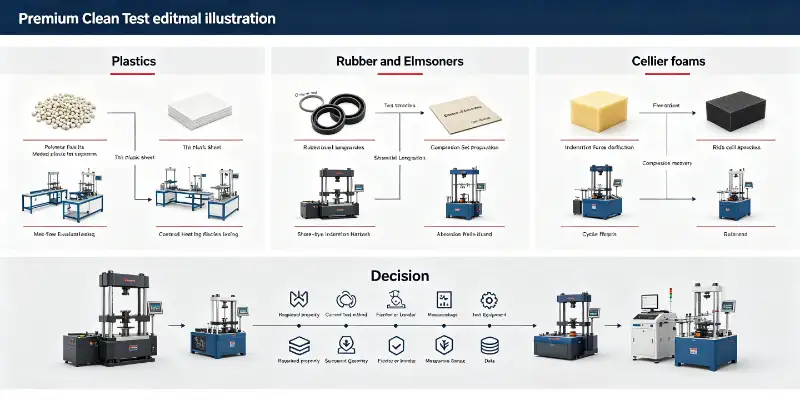
DR-J205 foam density meter and DR-J201 ball rebound tester address different material properties.
Recovery
Foam recovery-time equipment should be reviewed against the intended deformation, timing and endpoint.
Repeated loading
DR-J202 compression fatigue equipment requires a defined loading arrangement and before/after assessment.
Ask the quotation to identify the specimen dimensions, load or deformation control, measurement devices, accessories and result output for each selected test. Where one instrument is proposed for several methods, review each setup separately. Do not treat density-meter operation as proof of an appropriate volume method for every open-cell specimen.
07 / APPLICATION GUIDE
Questions from Foam Buyers
Does higher density always mean a firmer foam?
No. Density and firmness are different properties. Specify and test the response needed for the application rather than using density as a substitute.
Can ball rebound replace a fatigue test?
No. Rebound measures a different response. Fatigue assessment compares specified properties before and after a defined repeated-loading exposure.
Can the same limits be used for all mattress layers?
Not automatically. Layer function, material and customer requirements differ. Establish limits for the specified material and method.
YOUR APPLICATION, YOUR TEST REQUIREMENT
Describe the Foam and the Quality Decision
Send the foam type, intended mattress or cushion use, specimen size and the property or complaint you need to assess.