

How to Choose Material Testing Equipment for Plastics, Rubber and Foam
Date: September 7, 2026 Categories: Applications、Plastics, Rubber & Foam Testing Solutions Views: 1945
How to Choose Material Testing Equipment for Plastics, Rubber and Foam
The material name is only the starting point. A valid equipment configuration depends on the property to be reported, the current test method, specimen geometry, fixture, measurement range, conditioning and data requirements. Use this guide to turn a mixed list of plastic, rubber and foam tests into a reviewable laboratory requirement.
Start with the result—not a generic machine name
“Strength,” “hardness” and “compression” sound universal, but they can describe different measurements for a rigid plastic, an elastomer and a cellular foam. The governing method may change the specimen dimensions, loading rate, indenter, support, preload, conditioning, calculation and reported unit. Two materials that look similar may therefore need different apparatus or fixtures.
Begin by listing the exact properties used for formulation development, incoming inspection, production control or final product qualification. Then attach the current method and specimen form to each result. This separates tests that can share a configurable universal testing machine from tests that need dedicated instruments.
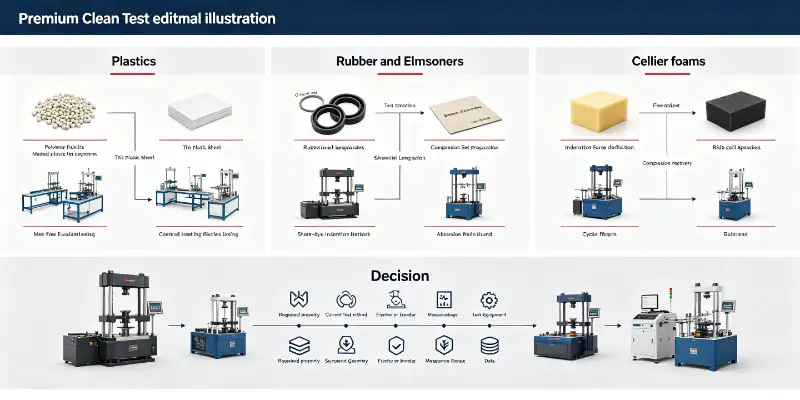
Processing and mechanical behaviour
Typical decisions may involve tensile, flexural or impact response, melt flow, heat-deflection behaviour, Vicat softening, density or environmental exposure. Pellet, sheet, film and moulded-part tests are not interchangeable.
Elasticity, cure and retained shape
Typical decisions may involve tensile and elongation, tear, Shore or IRHD hardness, compression set, rebound, abrasion, cure behaviour or ageing. Grip pressure and strain measurement can materially affect results.
Indentation, recovery and fatigue
Typical decisions may involve density, IFD/ILD, compression recovery, repeated-load fatigue, rebound, airflow or flammability. Open-cell, closed-cell, flexible and rigid foams require different specimen and loading considerations.
A six-step equipment-selection workflow
01Name the required property and decision
State whether the result will compare formulations, release incoming material, monitor a process, validate a finished component or investigate a failure. Record the result name, units, expected range and acceptance criteria. Avoid vague requests such as “test the quality of this rubber.”
02Confirm the current method and revision
Identify the applicable ASTM, ISO, customer or internal procedure and its current revision. Transcribe the required specimen, conditioning, apparatus, speed, cycles, temperature and calculation. Similar property names across methods do not automatically require identical configurations.
03Define the specimen actually available
Record whether the material arrives as pellets, film, sheet, plaque, moulded part, O-ring, dumbbell, block or finished foam product. Include thickness, width, gauge length, maximum dimensions, preparation process and permitted cutting or machining.
04Match fixtures and measurement to behaviour
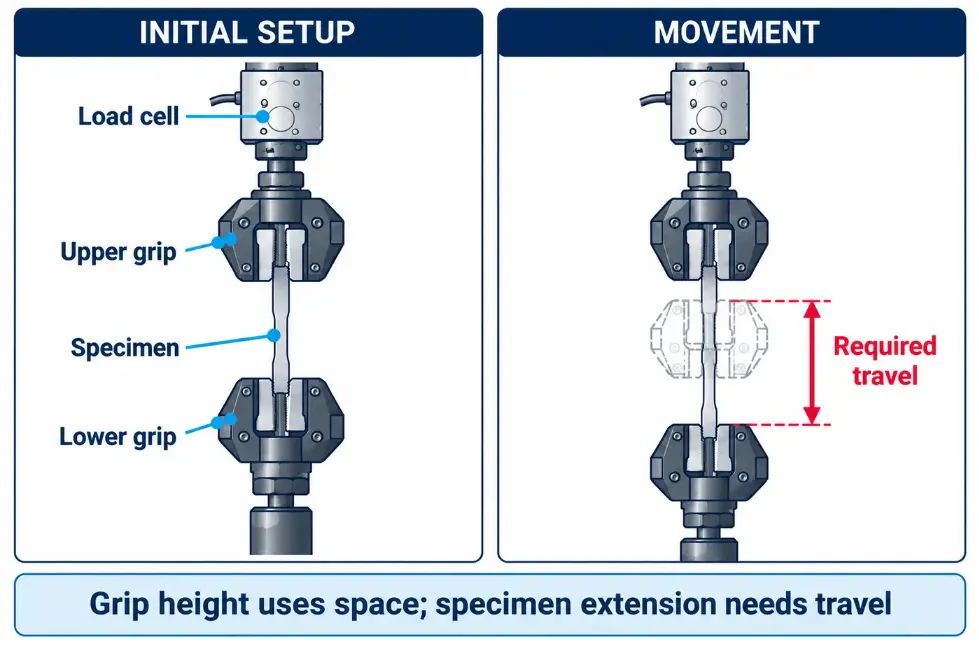
Flexible films may slip or tear at the grip; elastomers may stretch far beyond a short crosshead travel; soft foam requires an appropriate indenter and support surface. Confirm grips, platens, supports, extensometry, displacement reference, preload and any environmental enclosure as part of the system—not as later accessories.
05Size the usable range, not only the maximum
Provide expected minimum and maximum force, deformation, speed, frequency, temperature or other method-specific values. Review accuracy and control performance across the range actually used. A high-capacity frame is not automatically the best choice for low-force specimens.
06Plan throughput, data and changeover
Define specimens per batch, batches per shift, operator skill, fixture changes, conditioning transfer, raw data, calculations, templates, user permissions and export needs. The fastest individual test may not create the fastest laboratory workflow.
Universal testing machine or dedicated tester?
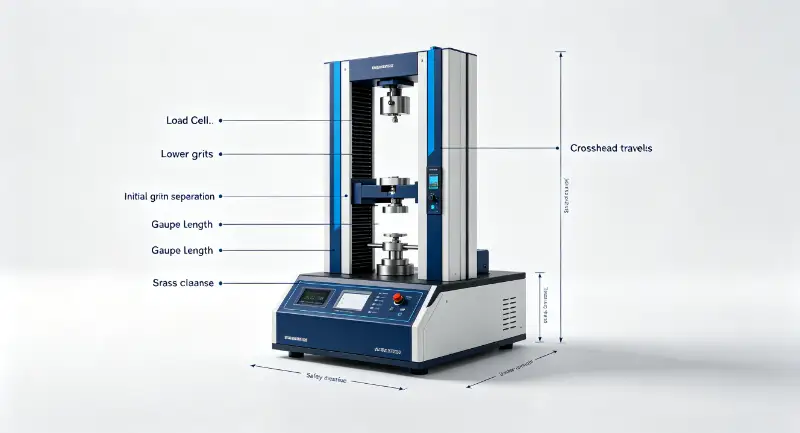
A universal testing machine can be the right platform for tensile, compression, flexural, peel or tear work when its frame, load cell, travel, speed, fixtures, strain measurement and software match the method. Its advantage is configurable force–displacement testing across several procedures.
Dedicated instruments are often more suitable when a method defines a specialized thermal process, indenter, oscillation, abrasion path, airflow circuit, impact geometry, melt-flow condition, cure measurement or repeated-load mechanism. These systems reduce changeover and may make routine production tests easier to reproduce.
Property-to-equipment planning matrix
| Test objective | Typical material context | Configuration questions to resolve |
|---|---|---|
| Tensile, elongation, tear or peel | Plastic film/sheet, rubber dumbbells, elastomers, flexible foam | Force range, travel, speed, grip type, slippage, extensometry, specimen preparation |
| Compression or indentation response | Rigid plastic, rubber components, flexible/rigid foam | Platen/indenter geometry, support, preload, deflection reference, venting, usable force range |
| Hardness | Rubber, elastomer, soft plastic, foam | Required hardness scale, indenter, specimen thickness, support, dwell time and reading method |
| Flow or thermal transition | Thermoplastic pellets or moulding materials | Method condition, temperature, load, die, specimen state, timing and cleaning workflow |
| Compression set or recovery | Rubber seals, elastomers, cellular materials | Constant force/deflection, spacers, exposure, recovery interval and thickness measurement |
| Fatigue, rebound or abrasion | Foam cushions, rubber components, finished products | Motion, rate, cycles, contact geometry, environmental condition and endpoint calculation |
These rows are planning categories, not substitutes for a test procedure. The current authorized method determines the apparatus and execution requirements.
Why specimen preparation and conditioning belong in the equipment scope
Material results can be dominated by thickness variation, cutting damage, moulding history, grip alignment, temperature, humidity or time after preparation. A purchase list that names only the primary tester may leave the laboratory unable to reproduce the required specimen state.
For each method, document specimen cutting or moulding, dimensional measurement, conditioning environment, timing, orientation and transfer to the tester. Decide whether these steps require dies, cutters, thickness gauges, balances, conditioning chambers, ovens or other controlled accessories. Keep confirmed requirements separate from optional convenience features.
Information to send for a comparable technical proposal
- Material family, grade/state and end-use application
- Required property, units, acceptance limits and expected range
- Current standard number, revision and any customer deviations
- Specimen drawing, dimensions, preparation and conditioning
- Required load, travel, speed, cycles, temperature and fixtures
- Daily/weekly throughput and expected changeover pattern
- Raw data, calculations, report format and traceability needs
- Destination country, available power, air, floor space and access
Supplying the same requirement package to each vendor makes quotations easier to compare and exposes exclusions before purchase.
Match the material, method and specimen to the right configuration
Send your procedure, specimen drawing, expected result range, throughput and site conditions. DERUI can organize the requirement by dedicated tester, configurable test frame, fixture and supporting preparation or conditioning equipment.
Plastics, Rubber and Foam Testing FAQs
Can one universal testing machine test plastics, rubber and foam?
It may support several force–displacement methods when the frame, load cells, travel, speed, grips, platens, strain measurement and software match each procedure. It does not replace dedicated apparatus required for properties such as melt flow, Vicat/HDT, cure behaviour, abrasion, airflow or other specialized methods.
Why is maximum machine capacity not enough for selection?
Testing quality depends on performance across the force, displacement and speed range actually used. Low-force specimens on an oversized system may require a different load cell or frame. Fixture mass, travel, resolution, control and usable workspace must also be reviewed.
Should equipment be selected by ASTM or ISO standard number?
The current method is essential, but the standard number alone is not a complete equipment specification. Provide the revision, specimen form, method option, expected range, fixtures, conditioning, workflow and reporting requirements.
What causes inconsistent rubber or foam test results?
Common causes include specimen variation, preparation damage, conditioning, misalignment, grip slippage, incorrect preload, timing differences, temperature, unsuitable force range and inconsistent result calculation. Investigate the complete method and workflow rather than only the tester.