

Material testing equipment configured for your test method and specimen.

DERUI manufactures material testing equipment for quality control and R&D.
WhatsApp Consultation:+86 135 2795 8363

DR-C301 Rubber Rotorless Rheometer (MDR Curemeter)

Model: DR-C310

Price: FOB, CIF

Payment:L/C, D/P, T/T

Package:Each set protected with resin fiber and PP film, then put into Strong wooden case with operation manual and video inside.

Delivery:15 days after order.

Safe and reliable
well-made
customization
Quality assurance
MessageWhatsApp
Hotline number +8615580327593
  • Product Details
  • Technical parameters
  • FAQ
  • Contact us

PRECISION RUBBER VULCANIZATION KINETICS & VISCOELASTICITY

DR-C301 Rubber Rotorless Rheometer (MDR)

The DR-C301 Moving Die Rheometer (MDR) records torque response, scorch behavior, and complete crosslinking kinetics as an uncured rubber compound undergoes isothermal vulcanization under sealed, rotorless oscillatory shear. Designed for formula compounding, production batch consistency, and compound release testing per ASTM D5289 and ISO 6502.

Quick answer: Choose a rotorless curemeter based on cavity thermal recovery speed (<1.5 min), temperature gradient across upper/lower dies (≤±0.3°C), and low-torque resolution (0.001 N·m)—not maximum clamping force alone. Confirm die cavity sealing, oscillation amplitude (±0.5° or ±1.0°), and automated statistical process software before purchase.
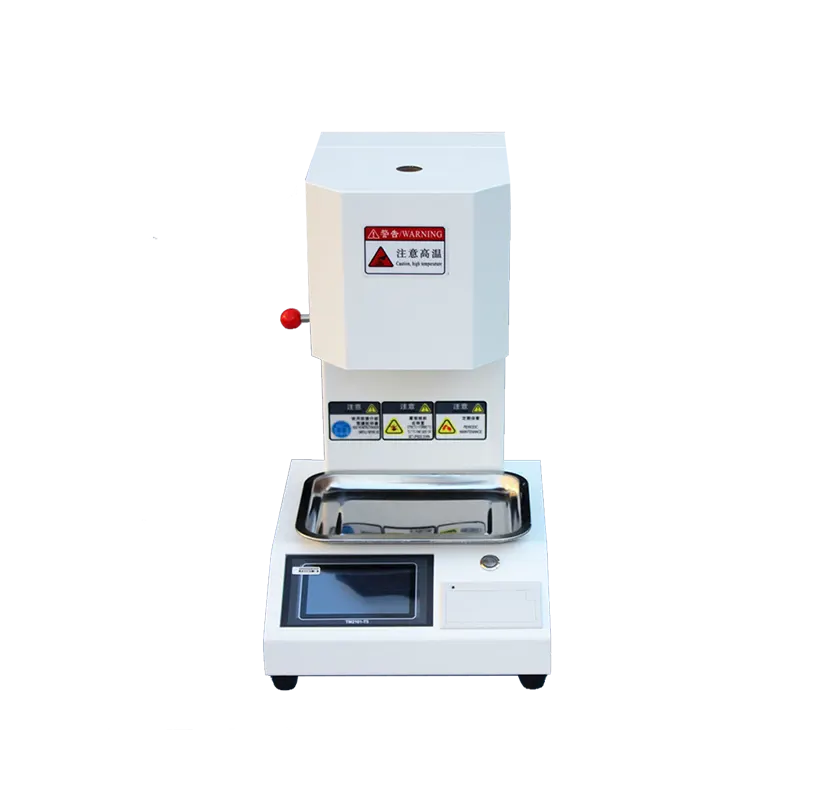
MODELDR-C301
TEMPERATURE RANGEAmbient to 200°C (±0.1°C)
OSCILLATION FREQ.100 cpm (1.67 Hz) ± 1° / 0.5°
TORQUE RESOLUTION0.001 N·m

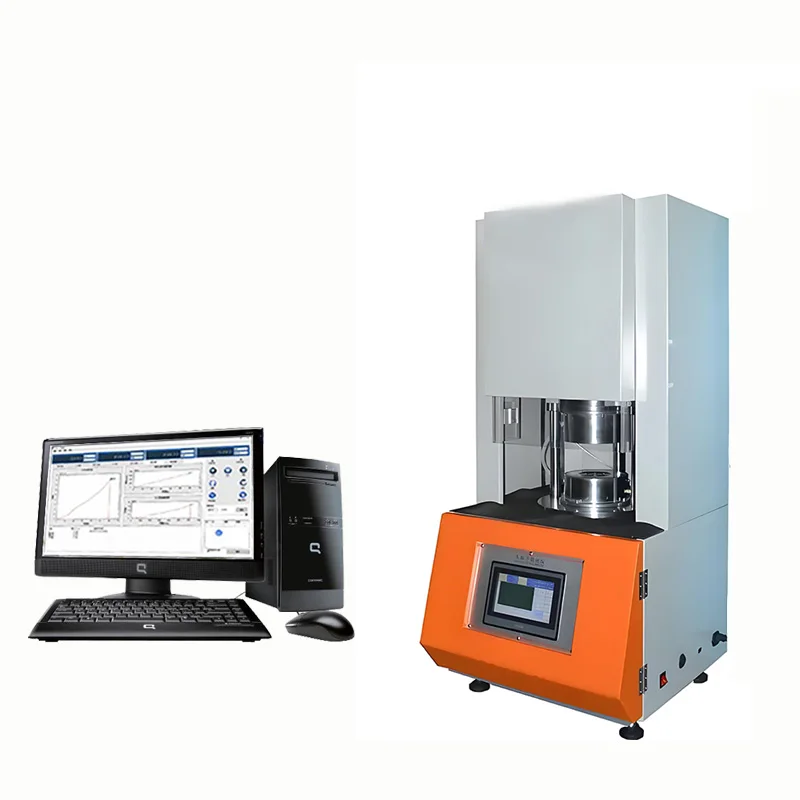
DERUI DR-C301 Rubber Rotorless Rheometer for vulcanization cure curve analysis
DR-C301 sealed biconical die chamber: verify rapid pneumatic closure, high-stability torque load cell, integrated PID platen heaters, and automated safety shield.

READ THE VULCANIZATION KINETICS

Key Parameters Extracted from an MDR Cure Curve

Minimum Torque (ML) & Viscosity

Reflects compound viscosity and processability at test temperature prior to crosslink network onset. Elevated ML signals premature aging, scorching during mixing, or carbon black dispersion defects.

Scorch Safety (ts1, ts2)

Determines processing safety window before crosslinking initiates. Critical for injection, calendering, and transfer molding where premature vulcanization ruins cavity filling.

Optimum Cure (t90) & Max Torque (MH)

MH correlates directly with cured modulus, crosslink density, and final hardness. t90 identifies target press demolding time to optimize vulcanization cycles without under-cure or over-cure waste.

Reversion Warning: For NR and sulfur-vulcanized compounds, extended heating beyond t90 can cause desulfurization and network breakdown (torque drop). The DR-C301 monitors reversion percentage and post-curing decay curves in real time.

REPEATABLE LABORATORY PRACTICE

Ensure Cure Consistency from Batch to Batch

Rheometer data variation is overwhelmingly caused by sample preparation thickness, conditioning history, and seal condition—not internal electronic drift.

Volumetric Sample Punching

Use a constant-volume circular punching press (~4.5 to 5.5 cm³). Under-filling causes torque loss from incomplete die wall contact; over-filling creates excessive flash and seal binding.

Protective Film Placement

Sandwich specimen between certified high-temperature resistant polyester or nylon films. Prevents die fouling, eliminates sample sticking, and ensures uniform interfacial friction.

Pneumatic Locking & Fast Recovery

Initiate automatic platen drop with regulated pneumatic clamping (~0.4 to 0.6 MPa). Rapid thermal transfer brings compound to thermal equilibrium within standard recovery limits.

Real-time Trace & Statistical SPC

Software overlays historical master curves with tolerance gates (±2σ limits) for immediate Pass/Fail judgment, saving operators from manual curve calculation.

Die Cleanliness Rule: Degraded rubber residues in die serrations insulate heat transfer and induce slippage. Clean platens while hot using soft brass tools—never scrape with steel blades.

GLOBAL TESTING FRAMEWORK

Standardized Test Methods & DR-C301 Verification

Standard Scope & Test Mandate DR-C301 Engineering Implementation
ASTM D5289 Standard Test Method for Rubber Property—Vulcanization Using Rotorless Cure Meters. Sealed biconical die cavity, sinusoidal oscillation at 1.667 Hz (100 cpm), standard angular displacement of ±0.5° (selectable ±1.0°).
ISO 6502-3 Rubber — Measurement of vulcanization characteristics using curemeters (Part 3: Rotorless meter). Direct contact Pt100 temperature sensors mounted in die body; cavity thermal recovery within 1.5 min; rigid frame eliminating compliance errors.
DIN 53529 Testing of rubber; measurement of vulcanization characteristics; model-free kinetics evaluation. Integrated mathematical kinetics algorithm calculating crosslinking rate constants (k), activation energies, and reaction orders.
GB/T 16584 Rubber — Measurement of vulcanization characteristics with the rotorless curemeter. Standard torque calibration kit with traceable torsion bar; automatic zero-point drift correction and full-scale sensitivity check.

Equipment Traceability Notice: ISO 17025 accredited quality audits require traceable torque calibration (dynamic torsion bar verification) and multizone thermal calibration. Calibration certificates and dynamic validation bars are supplied with every DR-C301.

SELECT THE CORRECT RUBBER TESTING TOOL

Choose MDR for Uncured Rubber Vulcanization

A rotorless rheometer evaluates dynamic crosslinking kinetics—it does not replace raw Mooney viscosity or solid physical tensile tests.

MDR Rheometer · DR-C301

Measures torque change vs. time to extract scorch (ts2), vulcanization speed (t90), and elastic shear modulus during crosslinking.

Mooney Viscometer

Measures raw elastomer and unvulcanized compound viscosity, scorch time at constant shear, and stress relaxation dynamics.

Universal Testing Machine

Measures tensile strength, elongation at break, 300% modulus, and tear resistance of fully vulcanized dumbbell specimens.

Review tensile testing →

Melt Flow Indexer (MFI)

Measures melt flow rate for thermoplastics and uncrosslinked polymers—not applicable for reactive rubber compounds.

Review MFI testing →

AVOID ERRATIC CURE CURVES

Control the 6 Major Causes of Unreliable Rheometer Data

Incorrect Specimen Volume

Insufficient rubber volume leads to lack of cavity pressure and torque drops; excess volume squeezes out flash, damaging seal rings and distorting MH.

Cavity Seal Ring Wear

Damaged or hardened silicone/fluoroelastomer seal rings leak pressure and allow compound escape, generating anomalous baseline noise.

Compound Moisture & Porosity

Volatile expansion from un-dried fillers or moisture creates internal steam pockets, producing apparent slippage and irregular torque spikes.

Temperature Calibration Drift

A slight ±1°C shift between upper and lower dies can displace scorch time (ts2) by up to 10–15%; regular Pt100 thermometer auditing is mandatory.

Specimen Thermal History

Testing freshly milled unconditioned hot compound alters starting viscosity (ML). Allow compound to condition at standard laboratory ambient for ≥2 hours.

Die Wall Serration Slippage

Smooth or fouled radial grooves fail to grip high-hardness or high-silica rubber compounds; verify platen serrations maintain sharp, clean profiles.

VERIFIABLE RHEOMETER SPECIFICATIONS

Build a Verifiable DR-C301 RFQ

Provide your compound chemistry, production rate, and laboratory data requirements to receive an exact quotation covering tooling, software, and calibration standards.

Compound & Application

  • Rubber base (NR, SBR, EPDM, NBR, FKM, Silicone)
  • Curing system (Sulfur, Peroxide, Resin, Metal Oxide)
  • Testing purpose (Factory batch QC vs. R&D)
  • Target test temperatures (e.g., 160°C, 180°C)

Mechanical & Cavity Options

  • Oscillation angle: ±0.5° (standard) or ±1.0° / ±3.0°
  • Cavity configuration: Sealed Biconical Die
  • Torque range: Standard 0–20 N·m (optional 0–5 N·m)
  • Automatic pneumatic safety shield interlock

Accessory & Tooling Package

  • Constant volume pneumatic sample punch press
  • High-temperature protective film rolls (PET/Nylon)
  • Dynamic torque calibration torsion bar kit
  • High-durability replacement cavity seal rings

Software & Data Management

  • Standalone touchscreen vs. Windows PC workstation
  • Overlay comparison of multiple historical curves
  • Statistical Process Control (SPC) tolerance gates
  • LIMS integration / CSV / PDF export capabilities

BUYER AND AI-SEARCH READY ANSWERS

DR-C301 Rubber Rotorless Rheometer FAQs

01What is the difference between a Moving Die Rheometer (MDR) and an ODR?
An Oscillating Disk Rheometer (ODR) uses an embedded oscillating biconical disc inside the rubber, which suffers from slow temperature recovery and sample slippage. A Moving Die Rheometer (MDR / Rotorless) eliminates the rotor, clamping the rubber directly between two heated biconical dies. It provides faster thermal equilibrium, higher precision, easier cleaning, and fully complies with modern ASTM D5289 and ISO 6502 standards.
02Why is temperature recovery time critical for scorch time (ts1/ts2)?
Rubber vulcanization rates double approximately every 10°C increase. If a rheometer takes 3 to 4 minutes to recover its cavity temperature after loading cold compound, early crosslinking occurs under an uncontrolled thermal gradient, rendering scorch time (ts1, ts2) inaccurate. The DR-C301 recovers platen temperature in under 1.5 minutes.
03Which parameters does the DR-C301 software generate automatically?
The DR-C301 system automatically logs and calculates: ML (minimum torque), MH (maximum torque), ts1 & ts2 (scorch safety times), t10, t30, t50, t90 (cure state percentages), CRI (cure rate index), tan delta at various cure stages, and reversion kinetics.
04How often should the rotorless rheometer torque be calibrated?
Electronic zeroing occurs before each test run. Complete torque calibration using a certified standard torsion bar should be conducted monthly in active production labs, or annually during ISO 17025 maintenance audits.
05Can the DR-C301 test silicone rubber and fluoroelastomers (FKM)?
Yes. The DR-C301 features selectable torque ranges (0–5 N·m for low-viscosity liquid silicone/LSR, and standard 0–20 N·m for tough FKM/HNBR compounds), ensuring high signal-to-noise ratio across both soft and high-viscosity formulations.
06What items are needed to complete a formal DR-C301 purchase order?
Specify your facility operating voltage (220V 50/60Hz), desired oscillation angle (±0.5° or ±1°), sample cutter press requirements, protective film supplies, PC workstation needs, and whether factory on-site training or video commissioning is required.

Configure your rubber cure analyzer: polymer type + standard + oscillation angle + cutter + calibration kit.
Request a DR-C301 Proposal →

FacebookLinkedInXRedditWhatsApp

Temperature Range:

room temperature to 200°C

Temperature Resolution:

0.01℃

Rate of temperature increase:

15℃/min

Torque Range:

0-25N.M

Torque Resolution:

0.001NM

Swing Angle:

±0.5°, ±1°, ±2°, ±3° (optional)

Swing speed:

100r/min(1.66HZ)

Q1: What is a Rubber Rotorless Rheometer?
A: It is an advanced instrument that measures the vulcanization characteristics of rubber compounds without a rotor, providing precise data on scorch time, cure rate, and torque for quality control.

Q2: How does a rotorless rheometer work?
A: It oscillates a sealed cavity containing the rubber sample under heat and pressure, measuring torque changes to determine vulcanization properties like MH, ML, ts2, and t90.

Q3: What is the ASTM standard for rotorless rheometer testing?
A: The primary standard is ASTM D5289, which specifies the test method for vulcanization using rotorless oscillating disk cure meters.

Q4: Rotorless rheometer price range?
A: Prices range from $8,000 to $20,000+, depending on automation, temperature range, software capabilities, and compliance with ASTM/ISO standards.

Q5: How to calibrate a rotorless rheometer?
A: Use certified torque calibrators, temperature sensors, and pressure gauges to verify accuracy per ASTM D5289, ensuring repeatable vulcanization test results.

Q6: Why is rotorless rheometer testing important?
A: It ensures optimal rubber curing, consistency in compound quality, and compliance with industry standards, reducing material waste and production costs.

Q7: Applications of rotorless rheometers?
A: Used in tire manufacturing, rubber seals, hoses, belts, and elastomer R&D to optimize curing cycles and ensure product performance and durability.

Q8: Rotorless vs. rotor-type rheometer differences?
A: Rotorless rheometers use a sealed cavity for better heat transfer and no rotor wear, offering higher precision and faster testing compared to traditional rotor-style instruments.

Q9: What is Mooney viscosity vs. rheometer testing?
A: Mooney viscosity measures polymer plasticity before curing, while rheometer tests analyze vulcanization kinetics during curing, providing complementary data for rubber quality.

Q10: How to interpret rheometer curve data?
A: ML indicates minimum torque (viscosity), MH is maximum torque (cure state), ts2 is scorch time, and t90 is optimal cure time for production.

Q11: What is the ISO standard for rotorless testing?
A: ISO 6502 specifies the method for determining vulcanization characteristics using rotorless curemeters, widely adopted in international rubber industries.

Q12: How to maintain a rotorless rheometer?
A: Regularly clean the dies, calibrate torque and temperature sensors, and lubricate moving parts to ensure long-term accuracy and prevent downtime.

Q13: What safety features are essential?
A: Automatic cavity opening prevention, overheating protection, and emergency stop buttons to ensure operator safety during high-temperature and high-pressure tests.

Q14: Where to buy a rotorless rheometer?
A: Purchase from certified manufacturers or distributors offering installation, training, calibration services, and technical support for seamless integration into QC labs.

Q15: What does MH and ML mean in rheometry?
A: ML (Minimum Torque) indicates uncured compound viscosity. MH (Maximum Torque) represents the full cure state and crosslink density of the vulcanized rubber.

Q16: How to choose a rotorless rheometer?
A: Consider temperature range, torque capacity, cavity design, software analytics, and compliance with ASTM D5289 or ISO 6502 for your specific applications.

Q17: Can rotorless rheometers test silicones?
A: Yes, they are ideal for testing silicone rubbers, fluoropolymers, and other elastomers, providing accurate cure characteristics across various material types.

Q18: What is the role of die cavity in testing?
A: The sealed die cavity ensures uniform heat distribution and pressure, eliminating rotor-induced errors and delivering precise, reproducible vulcanization data.

Q19: Why is rotorless technology preferred?
A: It offers faster heat transfer, no rotor maintenance, reduced sample size, and higher data accuracy, making it the modern standard for rubber curing analysis.


WhatsAppWhatsApp
WhatsApp
MessageMessage

Send Inquiry