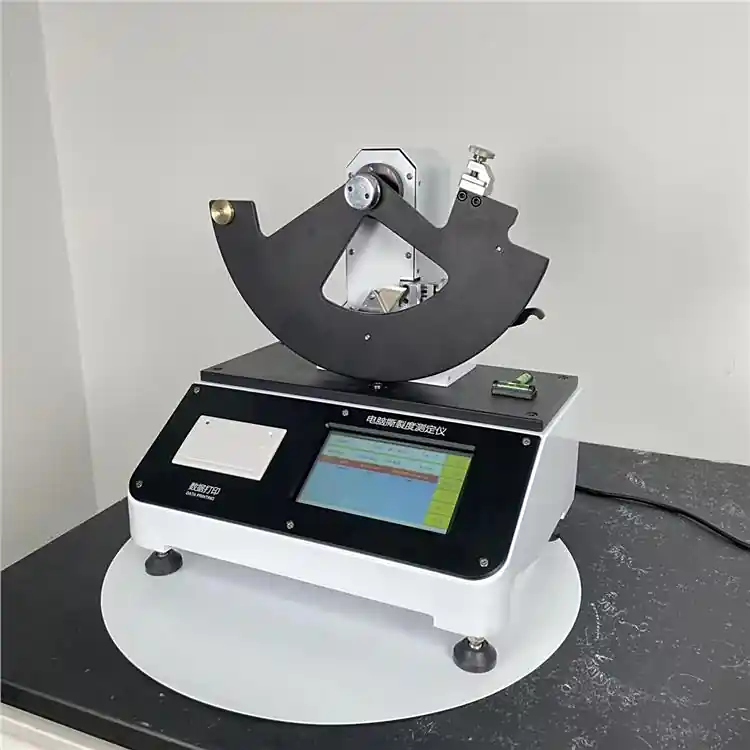




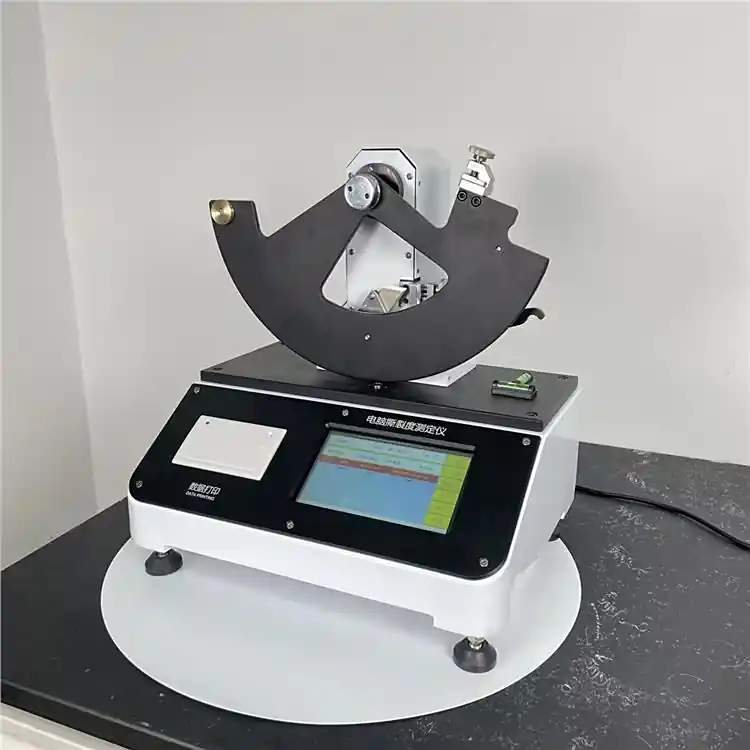
DR-T103 Digital Elmendorf Tearing Tester
The DR-T103 measures the ballistic tear force and energy required to propagate an existing slit across woven fabrics, nonwovens, coated textiles, and high-performance films. Engineered for rigorous laboratory quality control and rapid factory audit inspection conforming strictly to ASTM D1424 and ISO 13937-1.
Quick answer: Choose an Elmendorf tear tester based on modular pendulum ranges (8N up to 128N), pneumatic vs. manual specimen clamping, integrated notch cutter precision (20 ± 0.2 mm), and automatic tare friction zeroing—not bare machine weight. Verify dual-button release safety and direct multi-unit conversion before ordering.
What an Elmendorf Tear Value Tells Quality Teams
Instantaneous Tear Force (N / cN / gf)
Calculated directly from the pendulum's lost potential energy over the standard 43 mm tear path. Represents real-world snagging resistance when clothing snags on sharp obstacles.
Warp vs. Weft Anisotropy
Reveals yarn density imbalance, texturing tension variations, or coating penetration asymmetry between warp (machine direction) and weft (cross direction) orientations.
Yarn Mobility & Resin Brittleness
Chemical resin treatments, flame retardants, or excessive softening agents alter yarn slippage. Low tear strength often indicates chemical over-crosslinking or fiber embrittlement.
Standard Operating Procedure for Reliable Tear Tests
Ballistic tear repeatability requires strict control of sample pre-conditioning, slit cutter sharpness, pneumatic clamping pressure, and tare calibration.
Standard Conditioning & Cutting
Precondition fabrics at 20 ± 2°C and 65 ± 4% RH for ≥16 hours. Cut rectangular specimens (100 × 75 mm) accurately aligned parallel to warp and weft yarns.
Pneumatic Clamp & Slit Notch
Place specimen centered between the fixed and dynamic jaws; trigger pneumatic clamping to eliminate manual torque variation. Depress the cutter to create a clean 20 ± 0.2 mm slit.
Dual-Button Ballistic Release
Depress dual safety release buttons simultaneously. The balanced pendulum falls freely, separating the moving clamp and tearing through the remaining 43 mm fabric zone.
Optical Angle Readout & Brake
High-resolution non-contact rotary optical encoder captures peak rebound angle, instantly calculates tear force, and triggers the electromagnetic safety brake.
Blade Maintenance Rule: A blunt cutting knife tears or frays yarns at the slit root instead of cutting cleanly, causing premature unravelling and falsely low tear force readings. Inspect and replace blades regularly.
Standardized Test Methods & DR-T103 Compliance
| Standard | Scope & Specimen Criteria | DR-T103 Machine Configuration |
|---|---|---|
| ASTM D1424-21 | Standard Test Method for Tearing Strength of Fabrics by Falling-Pendulum (Elmendorf-Type) Apparatus. | Template 100 × 75 mm, slit length 20 ± 0.2 mm, tear path 43 mm, automatic friction calibration, digital optical angle capture. |
| ISO 13937-1:2000 | Textiles — Tear properties of fabrics — Part 1: Determination of tear force using ballistic pendulum method. | Modular weights covering 8N to 128N, jaw face dimensions 25 × 15 mm with serrated rubber or hardened steel finish. |
| GB/T 3917.1 | Textiles — Tear properties of fabrics — Part 1: Impact pendulum method. | Complete weight set A, B, C, D, selectable Chinese/English touchscreen interface, real-time statistical CV% and mean calculation. |
| ISO 4674-2 | Rubber- or plastics-coated fabrics — Determination of tear resistance — Part 2: Ballistic pendulum method. | High-load 64N & 128N pendulum support with reinforced clamp frame to prevent specimen pull-out under heavy loads. |
| ASTM D1922 / ISO 6383-2 | Propagation tear resistance of plastic film and thin sheeting by pendulum method. | Lightweight 8N pendulum and low-inertia shaft bearings engineered for plastic packaging films and thin laminates. |
Lab Compliance Notice: Citing ISO or ASTM tear compliance requires annual dynamic torque calibration using certified check weights and verifying clamp parallelism. The DR-T103 includes calibration certification traceable to ISO 17025.
Choose Elmendorf for High-Speed Ballistic Snagging
Elmendorf measures rapid tear propagation along a pre-cut notch; other testers evaluate static pull, surface friction, or light degradation.
Elmendorf · DR-T103
Evaluates dynamic, high-speed ballistic tear propagation energy in fabrics, coated sheets, and nonwovens.
Tensile Machine (CRE)
Evaluates static grab, strip breaking strength, and tongue tear methods (ASTM D2261) at slow crosshead speeds.
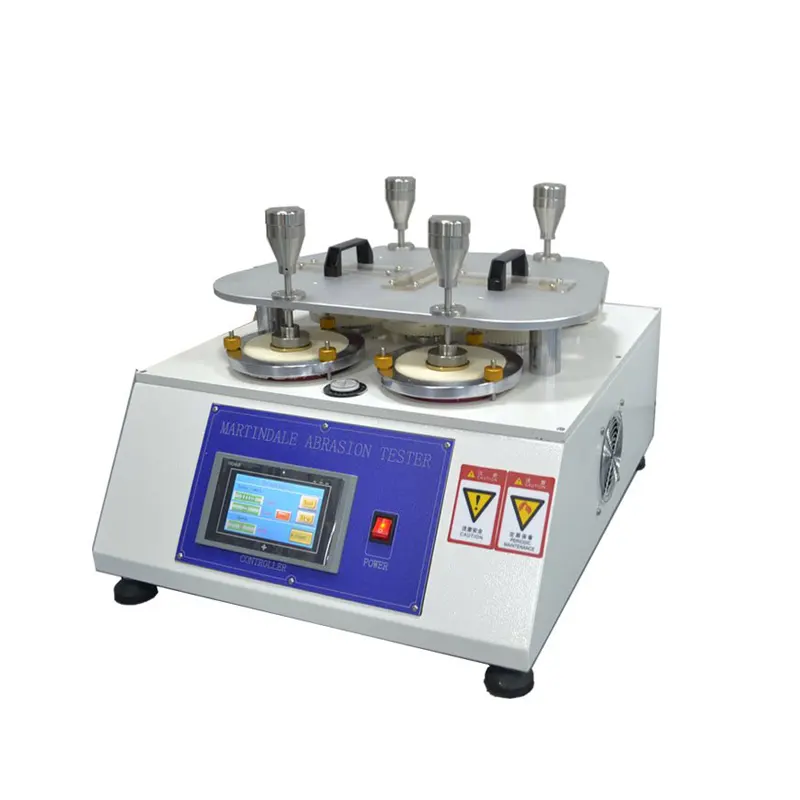
Martindale Abrasion
Assesses surface yarn wear, fuzzing, and pilling resistance under planar multi-directional Lissajous friction.
Xenon Light Fastness
Evaluates photochemical color fading, UV degradation, and fiber embrittlement under simulated solar radiation.
Control the 6 Major Causes of Invalid Elmendorf Data
Jaw Slippage & Pull-Out
Manual clamps often permit fabric slippage under high tear loads, dissipating kinetic energy as friction rather than fiber rupture. Pneumatic clamps resolve this.
Inaccurate Notch Slit Depth
A variation of ±1 mm on the 20 mm initial slit changes remaining tear length by >2%, resulting in substantial percentage errors in recorded force.
Off-Capacity Pendulum Selection
Selecting an oversized pendulum where readings register below 20% scale magnifies bearing tare drag into a massive relative error.
Unleveled Instrument Base
If the chassis bubble level is off-center, the pendulum arm rubs against side stops or swings eccentrically, losing potential energy to friction.
Cross-Tear & Yarn Unraveling
Loosely woven fabrics occasionally tear sideways out of the sample edge rather than straight; standards declare cross-tears invalid for averaging.
Unconditioned Fabric Moisture
Cellulosic fibers (cotton, linen) gain up to 20% tear strength when humid, whereas synthetics may soften; strict conditioning compliance is non-negotiable.
Build a Verifiable DR-T103 RFQ
Specify your target fabrics, applicable test standards, and daily testing throughput to receive an engineered proposal with calibrated weights and tooling.
Testing Scope & Materials
- Target material (Woven, Nonwoven, Coated, Film)
- Testing standard: ASTM D1424, ISO 13937-1, GB/T 3917.1
- Expected tear strength range (e.g., 5N up to 100N)
- Multi-ply stacked testing requirements
Pendulum Weights & Clamping
- Required weight set: 8N, 16N, 32N, 64N, 128N
- Pneumatic automatic clamping vs. Manual screw clamp
- Dual-button safety release protection
- Integrated automatic electromagnetic pendulum brake
Tooling & Verification Kits
- Pneumatic laboratory sample template cutter
- Spare hardened alloy slitting knife blades
- Certified dynamic torque calibration check weights
- Replacement clamp jaw faces (smooth & textured)
Software & Data Traceability
- Integrated color touchscreen microcomputer
- Direct unit conversion (N, cN, gf, lbf)
- USB / RS232 output for LIMS and Excel export
- Factory calibration certificate traceable to ISO 17025
DR-T103 Elmendorf Tear Tester FAQs
01What is the difference between Elmendorf tear testing and tensile testing?
02Why must test results fall between 20% and 80% of pendulum capacity?
03Why choose pneumatic clamping over manual screw clamps?
04Can the DR-T103 test plastic films, paper, and nonwovens?
05How does the tester compensate for bearing friction and air resistance?
06What information is needed to receive a complete DR-T103 quote?
Configure your textile tear testing system: standard + capacity range (8N–128N) + pneumatic clamping + calibration kit.