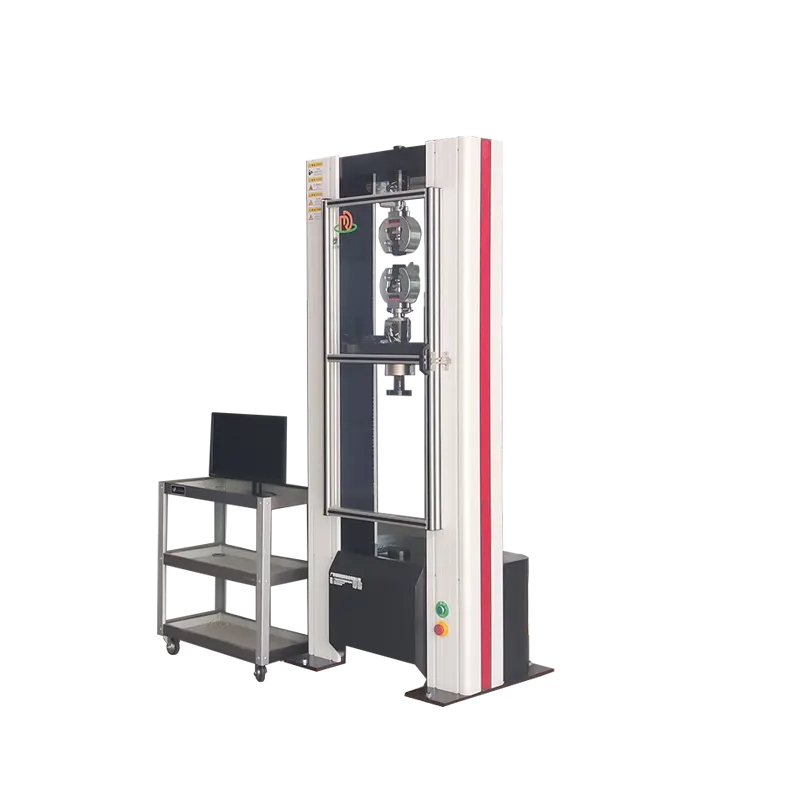
Can you integrate an environmental chamber with a hydraulic tester?
Yes, this is a common and powerful combination. High-force servo-hydraulic frames are often paired with environmental chambers for temperature testing (from -70°C to +300°C or higher). This allows for evaluating material properties under extreme conditions—such as testing aerospace alloys at cryogenic temperatures or polymers at elevated temperatures. The integration requires specially designed chamber access ports and often upgraded seals on the hydraulic actuator.
What is the lead time from order to installation?
Lead times for a custom-configured hydraulic tensile testing machine are typically 16 to 24 weeks. This includes manufacturing of the load frame and power unit, assembly, factory acceptance testing (FAT), and ocean freight. Complex systems with dynamic controllers or large custom fixtures may take longer. It’s crucial to factor in this timeline and any site preparation work (like pouring a foundation) that must be completed before delivery.
What kind of foundation or lab space is needed for installation?
Installation is more involved than for a benchtop unit. Key requirements include:
-
Substantial Foundation: A thick, reinforced concrete floor (often >12 inches) is mandatory to absorb the massive reaction forces and prevent vibration.
-
Adequate Space: Plan for the machine’s footprint plus 3-4 feet of clearance on all sides for operator access, fixture handling, and maintenance.
-
Utilities: Requires a 3-phase electrical supply for the hydraulic power unit and potentially process water cooling. The lab must have adequate ventilation and a stable ambient temperature.
-
Professional Installation: Always requires factory-trained technicians for assembly, alignment, and commissioning.
What are the main applications in the construction industry?
In construction and civil engineering, hydraulic tensile testing machines are indispensable for quality assurance and compliance:
-
Rebar and Pre-stressing Steel: Tensile testing per ASTM A615, A706, and A416 to verify yield strength, tensile strength, and elongation.
-
Concrete Compression: Testing cylinders and cores per ASTM C39/C39M using high-capacity compression platens.
-
Geosynthetics and Soil Mechanics: Wide-width tensile tests on geotextiles and geogrids (ASTM D4595) and direct shear tests.
-
Anchors and Fasteners: Proof testing and determining ultimate load capacity of post-installed anchors and heavy-duty bolts.
Can a hydraulic tensile tester perform low-cycle fatigue tests?
Absolutely. This is a core strength of a servo-hydraulic system. These machines are exceptionally well-suited for low-cycle fatigue (LCF) testing, where materials are subjected to high-strain, cyclic loads until failure (typically from 1 to 100,000 cycles). The fast response of the servo valve allows for precise control of complex load or strain waveforms, making them ideal for studying the durability of welds, aerospace components, and structural metals under simulated service conditions per standards like ASTM E606.
What maintenance does a hydraulic UTM require, and how often?
Regular maintenance is crucial for reliability and accuracy. Key tasks include:
-
Daily/Weekly: Check for hydraulic oil leaks, verify fluid levels, and inspect hose connections.
-
Every 6-12 Months: Change hydraulic filters and perform an oil analysis to check for contamination or degradation.
-
Annually: Schedule a professional preventive maintenance and calibration service by the manufacturer or an accredited lab. This ensures all sensors, the servo valve, and the controller are performing to specification. Derui offers comprehensive service contracts to manage this proactively.
What is the difference between a servo-hydraulic and a standard hydraulic tester?
The key difference is control precision. A standard (or open-loop) hydraulic tester uses manual valves to apply force, offering basic functionality for simple break tests. A servo-hydraulic tensile testing machine employs a closed-loop digital control system. It uses real-time feedback from sensors to a servo valve, allowing for precise control of load, displacement, or strain. This enables not only highly accurate static tests but also complex dynamic waveforms, sine waves, and fatigue cycles, making it essential for modern R&D and certification labs.
What industries are the primary users of hydraulic UTMs?
Key industries include:
-
Construction & Civil Engineering: For testing rebar, concrete, tendons, and soil/geo-synthetics.
-
Aerospace & Defense: For testing large composite structures and landing gear components.
-
Heavy Manufacturing: For validating the strength of large forgings, castings, and welded assemblies.
-
Automotive: For testing chassis components, axles, and suspension parts, especially for fatigue life.
-
Research & Certification Labs: For conducting advanced material research and providing third-party certification for large-scale products.
Can a hydraulic tester perform static, dynamic, and fatigue tests?
Yes, this is a key advantage. A modern servo-hydraulic tensile testing machine with a digital controller can be configured for standard static tension/compression tests, low-cycle fatigue tests, and high-frequency dynamic tests. The same machine can be a versatile hub for both routine QC and advanced R&D.
What kind of maintenance does a hydraulic UTM require?
Regular maintenance includes monitoring and changing hydraulic fluid and filters, checking for leaks, and verifying system calibration. Compared to electromechanical systems, they require more attention to the hydraulic power unit but are exceptionally robust. Derui provides clear maintenance schedules and offers comprehensive service contracts to ensure optimal performance and uptime.
What is the typical force range and cost for a hydraulic tensile testing machine?
Force capacities typically start around 300kN and can exceed 10,000kN. Prices vary significantly with capacity and sophistication, generally starting in the range of $10,000 to $30,000 for a basic static system and can exceed $20000 for high-capacity systems with dynamic controllers and advanced software. Request a detailed quote based on your specific force, space, and application needs.
What is the main difference between an electromechanical and a hydraulic tensile testing machine?
Electromechanical UTMs use a motor and ball screw to generate force and are ideal for precise, lower-force applications (typically up to 300kN). Hydraulic tensile testing machines use a hydraulic actuator and are designed for much higher forces (300kN to 10,000kN+), longer strokes, and dynamic/fatigue testing capabilities, making them suitable for heavy construction materials and large components.
What is the lead time, and what support is included after purchase?
Lead times typically range from 4 to 6 weeks for standard configurations, depending on customization. Every Derui system includes:
-
Professional Installation & Commissioning: Our engineers ensure it's set up correctly.
-
Comprehensive On-Site Training: We train your operators on hardware and software.
-
Warranty & Ongoing Support: Access to technical support, spare parts, and calibration services to ensure your lab's productivity for years to come.
What are some typical industry applications for these machines?
Our floor-standing UTMs are used across industries for critical testing:
-
Automotive: Testing seat belts, airbag fabrics, metal brackets, and composite panels.
-
Aerospace: Qualifying lightweight alloys, composite laminates, and fastener systems.
-
Construction: Verifying the yield strength of rebar and the performance of structural connectors.
-
Medical Devices: Validating the strength of bone screws, joint implants, and surgical tooling.
How do I choose between a single-column and a dual-column (floor-standing) UTM?
Choose based on your force requirements and needed precision:
-
Single-Column (Benchtop): Best for lower force tests (typically <5 kN), smaller samples (plastics, thin metals, textiles), and labs with severe space/budget constraints.
-
Dual-Column (Floor-Standing): Essential for higher forces (>5 kN to 1,000+ kN), superior alignment/rigidity for accurate modulus on stiff materials, and accommodating larger fixtures or environmental chambers. It's the choice for industrial QC and advanced R&D.
What kind of maintenance and calibration services are needed?
To ensure ongoing accuracy and data integrity, we recommend:
-
Regular Calibration: Annual calibration by an accredited service (traceable to NIST) is standard for quality labs. Derui offers global calibration services.
-
Preventive Maintenance: Periodic lubrication and inspection of mechanical components.
-
Software Updates: Keeping the control and analysis software up to date.
We offer comprehensive service contracts to cover calibration, maintenance, and technical support, ensuring your investment is protected.