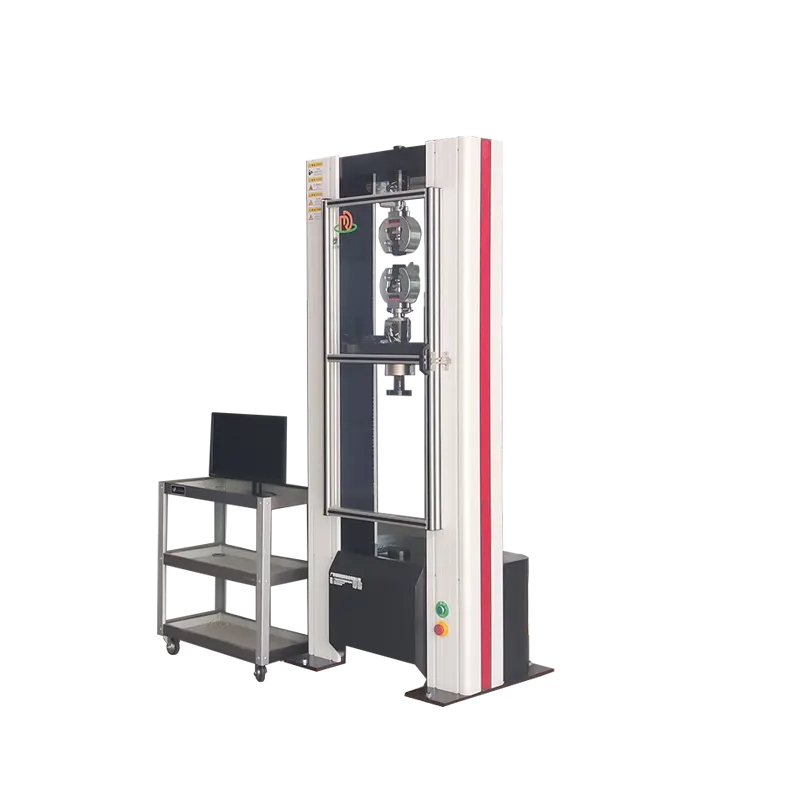
Can a floor-standing UTM perform tests other than tension, like compression or bending?
Absolutely. A key advantage of a universal testing machine is its versatility. By simply changing the grips and fixtures, the same system can perform:
-
Compression Tests: Using compression platens for concrete, foam, or components.
-
Flexure (Bend) Tests: Using 3-point or 4-point bend fixtures for plastics or beams.
-
Shear and Peel Tests: With specialized fixtures for adhesives and composites.
What lab space and setup is required for installation?
These are permanent installations requiring planning. Key requirements include:
-
A Solid, Level Floor: Typically reinforced concrete.
-
Adequate Footprint: Allow for the machine's base plus 2-3 feet of clearance on all sides for operator access and maintenance.
-
Power: Most models require 3-phase electrical power. Specific voltage and amperage will depend on the force capacity.
-
Environment: A stable, climate-controlled lab environment is recommended for optimal accuracy. Our team provides detailed site preparation guides and can often manage turnkey installation.
How accurate are floor-standing UTMs compared to benchtop models?
Floor-standing UTMs are designed for superior accuracy, especially for stiff materials. Their dual-column design provides exceptional frame rigidity (stiffness), which minimizes deflection during testing. This is critical for obtaining precise modulus of elasticity (Young's Modulus) measurements. They are calibrated to meet or exceed stringent standards like ASTM E4 and ISO 7500-1, often achieving force accuracies within ±0.5% of the indicated load or better.
What materials and applications are floor-standing UTMs best suited for?
Floor-standing UTMs are engineered for high-force and high-precision testing of robust materials. They are the ideal choice for:
-
Metals: Tensile testing of steel, aluminum, and alloys per ASTM E8 / ISO 6892.
-
Composites: Characterizing the strength and modulus of carbon fiber and fiberglass laminates.
-
Construction Materials: Testing concrete rebar, structural components, and plastics.
-
Finished Components: Performing proof, flexure, and crush tests on automotive, aerospace, or industrial parts.
What is the typical price range for a floor-standing universal testing machine?
The cost of a floor-standing UTM varies significantly based on force capacity, controller sophistication, and accessories. A basic system might start in the range of $7000 to $15000, while high-capacity models (300kN+) with advanced software, video extensometers, or environmental chambers can range from $10000 to over $20000. For an accurate quote tailored to your specific testing needs (materials, standards, throughput), we recommend contacting our engineering team for a detailed configuration and price.
Can these machines be upgraded with new accessories or controllers?
Yes. The modular design allows for the addition of new grips, extensometers (including non-contact video systems), environmental chambers, and even controller upgrades. This future-proofs your investment against evolving testing standards and requirements.
How does the software for these advanced UTMs differ?
Software for high-end floor-standing UTMs includes features for complex test programming (multi-stage profiles, loops, external sensor input), advanced analysis modules (for anisotropy, energy calculation), enhanced data security and traceability, and robust networking capabilities for integration into Laboratory Information Management Systems (LIMS).
What kind of laboratory space and preparation is required?
A firm, level concrete floor is essential. The machine requires a defined footprint, access to standard three-phase electrical power (for higher-capacity models), and sufficient clearance for operator access and fixture handling. We provide detailed site preparation guidelines and can offer installation services.
What are the main advantages of a floor-standing UTM over a large benchtop model?
Floor-standing models offer significantly greater frame rigidity (higher stiffness), which is critical for accurate modulus measurement on stiff materials. They typically have higher force capacities (often >50kN), larger test spaces for environmental chambers, and are installed as permanent, vibration-damped systems, enhancing long-term stability and accuracy.
How do I choose between a single-column and a dual-column benchtop tester?
For most low-to-medium force applications on standard materials, a single-column benchtop tester is perfectly sufficient and more cost-effective. Choose a dual-column benchtop model if you require superior frame rigidity for slightly higher forces, slightly larger samples, or the utmost alignment precision for advanced research applications. Our engineers can help you decide.
Can the system be upgraded later with new grips or an extensometer?
Yes, modularity is a key feature. You can start with a core system and easily expand its capabilities later by adding specialized grips for different materials, high-precision extensometers for strain measurement, or even environmental chambers for temperature testing.
What kind of after-sales support and calibration service is available?
We provide full lifecycle support: installation guidance, operator training, a comprehensive warranty, and access to technical support. We also offer certified calibration services to ensure your machine maintains traceable accuracy. Long-term spare parts availability is guaranteed to minimize future downtime.
How much bench space is required, and do we need any special lab preparation?
Benchtop testers are designed for space efficiency. A typical unit requires less than 1 square meter of bench space. No special lab preparation (like reinforced floors) is needed. Simply ensure the bench is sturdy, level, and can support the machine's weight (usually under 100kg).
Can a benchtop tensile tester also do compression, bend, and peel tests?
Absolutely. This is a core benefit. A benchtop universal testing machine (UTM) is a modular platform. By using dedicated fixtures (compression platens, bend fixtures, peel grips), the same machine can perform a wide range of tests—tensile, compression, flexure, shear, and peel—making it an incredibly versatile and cost-effective lab centerpiece.
Is it difficult to install and operate a benchtop tester? Do we need special training?
A major advantage of benchtop testers is their plug-and-play simplicity. They require minimal installation—just a standard power outlet and a level bench. Operation is streamlined through intuitive software. We include comprehensive initial training with every system, enabling most operators to perform standard tests proficiently after a short familiarization period.
How accurate are benchtop tensile testers compared to larger machines?
High-quality benchtop tensile testers, like those from Derui, are engineered for laboratory-grade accuracy. They utilize precision load cells and robust frames to ensure data integrity and repeatability that meet or exceed international standards (ASTM, ISO). The key difference is not accuracy, but maximum force capacity and frame rigidity for larger samples.