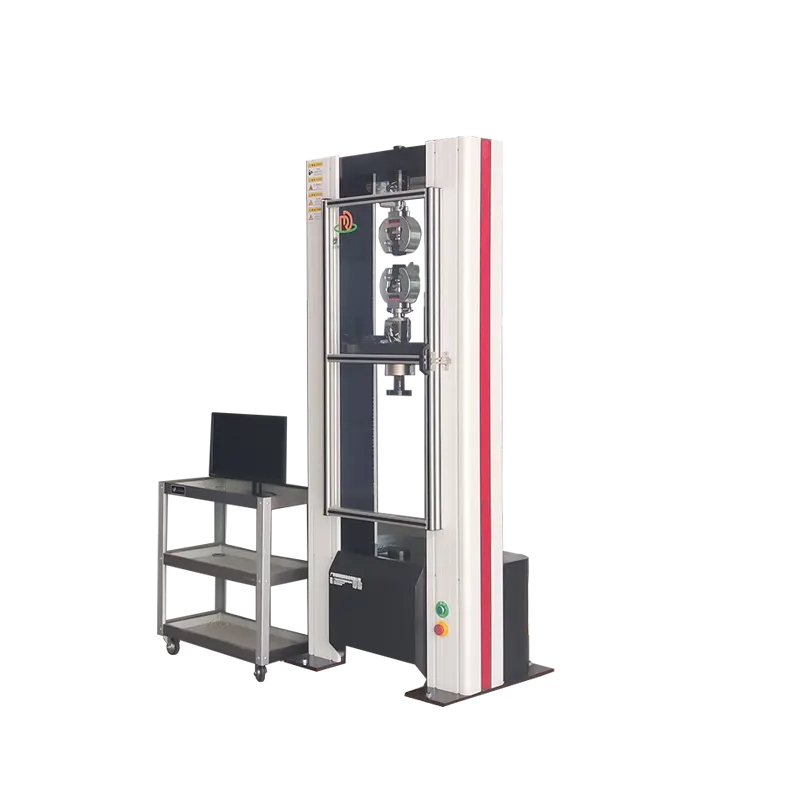
What test speed should I use, and why does it matter?
Speed is critical for comparable results. ASTM D642 specifies 12.7 mm/min (0.5 in/min) for BCT. Different speeds can yield different peak load values because materials behave differently under varying strain rates. Always follow the speed prescribed by your target standard.
How do I estimate the force capacity needed for my boxes?
A rough estimate can be made using the box’s perimeter (2*(Length+Width) in inches) and the target stacking load. However, the only sure way is to test representative samples. Our engineers can help you analyze your typical box sizes and storage conditions to recommend an appropriate machine capacity.
What’s the difference between BCT (Box Compression Test) and ECT (Edge Crush Test)?
ECT measures the linerboard’s crushing strength perpendicular to the flutes (a material property). BCT measures the finished box’s overall stacking strength (a performance property). While related, BCT is the definitive test for predicting real-world warehouse performance. ECT is used in box strength estimation formulas like McKee.
Do your systems support Combined Environmental Stress Testing (CEST)?
Absolutely. Our shakers are engineered for seamless integration with thermal chambers (both mechanical convection and liquid-to-liquid) to perform simultaneous vibration and temperature cycling. This CEST capability is crucial for uncovering failures that only occur under combined stresses, which is a requirement in many advanced automotive, aerospace, and defense validation programs.
How do I accurately calculate the required force (thrust) rating for my shaker system?
The basic formula is Force (lbf or N) = Total Moving Mass x Peak Acceleration. The “Total Moving Mass” must include your heaviest Device Under Test (DUT), its fixture, and the shaker armature/head expander. For random vibration, you must calculate using the peak acceleration in the profile, not just the GRMS value. We strongly recommend a safety margin of 30-50% over your calculated peak force to ensure headroom and system longevity. Our engineering team provides free thrust calculations as part of the consultation.
What is the difference between random and sine vibration testing, and which does my product need?
Sine vibration applies a single, controllable frequency at a time, ideal for resonance search and dwell testing to find and stress product weaknesses at specific frequencies. Random vibration simultaneously applies a broad spectrum of frequencies, better simulating real-world environments like transportation or operational stress. Most standards require one or both; our experts can help you define the profile based on your product’s lifecycle and applicable MIL-STD, IEC, or ISO standards.
How often should Vibration Testing be performed?
The frequency of Vibration Testing depends on various factors, including the specific industry standards, the critical nature of the product, and any design changes. Generally, it is advisable to perform vibration tests during the development phase, after significant modifications, and periodically for maintenance to ensure ongoing product reliability.
What should I consider when choosing a Vibration Test System?
When selecting a Vibration Test System, consider factors such as the frequency range and acceleration level required for your specific application, the size and weight of the items to be tested, data acquisition capabilities, and the ease of use of the system. It's also important to assess the manufacturer's reputation and customer support services.
What industries utilize Vibration Test Systems?
Vibration Test Systems are utilized across a variety of industries, including aerospace, automotive, electronics, telecommunications, and medical devices. Each industry has specific testing requirements related to the types of vibrations encountered during use, making vibration testing crucial for product development and quality assurance.
What are the benefits of using Vibration Test Systems?
Using Vibration Test Systems has numerous benefits, including identifying potential product failures before they occur, ensuring compliance with industry standards, enhancing product reliability, and minimizing costly recalls. They can also help in refining product designs and improving customer satisfaction by delivering robust, quality products that withstand expected operational conditions.
We need to upgrade from single-axis to multi-axis testing. Is this possible?
Many of our systems are designed with scalability in mind. It is often possible to upgrade a single-axis vertical shaker to a multi-degree-of-freedom (MDOF) system by adding horizontal slip tables and additional controllers. Consult with us about your future roadmap.
Do you provide installation, training, and IQ/OQ services?
Yes. We offer turnkey solutions including professional installation, comprehensive operator training, and full documentation packages (Installation/Operational Qualification) to support your quality system and regulatory audits.
What kind of maintenance do these systems require?
Regular maintenance includes checking armature air gaps, cleaning/replacing cooling filters, verifying torque on mounting hardware, and annual calibration of the shaker, amplifier, and control sensors to ensure ongoing accuracy.
Why is fixture design so important?
A poorly designed fixture can dampen vibration, create unintended resonances, or even fail catastrophically. It must rigidly couple the DUT to the shaker table while being as lightweight as possible to maximize usable force. We offer expert fixture design consultation.
Can one system perform sine, random, and shock testing?
Yes, a modern digital vibration controller allows a single electrodynamic shaker system to generate precise sine, random, and classical shock waveforms. The system must have sufficient displacement and frequency range to cover all your target profiles.
How do I calculate the required force (thrust) for my application?
The fundamental formula is Force (N) = [Mass of DUT + Mass of Fixture] x Acceleration (m/s²). Always include fixture mass and account for peak acceleration in your profile. Our application