What training ensures proper chamber operation?
We provide comprehensive certification programs: Basic Operator (4 hours), Advanced Programming (8 hours), and Maintenance Technician (16 hours)—all with competency testing and annual refresher courses included.
How does your chamber reduce energy consumption?
Our EcoMode technology reduces energy use 30-40% through variable-speed compressors, heat reclaim systems, and intelligent defrost cycles. Typical 64 cu.ft. chamber operates on ≤ 4 kW at 23°C versus industry standard 5-6 kW.
What's the lead time for custom chamber configurations?
Standard units: 8-12 weeks. Custom walk-in rooms: 14-20 weeks. Critical path items include compressor manufacturing (6 weeks) and control system programming (2 weeks). We maintain inventory of common components to accelerate delivery.
How do we validate chamber performance before purchase?
Request third-party uniformity mapping per ISO 17025 with your actual test load. Reputable suppliers provide this data showing temperature/RH at 9-27 points throughout the workspace under loaded conditions.
Can chambers simulate altitude/pressure changes?
Yes—combined environment chambers integrate vacuum systems to simulate altitudes up to 100,000 feet while maintaining temperature/humidity control. Critical for air freight validation and electronics testing.
What maintenance prevents most chamber failures?
Monthly filter inspection (clogged filters cause 40% of compressor failures), quarterly drain line flushing (preventing biological growth), and semi-annual calibration verification catch 85% of potential issues before they cause downtime.
How does chamber size affect temperature uniformity?
Uniformity correlates directly with workspace volume utilization. For optimal ±0.5°C uniformity, load should not exceed 70% of advertised volume. Our engineers provide loading configuration templates ensuring consistent results regardless of chamber size.
What are the key maintenance tasks, and how often should calibration be performed?
Daily/Weekly: Visually inspect for damage, clean platens.
Monthly: Check and tighten fasteners, verify machine level.
Annually: Perform a full metrological calibration by an accredited service (traceable to NIST or equivalent). This includes load cell verification, crosshead speed accuracy, and platen parallelism check. We provide scheduled calibration reminders and services to ensure your data is always audit-ready.
What data should I look for beyond just the “peak load” in a compression test report?
While peak load (BCT) is key, the full force-deformation curve provides invaluable insights:
-
Stiffness (Slope): Indicates how rigid the package is.
-
Energy to Failure (Area under curve): Measures total toughness.
-
Deformation at Peak Load: Shows how much the box bulges before collapsing.
Our advanced software automatically calculates and reports these parameters, giving you a complete picture of package performance for superior design analysis.
How do environmental conditions (temperature & humidity) affect compression results, and how can we test for this?
Corrugated fiberboard is hygroscopic; its strength decreases significantly in high humidity. To simulate real-world distribution, standards often require testing after conditioning (e.g., 48 hours at 23°C and 50% RH per ASTM D4332). For advanced analysis, our testers can be integrated with environmental chambers to perform compression tests under controlled hot, cold, or humid conditions.
We have both small cartons and large pallets. Do we need two separate machines?
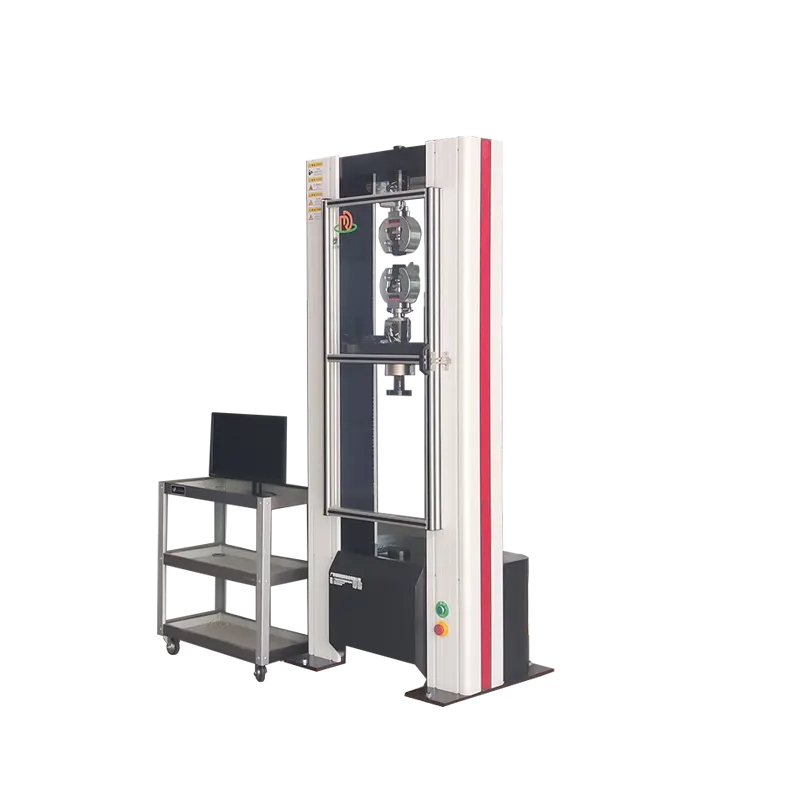
Not necessarily. A high-capacity universal testing machine (UTM) with interchangeable platens and a large test space can be the most cost-effective solution for labs with diverse needs. It can perform BCT on small boxes, switch to large platens for pallets, and even run material tests. We can help you size a single, versatile system to cover your entire range.
What is the importance of platen parallelism, and how is it maintained?
Perfect platen parallelism is critical for applying uniform, axial force and preventing premature failure due to uneven loading. Our testers feature spherical-seat self-aligning lower platens and rigid construction to achieve and maintain parallelism. Regular verification (per calibration schedule) ensures ongoing accuracy and test validity.
Can your tester help us comply with Amazon’s (or other retailer’s) packaging certification requirements?
Yes. Many retailer-specific certification programs, including Amazon’s Frustration-Free Packaging (FFP), require documented compression testing (like ISTA 3A or 6-AMAZON) to prove package integrity. Our systems generate the precise, auditable test reports you need for submission, helping you avoid non-compliance fees and ensure shelf-ready packaging.
How many samples should we test to get a statistically valid BCT result?
Industry standards like ASTM D642 recommend testing a minimum of 10-12 identical samples under controlled conditioning to account for natural material variation and obtain a reliable average strength value with a calculable standard deviation. For new designs or critical quality disputes, a larger sample size (20+) is advisable.
Do you offer systems that can automatically calculate stacking strength?
Yes. Our advanced software packages can use the BCT result, along with a defined safety factor and other parameters, to automatically calculate and report the maximum recommended stacking height for your boxes in a warehouse.
Can I use a universal tester for box compression tests?
Yes, a universal testing machine (UTM) equipped with large compression platens and appropriate software can perform BCT and many other tests. It offers superior flexibility but may have a higher initial cost than a dedicated BCT machine. It’s ideal for labs that also test materials in tension, peel, or flexure.