
Derui is a specialized manufacturer and supplier of material testing equipment.Our products serve quality control, research, and development needs
across industries like aerospace, automotive, and manufacturing.
Box & Packaging Compression Testers: Ensure Stacking Strength & Prevent Shipping Damage
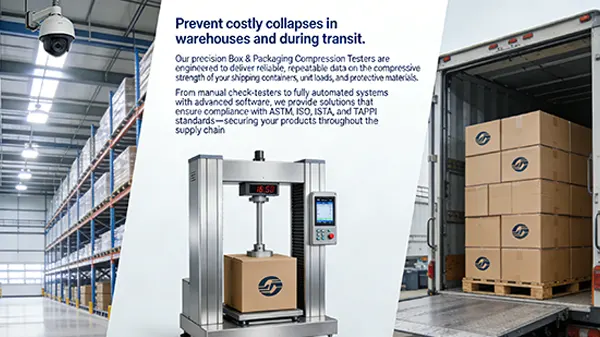
Prevent costly collapses in warehouses and during transit. Our precision Box & Packaging Compression Testers are engineered to deliver reliable, repeatable data on the compressive strength of your shipping containers, unit loads, and protective materials. From manual check-testers to fully automated systems with advanced software, we provide solutions that ensure compliance with ASTM, ISO, ISTA, and TAPPI standards—securing your products throughout the supply chain.
Beyond basic validation, this data empowers your team to make informed decisions—optimizing packaging design to reduce material use, validating new suppliers, and preventing over- or under-packaging. This turns your QC lab from a cost center into a strategic asset for profitability and brand protection.
Validate Packaging to Withstand Real-World Forces
Simulates: Warehouse stacking pressure, transportation compressive loads, and top-load handling stresses on packaging systems.
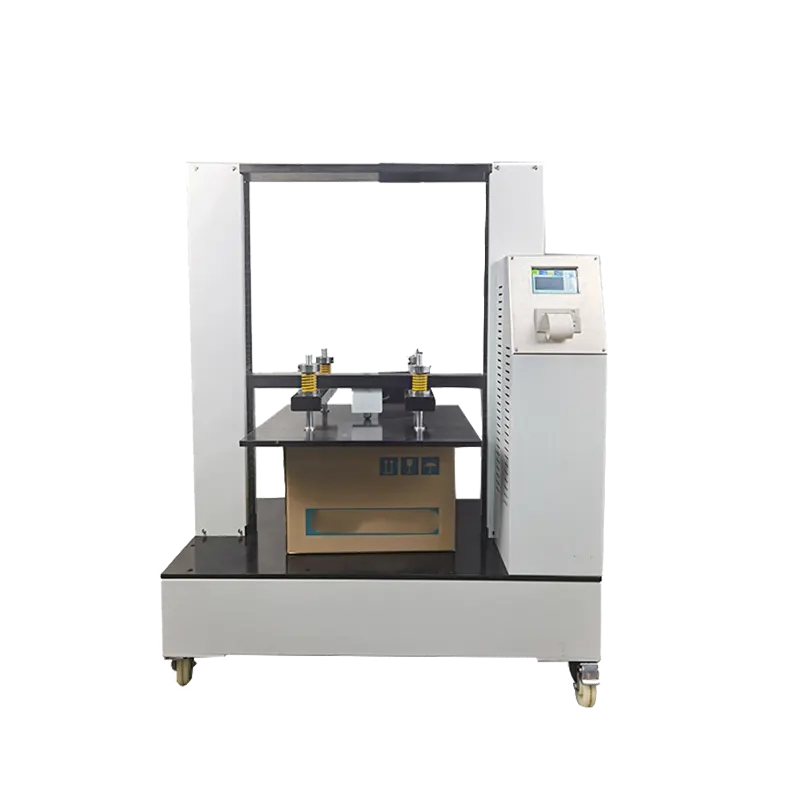
Why Choose Our Compression Testers
Engineered for Accuracy & Compliance: Our testers feature rigid frames, precision load cells, and accurate crosshead control to generate data that meets or exceeds the requirements of ASTM D642, ISO 12048, ISTA 3A, and TAPPI T804. Ensure your reports pass rigorous audits.
From Simple QC to Advanced R&D: Whether you need a basic pass/fail checker for production lines or a system that outputs full stress-strain curves for material development, we offer a scalable range. Our advanced software provides detailed analysis of peak load, deformation, and stacking strength calculations.
Built for Durability & User Safety: Constructed with heavy-duty steel and featuring emergency stop controls, overload protection, and secure guarding, our machines are built to withstand daily use in industrial QC labs while prioritizing operator safety.
Optimize Design & Save Material Costs: Go beyond simple validation. Use precise compression data to identify over-engineering, optimize corrugated flute combination, right-size cushioning, and validate lighter-weight packaging—reducing material costs without compromising protection.
How to Choose the Right Packaging Compression Tester
Selecting the correct tester is key to obtaining actionable data. Follow this 4-point guide.
1. Define Your Primary Test Type & Standard
Box Compression (BCT): The cornerstone test for shipping containers. Ensure the machine meets ASTM D642 or ISO 12048.
Top Load/Crush Resistance: For bottles, cans, and thin-walled containers. Key for ASTM D2659 (plastic bottles).
Pallet/Unit Load Stacking: Requires larger platens and higher force capacity. Governed by ASTM D1185 and ISTA 3E.
Cushioning Material Properties: For foams (EPE, EPS, PU). Requires controlled compression and recovery cycles per ASTM D3574.
2. Determine Critical Technical Specifications
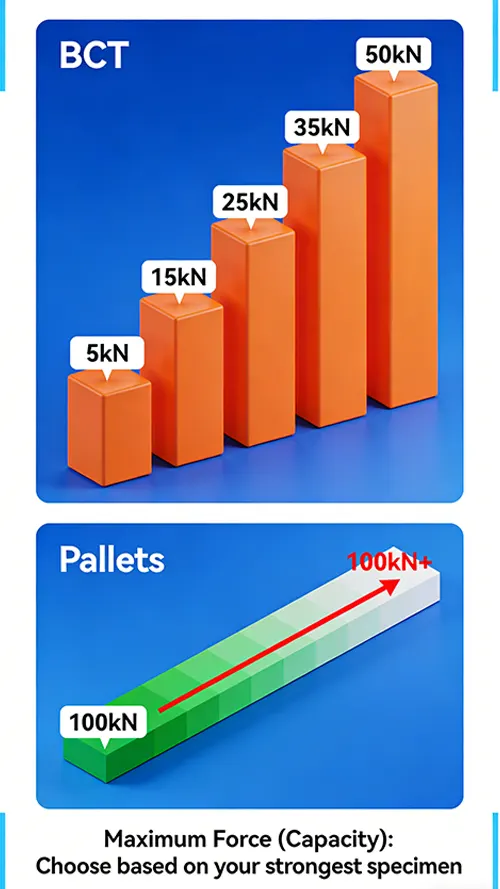
Maximum Force (Capacity): Choose based on your strongest specimen. For BCT, common ranges are 5kN (~500kgf) to 50kN (~5000kgf). For pallets, 100kN+ may be needed.
Test Space (Platen Size & Distance): Must accommodate your largest box or pallet footprint. Test Space (Platen Size & Distance): Must accommodate your largest box or pallet. Verify the opening’s width, depth, and the maximum height between the platens.
Data Output & Control: Decide between a simple digital peak-hold indicator or a PC-based system that controls test speed, records the entire force-deformation curve, and generates automated reports.
3. Consider Your Workflow & Accessories
Automation Needs: High-volume labs benefit from automatic height adjustment, barcode scanning, and direct ERP integration.
Specialized Fixtures: Spherical self-alignment platens for BCT, custom bottle holders for top-load tests, and large steel platens for pallets.
Environmental Conditioning: For testing packages or materials at specific temperatures/humidity (e.g., after conditioning per ASTM D4332).
4.Plan for Support & Calibration
Calibration: Ensure the supplier offers traceable calibration services (to NIST, ISO 17025) for the load cell and system.
Training & Software Updates: Verify that comprehensive operator training and ongoing software support are included.
A Box Compression Tester (BCT) is a specialized piece of packaging lab equipment designed to apply a controlled compressive force to a shipping container (like a corrugated box) until it deforms or collapses. It measures the maximum load the box can withstand, which directly correlates to its stacking strength in a warehouse environment.
This data is critical for performance-based packaging design. It allows engineers to move away from rule-of-thumb designs and create containers that are strong enough to protect their contents efficiently, often leading to significant reductions in material use, weight, and cost, while also supporting sustainability goals.
The testing process follows a standardized, controlled sequence to ensure reproducibility:
1.Conditioning: Specimens are placed in a standard atmosphere (e.g., 23°C, 50% RH) per ASTM D4332 to normalize moisture content.
2.Specimen Placement: The box, package, or material is centered on the lower compression platen of the tester.
3.Test Configuration: The operator sets the test speed (typically 12.7 ± 2.5 mm/min for BCT) and parameters in the software or controller.
4.Application of Force: The upper platen descends at a constant rate, applying increasing compressive force to the specimen.
5.Data Capture: The load cell records the force in real-time. The system tracks the corresponding deformation (strain).
6.Failure & Analysis: The test continues until a pre-defined drop in load (indicating collapse) or a maximum deformation is reached. The software calculates key results: Peak Load (BCT Value), Stiffness, and Work Done.
More Than a Number: Your Packaging Optimization Hub
Modern compression testers provide data that drives critical business decisions across the packaging lifecycle.
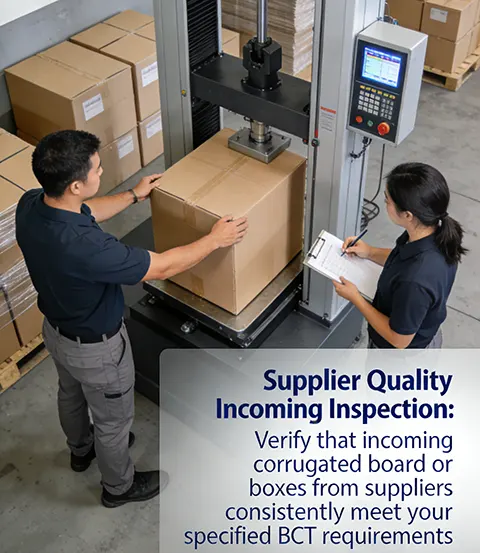
Supplier Quality Incoming Inspection
Verify that incoming corrugated board or boxes from suppliers consistently meet your specified BCT requirements.
Design Validation & Prototyping
Test new box designs, flute profiles, or internal partitions to ensure they meet distribution challenges before full-scale production.
Cost-Reduction Projects
Quantify the strength of lighter-weight or alternative materials, providing the hard data needed to approve design changes that save money.
Root-Cause Analysis of Field Failures
Replicate warehouse stacking scenarios to diagnose why a package failed in the field and develop a corrective action.
Frequently Asked Questions About
What’s the difference between BCT (Box Compression Test) and ECT (Edge Crush Test)?
ECT measures the linerboard’s crushing strength perpendicular to the flutes (a material property). BCT measures the finished box’s overall stacking strength (a performance property). While related, BCT is the definitive test for predicting real-world warehouse performance. ECT is used in box strength estimation formulas like McKee.
How do I estimate the force capacity needed for my boxes?
A rough estimate can be made using the box’s perimeter (2*(Length+Width) in inches) and the target stacking load. However, the only sure way is to test representative samples. Our engineers can help you analyze your typical box sizes and storage conditions to recommend an appropriate machine capacity.
What test speed should I use, and why does it matter?
Speed is critical for comparable results. ASTM D642 specifies 12.7 mm/min (0.5 in/min) for BCT. Different speeds can yield different peak load values because materials behave differently under varying strain rates. Always follow the speed prescribed by your target standard.
Can I use a universal tester for box compression tests?
Yes, a universal testing machine (UTM) equipped with large compression platens and appropriate software can perform BCT and many other tests. It offers superior flexibility but may have a higher initial cost than a dedicated BCT machine. It’s ideal for labs that also test materials in tension, peel, or flexure.
Do you offer systems that can automatically calculate stacking strength?
Yes. Our advanced software packages can use the BCT result, along with a defined safety factor and other parameters, to automatically calculate and report the maximum recommended stacking height for your boxes in a warehouse.
How many samples should we test to get a statistically valid BCT result?
Industry standards like ASTM D642 recommend testing a minimum of 10-12 identical samples under controlled conditioning to account for natural material variation and obtain a reliable average strength value with a calculable standard deviation. For new designs or critical quality disputes, a larger sample size (20+) is advisable.
Can your tester help us comply with Amazon’s (or other retailer’s) packaging certification requirements?
Yes. Many retailer-specific certification programs, including Amazon’s Frustration-Free Packaging (FFP), require documented compression testing (like ISTA 3A or 6-AMAZON) to prove package integrity. Our systems generate the precise, auditable test reports you need for submission, helping you avoid non-compliance fees and ensure shelf-ready packaging.
What is the importance of platen parallelism, and how is it maintained?
Perfect platen parallelism is critical for applying uniform, axial force and preventing premature failure due to uneven loading. Our testers feature spherical-seat self-aligning lower platens and rigid construction to achieve and maintain parallelism. Regular verification (per calibration schedule) ensures ongoing accuracy and test validity.
We have both small cartons and large pallets. Do we need two separate machines?
Not necessarily. A high-capacity universal testing machine (UTM) with interchangeable platens and a large test space can be the most cost-effective solution for labs with diverse needs. It can perform BCT on small boxes, switch to large platens for pallets, and even run material tests. We can help you size a single, versatile system to cover your entire range.
How do environmental conditions (temperature & humidity) affect compression results, and how can we test for this?
Corrugated fiberboard is hygroscopic; its strength decreases significantly in high humidity. To simulate real-world distribution, standards often require testing after conditioning (e.g., 48 hours at 23°C and 50% RH per ASTM D4332). For advanced analysis, our testers can be integrated with environmental chambers to perform compression tests under controlled hot, cold, or humid conditions.
What data should I look for beyond just the “peak load” in a compression test report?
While peak load (BCT) is key, the full force-deformation curve provides invaluable insights:
-
Stiffness (Slope): Indicates how rigid the package is.
-
Energy to Failure (Area under curve): Measures total toughness.
-
Deformation at Peak Load: Shows how much the box bulges before collapsing.
Our advanced software automatically calculates and reports these parameters, giving you a complete picture of package performance for superior design analysis.
What are the key maintenance tasks, and how often should calibration be performed?
Daily/Weekly: Visually inspect for damage, clean platens.
Monthly: Check and tighten fasteners, verify machine level.
Annually: Perform a full metrological calibration by an accredited service (traceable to NIST or equivalent). This includes load cell verification, crosshead speed accuracy, and platen parallelism check. We provide scheduled calibration reminders and services to ensure your data is always audit-ready.