
Derui is a specialized manufacturer and supplier of material testing equipment.Our products serve quality control, research, and development needs
across industries like aerospace, automotive, and manufacturing.
Paper & Board Testing: Precision Instruments for Packaging & Material Integrity
Paper and paperboard are engineered materials where precise physical properties directly dictate performance. Our specialized Paper & Board Testing Equipment provides the critical data needed to predict real-world behavior—from the stacking strength of a shipping container to the runnability of paper on a high-speed press. Move beyond guesswork with instruments designed to execute international standards with accuracy and repeatability, ensuring your materials and final products meet specifications for quality, cost-efficiency, and durability.
Core Testing Solutions for Paper & Board
Explore our range of dedicated testers designed to measure the fundamental properties that define paper and board performance.
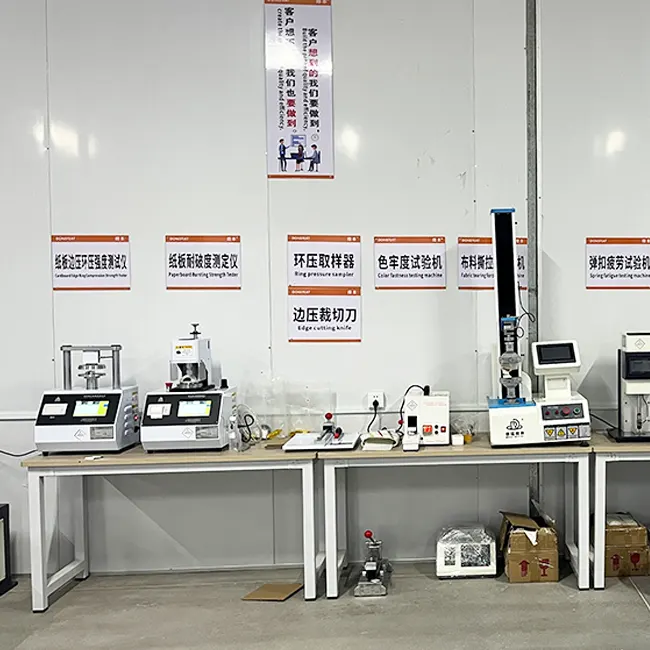
Why Choose Derui for Paper & Board Testing?
Engineered for Standards Compliance
Every instrument is built to meet the strict methodology of TAPPI, ISO, and ASTM standards. From clamp pressure in burst testers to compression speed in RCT testers, our design ensures your results are globally recognized and auditable.
From Raw Data to Actionable Intelligence
Our software transforms measurements into decision-ready reports. It doesn't just record peak force; it calculates RCT, ECT, Tensile Index, Burst Index, and SCT automatically, complete with statistical analysis and standard-compliant report formats.
Optimized for Laboratory Productivity
Dedicated fixtures and intuitive workflows minimize sample preparation and operator training time. Achieve faster, more consistent results—essential for high-throughput quality control labs and mill environments.
Robust & Reliable for Continuous Operation
Constructed with heavy-duty components for long-term stability. Our instruments are calibrated to maintain accuracy over time, providing the reliable data foundation needed for critical process control and quality assurance decisions.
Applications Across the Paper & Packaging Industry
-
Corrugated Box Manufacturers: Use Ring Crush and Edge Crush Testers to validate incoming containerboard and certify finished box performance, optimizing flute design and reducing material waste.
-
Paper Mills: Employ Tensile, Burst, and SCT Testers for routine quality checks on finished reels, ensuring batches meet customer specifications for printability and convertibility.
-
Converters & Printers: Utilize Bending Stiffness and Tensile Testers to predict runnability on folding carton gluers and avoid web breaks during high-speed printing.
-
Brand Owners & Packaging Labs: Implement a complete test suite to objectively compare supplier materials, troubleshoot field failures, and validate new, lightweight packaging designs for sustainability projects.
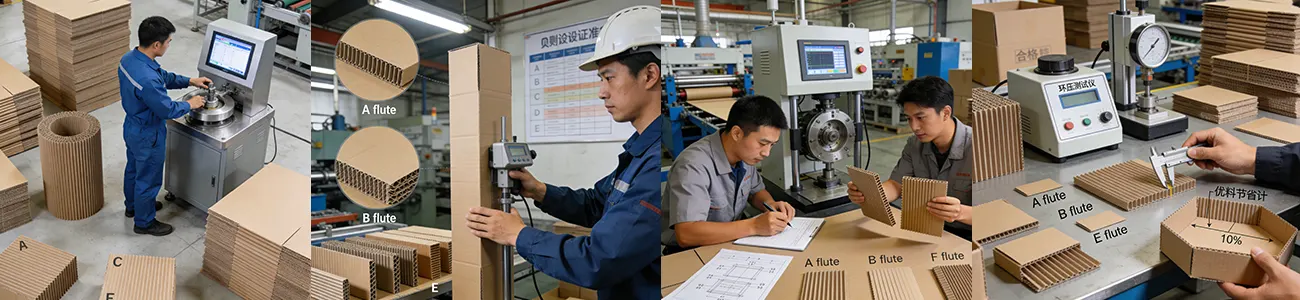
Consider these factors to build an optimal testing setup:
-
Define Your Material Spectrum: What grades do you test? Lightweight printing paper, heavy linerboard, or finished corrugated board? This determines the required force capacity and fixture type.
-
Identify Governing Standards: Are you supplying to global markets? Determine if you need TAPPI (North America), ISO (International), or ASTM compliance. Your equipment must precisely replicate these test methods.
-
Assess Throughput Requirements: A high-volume mill QC lab needs robust, fast, and potentially automated instruments, while an R&D facility might prioritize flexibility and detailed data analysis features.
-
Plan for Data Integration: Do you need simple data logging, networked data management, or direct export to a Mill Information System? Ensure the instrument's software matches your data workflow.
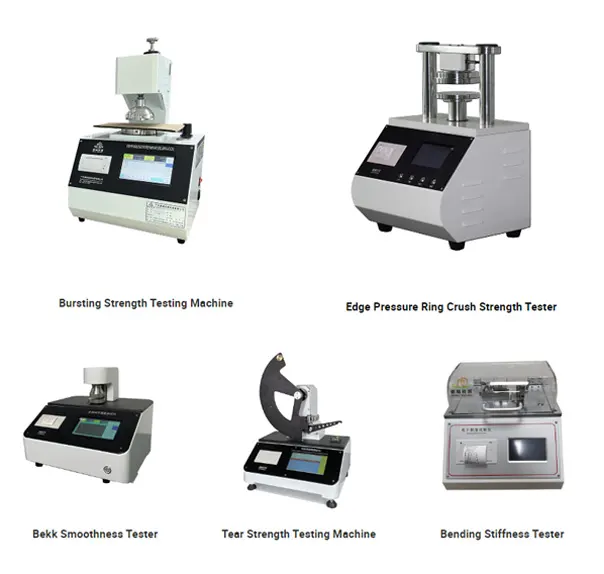
Paper and Board Testing Equipment refers to a category of specialized, precision instruments engineered to perform standardized physical tests on paper, paperboard, and corrugated materials. Unlike general-purpose Universal Testing Machines (UTMs), this equipment is designed and built for a specific mission: to execute defined industry test methods—such as Ring Crush (RCT), Burst Strength, Tensile Strength, and Stiffness—with exceptional repeatability and efficiency.
The core value of this dedicated equipment lies in its ability to transform a manual, variable process into a reliable, automated workflow. Each instrument integrates purpose-built fixtures, controlled mechanics, and intelligent software tailored to specific standards (like TAPPI, ISO, and ASTM). This ensures that every test is performed consistently, generating audit-ready, actionable data that directly predicts real-world performance—whether it's the stacking strength of a shipping container or the runnability of paper on a high-speed press.
In essence, while a UTM is a versatile tool for broad material exploration, Paper & Board Testing Equipment represents the optimized solution for high-frequency quality control. It is the definitive choice for mills, converters, and packaging labs where standardized methodology, operational simplicity, and data integrity are critical for making confident decisions about material quality and product design.
Frequently Asked Questions About Paper & Board Testing Equipment
What is the difference between Ring Crush (RCT) and Edge Crush (ECT) tests?
Both measure compressive strength but use different samples. RCT uses a carefully prepared ring of containerboard, isolating the material's inherent strength. ECT tests a small segment of finished corrugated board's edge, factoring in flute structure. RCT is often used by mills, while ECT is common for box manufacturers.
Can one machine perform both tensile and compression tests on paper?
While a high-end Universal Testing Machine (UTM) can do both with fixture changes, it is not optimized for standardized paper tests like RCT or Burst. For accurate, efficient, and standard-compliant results, dedicated testers are recommended. They offer faster operation and direct output of specific industry metrics.
How often should paper testing equipment be calibrated?
We recommend an annual calibration by an accredited service to ensure traceability and accuracy. For high-use environments or critical applications, a semi-annual check with traceable reference standards is advisable. Derui offers comprehensive calibration services and certificates.
Can your tensile testers handle both standard paper strips and other flexible packaging materials?
Yes. Our advanced paper tensile testers feature interchangeable grips, including those for standard paper strips, plastic films, and laminates. With customizable test methods in the software, a single instrument can characterize a broad range of sheet materials, making it a versatile investment for labs testing beyond just paper.
How do you ensure the long-term accuracy and compliance of your testing equipment?
We ensure accuracy through a multi-layered approach: 1) Precision Manufacturing: High-rigidity frames and certified load cells. 2) Traceable Calibration: Every instrument ships with a certificate traceable to national standards. 3) Compliant Software: Pre-programmed, locked test methods prevent accidental deviation from standards. We also offer scheduled recalibration and maintenance services to keep your lab audit-ready.
Our lab needs to test according to both TAPPI and ISO standards. Is that possible with one instrument?
Absolutely. Our equipment software typically includes pre-configured test profiles for multiple global standards. For instance, a burst strength tester may have separate, selectable programs for TAPPI T403, ISO 2758, and ASTM D774, automatically applying the correct clamp pressure, speed, and calculation for each. This flexibility ensures global market compliance.
What kind of data export and integration capabilities do your systems offer?
Our systems are designed for modern labs. Standard features include generating PDF reports (with curves and stats) and exporting raw data to CSV/Excel. For higher integration, many models support direct network connectivity and can be configured to output data to a SQL database or interfaced with your Laboratory Information Management System (LIMS) for full traceability.
Do you provide samples for correlation testing before purchase?
Yes. We strongly encourage correlation testing. We can provide certified reference materials or work with you to test your own samples, comparing results against your existing equipment or known values. This hands-on validation ensures the instrument meets your specific accuracy requirements before installation.